
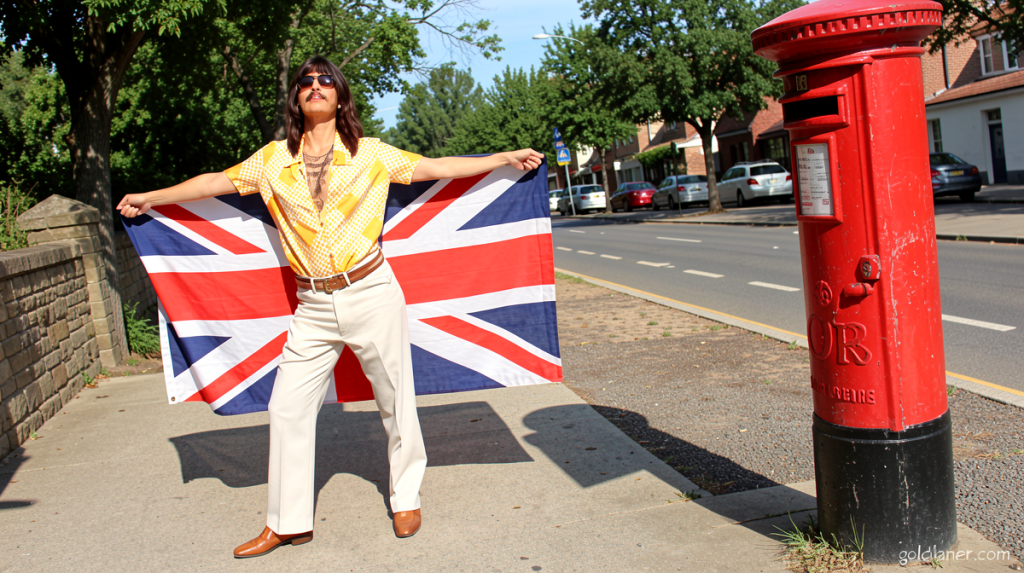
A Drag King in a Brexit Town: How Comedy Became a Political Act in Ramsgate
Goldlaner.com – On a stretch of England’s southeast coast where Union Jack bunting still snaps above the harbor and the decade since the 2016 referendum has reshaped the political landscape, a 52-year-old Welsh-born performer spends her evenings transforming into a character who would make any 1970s family gathering deeply uncomfortable. The result is Pat Riarchy, a drag king whose leopard-print G-string, flowing mullet, and unapologetic sexism function as a satirical mirror held up to a specific brand of working-class British masculinity.
The transformation itself is elaborate. Trudi Jackson, the actor and performance coach behind the character, spends roughly an hour sculpting a chiselled jawline, sponging dragon tattoos onto her forearms, taping down her chest, and gluing hair in place. She describes the chin work as her personal favourite, because it allows her to carve out a dimple. But the true inflection point arrives when she clips on a mustache — a furry appendage transported to each performance in its own Tupperware container. At that moment, the voice drops, the shoulders square, and the gait shifts into a rolling swagger. Every woman in the room receives a raised eyebrow and a casual appraisal:
“Alright ‘luv?”
Jackson has left the building. Pat Riarchy has arrived.
The Character: A Satire of Toxic Masculinity
Pat is constructed as the archetype of the inappropriate uncle — leery, sexist, and deriving genuine pleasure from making women squirm. Yet beneath the bravado of the mullet and the flag-waving, the character is tragically out of step with the world he inhabits. In his stage shows, Pat frequently brandishes a Union Jack while attempting to parse a reality where, in his words,
“it’s hard being a bloke.”
He jokes about women taking men’s jobs. He is baffled by the acronym LGBTQIA+. At his self-styled “Karablokey” nights, he belts out an original number titled “While Yer Down There Luv.” During a Pride festival performance at a local swimming pool, he addressed the gathered swimmers with the declaration:
“I am not a professional aqua aerobics instructor. But like all blokes, I can turn my hand to anything.”
For Jackson, the act is cathartic. She grew up in a mining town in south Wales, where the dominant masculine culture was, in her recollection, “hugely toxic.” Playing Pat allows her to externalise and interrogate what it felt like to be born female into that world. The character has been in continuous development for five years, though its roots stretch further back into the cancel-culture anxieties she observed in earlier years.
Screaming Alley: Cabaret in a Barber Shop
These days, Jackson and Pat call Ramsgate home. The port town, tucked into Kent’s Thanet district, carries the same contradictions found across Britain’s post-Brexit coastlines: pockets of deep deprivation alongside a growing influx of artists and London transplants seeking a quieter pace of life. Strings of Union Jacks flutter along the waterfront, a visual echo of the political mood that swept the area in 2016.
Tucked at the back of a local barber shop is Screaming Alley, a cabaret production company dedicated to independent artists. A hot-pink stairwell plastered with posters of George Michael and Madonna leads down to the Alley Bar and its small stage. On any given evening, the space hosts an open mic, a community workshop, or — more recently — Jackson’s masterclass for aspiring drag kings. Over six weeks, students develop their own characters, studying masculinity, costume design, makeup technique, and physical movement, with the goal of performing to a live audience by the programme’s end.
Comedy as Counterweight to Polarisation
The timing of these classes is not incidental. Ramsgate voted strongly for Brexit, and in the decade since, the hard-right Reform UK party has established itself as a major political force in the area. Like other populist movements worldwide, Reform’s brand is tightly bound to a traditionalist, pub-culture masculinity. Its leader, Nigel Farage, has cultivated an image of the everyman making campaign stops in local pubs, railing against what he frames as social “wokeism” that prevents young men from simply being young men.
It is precisely this macho imagery that drag kings exist to subvert. Lara Clifton, co-director of Screaming Alley, frames the company’s mission as a response to the polarisation now saturating conversations about gender, identity, class, and power.
“What interests me is creating a space in the middle of those conversations – not to tell people what to think, but to invite them to play, laugh and spend time together.”
Pat himself would never cast a ballot for Reform. Jackson notes that the character views the affluent, private-school-educated Farage as
“a posh boy.”
Class, Jackson emphasises, is a crucial layer of the act. The so-called liberal elite are educated, and that education is itself a privilege.
“It’s a privilege to be woke. And rather than shaming people for their viewpoint, let’s have the conversation: ‘is it true? Is that real?'”
Her broader philosophy runs against the silencing impulse she witnessed in earlier years of online culture wars.
“If we can’t debate properly, you close people down and they go underground. Which is why then the manosphere exploded. My feeling is, let’s shine the light on it and laugh at it – let’s laugh at Pat, not silence him.”
In a town where the political temperature has risen sharply since 2016, that choice — comedy over condemnation, invitation over exclusion — may be the most radical act available. The mustache goes on. The swagger rolls. And the conversation, however uncomfortable, continues.
Related Reading
Frequently Asked Questions
What is God save the drag kings of England?
God save the drag kings of England is the main topic of this guide. The article explains the context, practical details, and next steps readers should understand.
Why does God save the drag kings of England matter?
God save the drag kings of England matters because readers are looking for a useful answer, not just a short summary. Good content should match search intent and help them decide what to do next.