
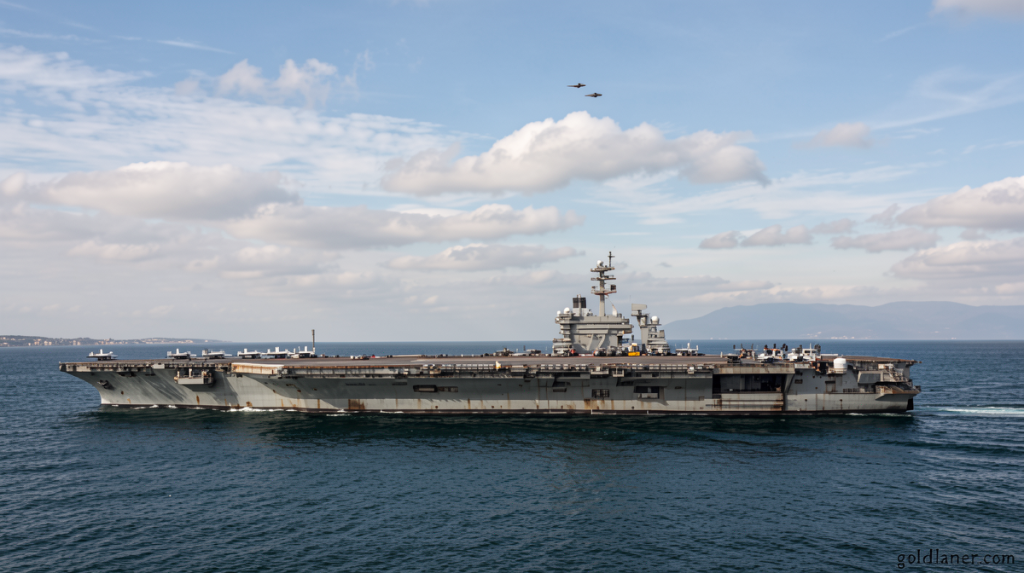
Aboard the USS Abraham Lincoln: Nine Months at Sea
Goldlaner.com – Aboard the USS Abraham Lincoln, the first thing a visitor notices is the sound — a low, rolling thunder of jet engines cycling through launch sequences, audible even in the mess deck. The carrier had pulled alongside the port at Duqm, Oman, on July 7, and within an hour of stepping onto the flight deck, a journalist was watching live ordnance arc into the Gulf sky. Iran had just struck a third tanker transiting the Strait of Hormuz, and US Central Command was already assembling a retaliatory response. The conflict, which has claimed the lives of 18 American service members since it ignited in February, was accelerating again. Yet below deck, the mood registered almost nothing of that urgency.
The following morning was designated a “no fly day,” a scheduled pause that lets air crews decompress after a brief port call. While jets sat silent on the deck, American strike packages were hitting Iranian targets from other naval platforms, and the tentative peace framework between Washington and Tehran was visibly fraying into sharper rhetoric on both sides. In the mess deck at 6 a.m., senior enlisted sailors ate their breakfasts with an almost studied indifference. Most had not tracked the overnight headlines, despite the ship carrying Wi-Fi. They had cycled through escalation and de-escalation so many times that the current spike felt procedural rather than existential.
A Deployment That May Set a Record
The vessel’s current mission cycle is approaching what could be the longest continuous deployment of any US carrier away from its home port — nearly nine months at sea. Families ashore have raised alarms about suicide ideation among crew members and at least one incident in which sailors were pulled from the water. Defense Secretary Pete Hegseth has pushed back publicly, calling the depiction of conditions “completely misrepresented.” President Donald Trump, speaking the previous week, declared the deployment “not nearly long enough.” That framing landed poorly with many of the sailors in regular contact with journalists, and it underscores how easily a soundbite flattens a situation that is far more textured.
Three days spent roaming the ship — the Navy permitted essentially unrestricted movement with an escort, and dozens of conversations were conducted with both officers and enlisted personnel — revealed a picture messier than any single narrative. Genuine hardship and genuine resilience coexist, sometimes in the same individual, sometimes within the same sentence.
When the Supply Chain Breaks
Food on the carrier has become a proxy metric for the war’s logistical toll. Early in the conflict, Iranian strikes disrupted the resupply corridor running through Bahrain, plunging the ship into a rationing period that sailors still recount with vivid specificity. For a stretch, meals collapsed into tuna stirred into noodles or corn dogs. Several crew members described losing meaningful weight during that window.
By the time of the July port call, conditions had improved. Breakfast tables carried fresh fruit and vegetables — a recent arrival from the Oman stop. Daily output now runs between 17,000 and 18,000 meals, drawn largely from frozen stock and rotated on a fourteen-day cycle that sailors memorize by name: “pizza day,” “burger day.” Morale-boosting events such as ice cream socials punctuate the rotation. Yet young enlisted sailors still queue for up to an hour per meal, a daily grind that erodes patience quickly. Many spoke of dreaming about their first plate back home — Chinese takeout, a Chipotle burrito, a mother’s homemade bolognese.
“Food has slightly increased in edibility, if I was asked a few months ago I would say a lot of people were losing weight due to the food.”
That is not a five-star review. Nor is it the crisis some coverage has implied. It is an honest accounting by people living on a warship operating in rough seas, describing a supply chain that fractured and then partially healed.
“Lincoln is operating in a highly contested environment where traditional supply hubs in the Middle East were disrupted by combat actions. In response, leadership prioritized mission-critical supplies: first food, then hygiene items, then mail.”
The Navy’s own statement frames the disruption as a function of contested geography rather than institutional failure — a distinction that matters for how the public understands what sailors endured during those lean months.
Quarters, Jets, and the Small Realities of Carrier Life
Guest quarters in the ship’s lower decks sit beneath a near-constant rhythm of jet launches. The communal officers’ bathroom available to visitors delivered hot water but demanded a thorough scrub before use. Elsewhere on board, crew members described backed-up toilets and the cumulative fatigue of living in a steel tube that never stops moving. These are not dramatic crises; they are the texture of daily existence at sea, and they accumulate.
Frequently Asked Questions
How long has the USS Abraham Lincoln been deployed? Nearly nine months, making it potentially the longest continuous deployment of any US carrier away from its home port.
What happened to food supply during the conflict? Iranian strikes disrupted the resupply corridor through Bahrain, forcing a rationing period. By the July port call at Duqm, Oman, daily meal output had recovered to 17,000–18,000 servings drawn from frozen stock on a fourteen-day rotation.
How many American service members have been killed since the conflict began? Eighteen, according to reporting from aboard the carrier.
Can