
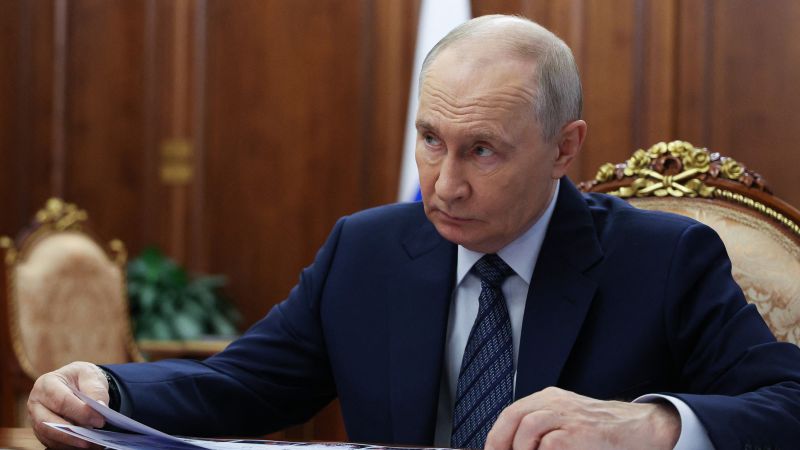
Trump’s Search for a Ukraine Deal Collides With Putin’s Different Calculation
Goldlaner.com – Donald Trump’s drive to end the war in Ukraine rests on a straightforward proposition: stopping the conflict could save lives, reopen commerce and ease the economic barriers separating Washington and Moscow. For Vladimir Putin, however, the war appears tied to objectives that have proved far less negotiable than trade opportunities or diplomatic gestures.
The contrast has become central to repeated attempts by the Trump administration to build a path toward talks. Trump has often portrayed the conflict, now in its fifth year, as an avoidable tragedy that is costing the lives of thousands of young people each month. In his view, a settlement could bring an end to battlefield deaths while creating room for sanctions relief and new commercial arrangements with Russia.
But Putin’s priorities have not appeared to shift in response to those incentives. The Russian president has continued to press Moscow’s core demands, including control of all of eastern Ukraine’s Donbas region and influence over Ukraine’s future security framework. Those positions leave little space for the rapid compromise Trump has sought.
St. Petersburg Meeting Tests the Gap
That divide was on display during Steve Witkoff’s latest meeting with Putin in St. Petersburg. Witkoff, Trump’s special envoy, met the Russian leader after discussions in Norway involving US, European and NATO officials alongside Ukrainian President Volodymyr Zelensky.
Those meetings examined possible new proposals for ending the war, including economic incentives aimed at Moscow. Putin told Witkoff that he was interested in hearing what had emerged from the Norway talks. Yet the Kremlin’s response afterward was dismissive.
“In truth, these contained little of actual value for resolving the Ukrainian crisis.”
The assessment reflected a familiar Kremlin position: economic offers alone do not address the political and territorial demands Russia has placed at the center of its war aims. A US official said Witkoff’s trip was intended to test whether a new plan could serve as a foundation for negotiations. Russia later indicated it was willing to resume trilateral peace talks in November, but willingness to meet does not necessarily mean willingness to compromise.
Economic Incentives Meet Strategic Ambitions
The White House may have expected Moscow to show greater flexibility after Trump lifted sanctions on Russian diesel exports the previous week. The move was linked to efforts to lower fuel costs in the United States before the midterm elections, while also offering Russia a substantial economic benefit.
Trump subsequently announced an energy ceasefire proposal that would have required Ukraine to stop drone attacks on Russian oil refineries. The proposal did not succeed. During the fallout, US intelligence sharing was affected, and Trump called for a change in Ukraine’s leadership—language that aligned closely with Moscow’s long-standing hostility toward Kyiv’s government.
From the Kremlin’s perspective, these developments may reinforce rather than moderate its approach. Russia can view concessions, commercial outreach and criticism of Kyiv as evidence that its strategy toward Washington is producing results. Putin has repeatedly demonstrated that he sees the war not simply as an economic burden, but as a contest over Russia’s stated geopolitical interests.
That creates a difficult reality for negotiators. Trump’s belief that mutually beneficial business arrangements can unlock a settlement depends on Moscow placing significant value on the financial rewards of peace. Putin’s conduct suggests he may instead see economic cooperation as an additional advantage to pursue without giving up his central demands in Ukraine.
Deals, Diplomacy and Personal Appeals
The St. Petersburg talks also included fresh discussion of potential economic cooperation. Putin praised the diesel arrangement and raised the possibility of increasing Russian fertilizer exports to the United States. Kiril Dmitriev, who leads Russia’s sovereign wealth fund and has been a key contact with Trump administration officials, described a broader set of possibilities after the meeting.
“We are also discussing different projects such as data centers, projects in energy and energy cooperation.”
Such proposals speak directly to Trump’s emphasis on transactions and economic gains. Yet they also illustrate the challenge facing the administration: Russia can offer the prospect of profitable partnerships while holding firm on the conditions it seeks in Ukraine.
The Kremlin has also used humanitarian gestures to shape the atmosphere around diplomacy. Before the St. Petersburg meeting, Russia released Stephen Hubbard, a 74-year-old American citizen from Michigan. Hubbard had been held after being captured in Ukraine in 2022, at the beginning of Russia’s full-scale invasion.
Witkoff described Putin as a “humanitarian” following the release. The episode gave Moscow an opportunity to demonstrate cooperation on an issue of personal importance to the United States while continuing to resist a broader political settlement.
A Negotiation With Unequal Expectations
The central problem is not a lack of meetings or potential economic packages. It is that Washington and Moscow appear to be approaching the process with different assumptions about what peace would require. Trump sees an opportunity to halt a destructive war and replace confrontation with prosperity. Putin appears to see a chance to secure Russian objectives while extracting additional benefits from engagement with the United States.
For Ukraine, the stakes extend well beyond commercial agreements or temporary pauses in energy attacks. Any future settlement would affect its territory, security and political independence. For Europe and NATO, the outcome would also carry consequences for regional stability and the credibility of security commitments.
Until Russia’s underlying demands change, the prospect of a quick agreement remains remote. The talks may continue, and economic proposals may multiply, but a durable peace will require more than promises of trade. It will require a shared understanding of what Russia is prepared to concede—and so far, that remains elusive.
Related Reading
Frequently Asked Questions
What is Where Trump sees a deal Putin?
Where Trump sees a deal Putin is the main topic of this guide. The article explains the context, practical details, and next steps readers should understand.
Why does Where Trump sees a deal Putin matter?
Where Trump sees a deal Putin matters because readers are looking for a useful answer, not just a short summary. Good content should match search intent and help them decide what to do next.