
Asian Students Maintain a Strong Edge as Global Skills Decline
Goldlaner.com – Fifteen-year-old students in several Asian education systems continue to outperform many peers in the West, while international results show broad weakening in reading, mathematics and science. The findings arrive as schools confront a fast-changing technological environment and governments compete to build workforces capable of succeeding in an economy increasingly shaped by artificial intelligence.
The 2025 Programme for International Student Assessment, released this week by the Organisation for Economic Co-operation and Development, shows that average achievement has continued to slide across the three core subjects. The downturn is particularly concerning because the abilities measured by the exam are closely linked to how students process information, solve unfamiliar problems and judge evidence.
Top results concentrated in Asia
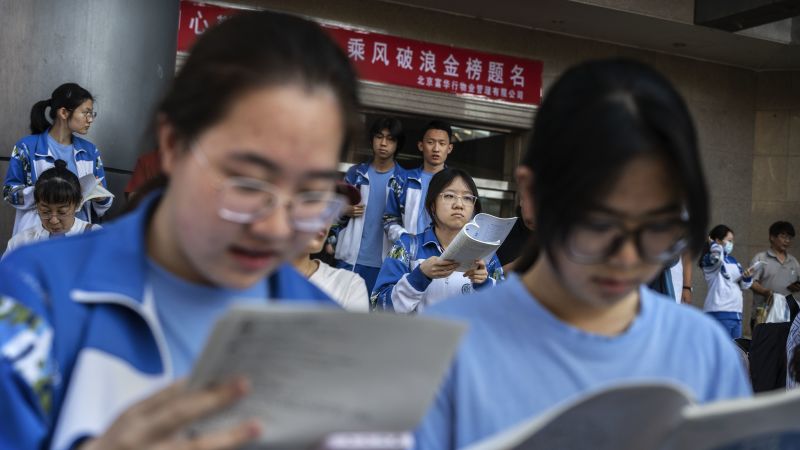
Students in Beijing and Shanghai, as well as China’s Jiangsu and Zhejiang provinces, ranked among the strongest performers last year. Singapore also remained near the top. Japan and South Korea placed in the Asia-heavy top 10 for reading, science and mathematics, joined by Macao and Taiwan.
These results highlight a widening contrast with the United States, where secondary-school reading performance has dropped toward levels not seen in nearly a quarter-century. American students remain behind those from the four Chinese jurisdictions participating in PISA, which have maintained a substantial advantage in the assessment for years.
China’s participation figures require careful interpretation. The submitted results cover Beijing, Shanghai, Jiangsu and Zhejiang rather than the full country, and all four are comparatively affluent areas along China’s eastern coast. Even with that limitation, the long-running decline in US results over the past decade has drawn sustained concern from educators and policymakers.
AI raises the stakes for schools
The results emerge during sharper competition between China and the United States over technological leadership, research capacity and innovation investment. China has moved ahead of the US in the number of published scientific reports, while both countries spent more than $1 trillion on research in 2024.
Yet stronger research budgets and rapid advances in AI do not automatically produce stronger foundational learning. The OECD’s education and skills director, Andreas Schleicher, warned that the worldwide decline is affecting abilities that are becoming more valuable as digital tools generate and distribute immense quantities of material.
“Most troubling is the decline in the very skills that matter most in the AI age: evaluating information, making connections across multiple sources, and thinking critically about what we read,” Andreas Schleicher, OECD director for education and skills, wrote in the report.
“In a world increasingly flooded with information, our students are less likely to think deeply and separate signal from noise.”
For students, those skills extend beyond earning higher exam marks. They influence whether a young person can distinguish reliable information from misleading claims, compare competing explanations and use AI-generated material thoughtfully instead of accepting it uncritically. As digital platforms become more embedded in daily life, schools face pressure to teach both technological fluency and disciplined attention.
Distraction and rushed reading
The assessment points to classroom distraction as one potential difficulty associated with heavier use of digital devices. Less than 10% of students in China, Japan and South Korea said classmates were distracted by devices during science lessons. Across participating systems worldwide, that figure stood at 28%.
Digital technology can support learning, but the results suggest that access alone is not the deciding factor. Singapore offers one example of a system that has incorporated technology in classrooms while keeping an early emphasis on reading comprehension. That balance matters when students are expected to navigate screens without losing the ability to read carefully and sustain concentration.
The growth in “hasty readers” illustrates the challenge. This group includes students who move through texts too quickly and then select incorrect answers. Its share nearly doubled from 2018 to 2025. The pattern may matter well beyond standardized testing, since rapid but shallow reading can make it harder to assess complex claims or connect details across several sources.
The report also indicates that national wealth and family income have become less closely tied to student achievement as technology has advanced. That does not mean resources have stopped mattering, but it suggests that educational outcomes increasingly depend on how schools organize learning, support teachers, manage distractions and build strong habits around comprehension and reasoning.
Economic consequences of lower performance
Average scores across OECD members in science, reading and mathematics have reached their lowest recorded levels. The implications may eventually reach far beyond classrooms. Countries with large shares of students lacking basic proficiency can face a weaker pipeline of workers prepared for further study, technical training and jobs requiring analytical judgment.
The 2025 PISA report cited research from Stanford University estimating that if every 15-year-old in the United States reached a basic level of PISA proficiency, the country could gain more than $40 trillion over those students’ working lives. The estimate underscores the potential economic value of improving fundamental learning rather than treating school performance as an issue limited to families and educators.
Instead, the share of OECD students performing below that baseline rose from 16% in 2022 to 20% last year. Reversing that movement will likely require sustained attention to literacy, numeracy, science education and the conditions that allow students to focus deeply.
The emerging lesson is not that schools should reject AI or digital tools. Rather, the technology race makes basic human capabilities more urgent. Students who can read closely, question information, make connections and reason independently may be better placed to use new tools effectively—and less likely to be overwhelmed by them.
Related Reading
Frequently Asked Questions
What is Students in Asia extend lead over?
Students in Asia extend lead over is the main topic of this guide. The article explains the context, practical details, and next steps readers should understand.
Why does Students in Asia extend lead over matter?
Students in Asia extend lead over matters because readers are looking for a useful answer, not just a short summary. Good content should match search intent and help them decide what to do next.