
Epstein’s island: Inside the Caribbean fiefdom where he wooed the wealthy and abused girls
Epstein’s island: Inside the Caribbean fiefdom where he wooed the wealthy and abused girls
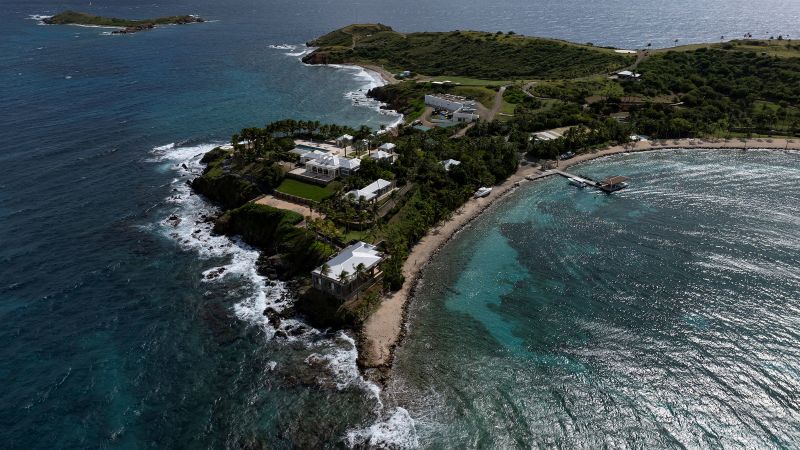
Jeffrey Epstein’s tropical retreat, Little St. James, served as a playground for elites and a prison for young women for nearly two decades. While high-profile visitors arrived via private jet and indulged in recreational activities like scuba diving or jet skiing, the girls Epstein brought to the island faced starkly different realities: taken from their homes, stripped of their passports, and subjected to severe sexual abuse. The island, spanning approximately 70 acres, became a dual-purpose sanctuary—both a luxurious backdrop for networking and a secluded site for exploitation.
A recent release of millions of pages from the Department of Justice has unveiled the full scope of Epstein’s operations on the island, now central to a global sex trafficking scandal. These documents, combined with CNN’s analysis of emails, photos, and videos, reveal how Epstein reshaped the remote location into a personal haven. The evidence suggests that his actions were not only covert but also deliberate, creating an environment where abuse could occur without immediate scrutiny.
A hidden paradise and a place of fear
Little St. James, located over a mile from St. Thomas in the US Virgin Islands, is accessible only by helicopter or boat. Its isolation made it an ideal setting for Epstein’s schemes. As described in a 2002 satellite image, the island initially had minimal infrastructure—just a few buildings and scattered structures. By the late 2000s, however, Epstein had expanded it into a lavish resort, complete with a theater, library, and staff quarters, masking its darker purpose.
“The activities were so obvious and bold that anyone spending any significant time at one of Epstein’s residences would have clearly been aware of what was going on,” a victim stated in a court document.
Photographs of naked girls on walls, reports from airport workers about Epstein’s trips with underage girls, and an interior decorator’s account of a bedroom designed with pink furnishings and bunk beds all point to the island’s role in trafficking. Despite these clues, some high-profile guests claimed ignorance, yet their own testimonies show they were complicit or at least aware of the abuse.
Notable figures and unspoken complicity
Documents reveal that Epstein’s circle included prominent individuals like Sergey Brin and Anne Wojcicki, co-founders of Google and 23andMe. According to a victim’s statement, these guests visited in 2007 and witnessed the girls’ silence and fear. “They observed that we did not speak and that we remained mute,” the statement said, “witnessing the trauma on our faces and in our eyes.” The victim noted that Brin and Wojcicki saw the girls’ distress but took no action.
Following Epstein’s death in 2019, his estate sold both Little St. James and Great St. James for about $60 million, some of which went toward settling legal claims. Yet, the island’s legacy as a hub for trafficking persists, raising questions about its role in his financial empire. Thomas Volscho, a professor at City University of New York, described it as “the hub” of Epstein’s operations, emphasizing its strategic use for isolating victims.
Epstein purchased the island for $8 million in 1998, a time when he was a rising financier with a pristine record. The previous owner, Arch Cummin, a venture capitalist, once noted: “You can hop off a plane and never see anybody again.” That sense of seclusion would later become Epstein’s tool for control, transforming a quiet island into a symbol of both opulence and exploitation.
