
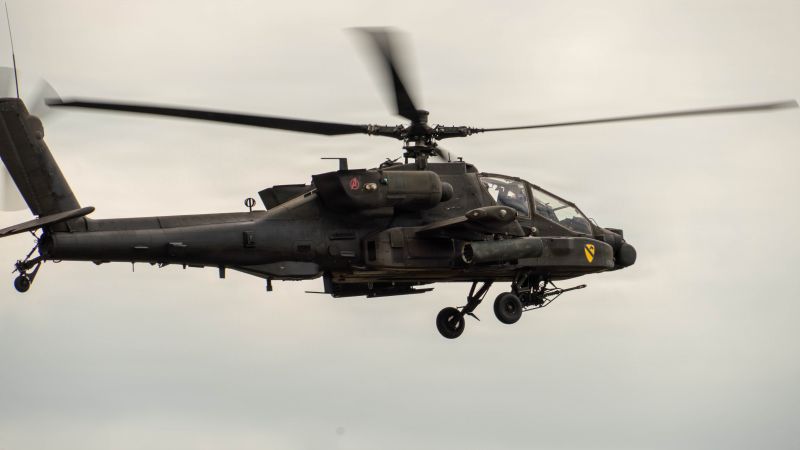
Apache Training Halted Following Fatal Crash at Texas Military Installation
Goldlaner.com – The United States Army has issued an immediate suspension of all Apache helicopter training operations after a devastating accident at Fort Hood in Texas claimed the lives of two service members. Military leadership announced that the temporary stand-down of AH64 Apache flight training will continue until investigators can determine what caused the fatal incident. This precautionary measure affects training schedules across the installation as safety protocols are reviewed.
Investigation Underway at Crash Site
Specialists from the Army Combat Readiness Center based in Fort Rucker, Alabama, traveled to the Texas location on Thursday to begin their comprehensive examination of the circumstances surrounding the crash. These investigators will lead the official inquiry into what went wrong during the training mission. The stand-down order remains active while they conduct their thorough assessment of the aircraft, weather conditions, and operational procedures that were in place at the time of the accident.
Military aircraft accidents trigger detailed review processes designed to prevent future occurrences. The investigation typically involves examining flight data recorders, interviewing witnesses, analyzing maintenance records, and reconstructing the sequence of events leading up to the crash. This methodical approach ensures that any systemic issues or mechanical failures are identified and addressed before training resumes.
Service Members Remembered
The two soldiers who lost their lives in the crash were identified as Chief Warrant Officer 2 Deontre Huey, age 34, and Warrant Officer Seth Olmstead, age 25. Both aviators served with Bravo Company within the 1st Battalion, 227th Aviation Regiment, which operates under the 1st Air Cavalry Brigade of the 1st Cavalry Division at Fort Hood. Their loss has resonated deeply throughout the military community.
Our hearts and deepest condolences are with the families of the Soldiers we lost Wednesday. The Army is a family, and a tragedy like this is felt throughout our formations and our community.
Lt. Gen. Kevin Admiral, the commanding general at Fort Hood, expressed the base’s collective grief in his official statement. The Apache helicopter accommodates two crew members during flight operations, with the pilot positioned in the rear of the aircraft and the co-pilot and gunner seated in the front. This configuration allows for effective division of responsibilities during complex missions and training exercises.
Advanced Combat Capabilities
The four-bladed Apache helicopter represents one of the most sophisticated attack platforms in modern military aviation. Its armament includes 16 Hellfire missiles, 76 aerial rockets, and 1,200 rounds for its integrated 30 mm gun system. These weapons enable the aircraft to engage diverse target types across multiple battlefield scenarios.
The Army describes the Apache as highly mobile and lethal, capable of destroying armor, personnel, and materiel targets even in obscured battlefield conditions. Its operational range extends out to 8 kilometers, which equals approximately 5 miles. These capabilities make it particularly valuable for rapid response missions and close air support operations.
With the addition of improved situational awareness, flight performance, and joint interoperability, the AH-64E has become the most advanced aerial fighting vehicle in the world.
Decades of Service and Future Outlook
The Apache program has undergone continuous upgrades and modernization since the aircraft was first introduced into service in 1984. This extensive history spans more than four decades of operational experience across numerous conflicts and peacekeeping missions. The Army has committed to keeping the Apache fleet in active service until at least 2050, reflecting confidence in its continued relevance on future battlefields.
The current training suspension affects not only the immediate Fort Hood installation but potentially other Army posts that utilize Apache helicopters for pilot development and crew training programs. Military aviation training follows strict protocols to ensure that pilots and crew members develop the skills necessary for combat readiness. Any disruption to these programs requires careful scheduling adjustments to minimize impact on overall force readiness.
The Apache’s evolution from its original design has included enhancements to navigation systems, communication equipment, and weapon integration capabilities. These improvements have transformed the aircraft into a versatile platform capable of operating alongside other military assets in joint operations. The AH-64E variant represents the latest iteration of this successful design lineage.
As the investigation continues, military officials will work to determine whether the crash resulted from mechanical failure, pilot error, weather conditions, or a combination of factors. The temporary grounding of training flights provides time for a thorough examination while maintaining safety standards for all personnel involved in Apache operations. Training schedules will be adjusted accordingly until the stand-down order is lifted following the completion of the investigative process.
Related Reading
Frequently Asked Questions
What is US Army grounds all Apache helicopter?
US Army grounds all Apache helicopter is the main topic of this guide. The article explains the context, practical details, and next steps readers should understand.
Why does US Army grounds all Apache helicopter matter?
US Army grounds all Apache helicopter matters because readers are looking for a useful answer, not just a short summary. Good content should match search intent and help them decide what to do next.