
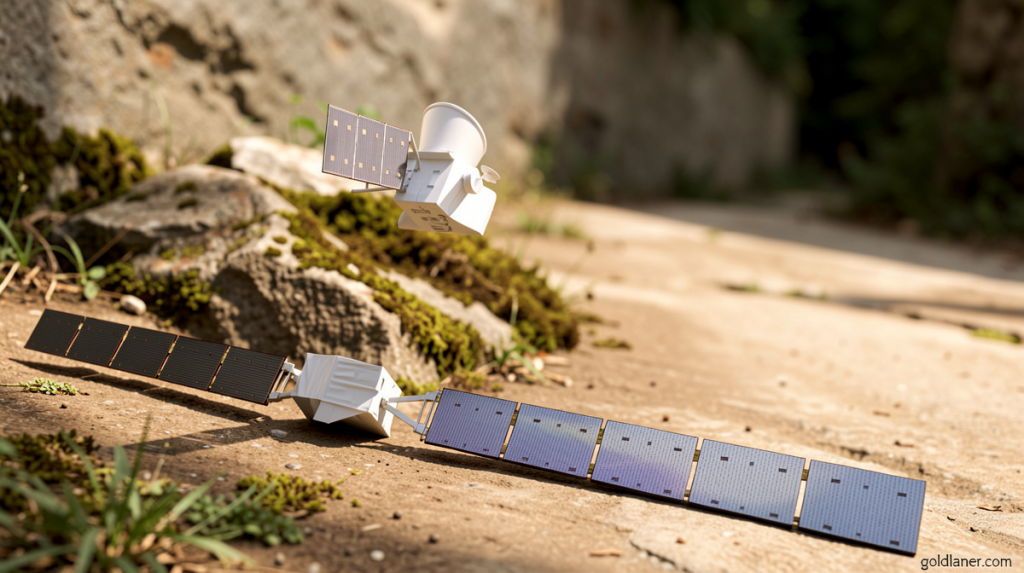
BepiColombo Sheds Its Cruise Module and Enters the Final Phase of a Nearly Eight-Year Odyssey to Mercury
Goldlaner.com – A spacecraft that has crossed more than 6 billion miles (10 billion kilometers) of interplanetary space completed a critical maneuver Thursday morning, detaching the propulsion module that carried it through years of solar-system transit. The separation, confirmed by European Space Agency mission control at 9:53 a.m. ET, marks the beginning of what engineers describe as roughly six months of high-stakes operations before two science orbiters finally settle into Mercury’s gravitational embrace.
The event was broadcast live by the ESA as ground controllers watched the Mercury Transfer Module — the engine room that powered the multiyear voyage — drift away from the stack of two science spacecraft. Within minutes of the 8 a.m. ET separation, the agency acquired a signal from the remaining payload and confirmed that the spacecraft was healthy and operating as expected. The discarded module, meanwhile, will continue orbiting the sun indefinitely and poses no threat of impacting the planet.
Why the Journey Took So Long
Mercury sits roughly 10 times closer to Earth than Jupiter does, yet BepiColombo has consumed nearly eight years in transit — longer than missions bound for the outer solar system such as Galileo and Juno required to reach their targets. The explanation lies in orbital mechanics rather than distance.
“You can go faster to Mercury if you take a direct way to it,” said Frank Budnik, flight dynamics manager for the BepiColombo mission at the ESA. “But the problem is we want to insert into an orbit with respect to Mercury. You have to bring the spacecraft to the same velocity as Mercury has, and this is a very energy-demanding transfer.”
To solve that velocity-matching problem, the spacecraft relied on a hybrid approach: electric propulsion for continuous, low-thrust acceleration, combined with gravitational assists from a total of nine flybys involving Earth, Venus, and Mercury itself. Each encounter shaved or added just enough speed to keep the trajectory on course without burning prohibitive quantities of propellant.
The Mission’s Origins and Namesake
BepiColombo is a joint venture between the European Space Agency and Japan’s Aerospace Exploration Agency (JAXA). It launched aboard an Ariane 5 rocket from Europe’s Spaceport in Kourou, French Guiana, in October 2018. Its name honors Giuseppe “Bepi” Colombo, an Italian engineer and mathematician whose mid-20th-century work on Mercury’s unusual rotation period and proposed transfer trajectories made possible NASA’s first planetary flybys in 1974.
Only two spacecraft have previously operated near the innermost planet: NASA’s Mariner 10, which performed three flybys in 1974, and MESSENGER, which entered orbit in 2011 after a nearly seven-year cruise. BepiColombo represents the first attempt to station two independent, fully operational orbiters around Mercury simultaneously.
A Staggered Arrival Sequence
Ignacio Tanco, head of Inner Solar System Mission Operations at the ESA, emphasized that Thursday’s separation is merely the opening act of a prolonged and intricate sequence.
“Unlike in other missions, BepiColombo’s arrival doesn’t mean a single event,” Tanco said. “We have about half a year of intense operations ahead of us.”
The timeline runs as follows: both orbiters will be captured by Mercury’s gravity and enter preliminary orbit on November 21. Between December 9 and 10, the two spacecraft will separate from one another. The ESA’s Mercury Planetary Orbiter (MPO) will then move into its dedicated science orbit on December 16, while JAXA’s Mercury Magnetospheric Orbiter (MIO) will follow into its own orbital slot on March 10. Full science operations for both spacecraft are scheduled to commence in April.
“It will be the first time that a mission releases two fully independent, fully operational separate spacecrafts around a different planet,” Tanco said.
Mercury’s Hostile Environment
The planet averages about 36 million miles (58 million kilometers) from the sun and completes one revolution every 88 days. That proximity produces surface temperatures approaching 800 degrees Fahrenheit (430 degrees Celsius) on the dayside — conditions that drove every aspect of the spacecraft’s thermal design.
“The spacecraft in itself has been designed to operate within conditions which are extremely punishing,” Tanco said. “It’s essentially equivalent to operating with a very hot pizza oven running right on your back.”
Santa Martinez, BepiColombo mission manager at the ESA, outlined the complementary science roles: the MPO will image and characterize the planet’s surface, geology, and interior structure, while the MIO will map the magnetic environment, plasma interactions, and exosphere surrounding Mercury. Together, the two orbiters aim to answer questions about how a rocky world so close to its star formed, retained its iron-rich core, and evolved over billions of years.
For planetary scientists, the stakes extend beyond Mercury alone. Understanding how the innermost planet managed to survive solar proximity — retaining a measurable magnetic field and a thin exosphere despite relentless radiation pressure — sharpens models of terrestrial-planet formation and habitability boundaries across the solar system. The data flowing back from April onward will constrain those models in ways no previous mission has allowed.
Related Reading
Frequently Asked Questions
What is The BepiColombo mission begins its arrival?
The BepiColombo mission begins its arrival is the main topic of this guide. The article explains the context, practical details, and next steps readers should understand.
Why does The BepiColombo mission begins its arrival matter?
The BepiColombo mission begins its arrival matters because readers are looking for a useful answer, not just a short summary. Good content should match search intent and help them decide what to do next.