
Serbian President Vucic says he will resign within weeks amid student-led protests
President Vucic Announces Resignation Amid Protests
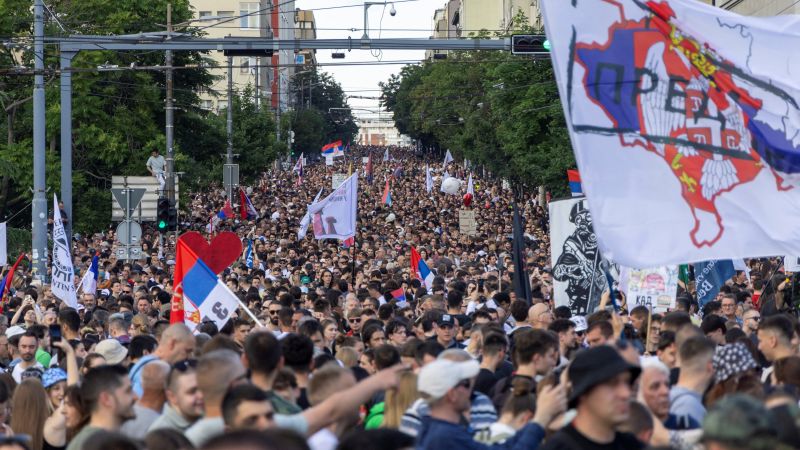
Serbian President Vucic says he will – Amid escalating public unrest and a wave of demonstrations, Serbian President Aleksandar Vucic has stated he will resign within weeks. The decision follows months of student-led protests that have increasingly challenged his leadership, with demands for political reform and accountability. These protests, which have grown in scale and intensity, highlight widespread frustration with the government’s handling of infrastructure projects and allegations of systemic corruption. As the country gears up for early elections, Vucic’s pledge to step down signals a pivotal moment in Serbia’s political landscape.
Triggering the Movement
The student-led protests gained traction after a tragic incident in Novi Sad, where a collapsed awning at a railway station in November 2024 killed 16 people. This disaster became a rallying point, exposing deep-seated issues in public infrastructure and government oversight. Critics argue that Vucic’s administration has prioritized political control over effective governance, fueling public discontent. The protests have since evolved into a broader critique, uniting students, activists, and ordinary citizens in a push for systemic change.
While Vucic’s resignation is framed as a step toward reform, some view it as a strategic move to maintain influence. He has not yet confirmed specific dates, but his announcement during a pro-government rally in Belgrade suggests a calculated effort to manage the transition. By aligning his departure with early elections, Vucic aims to preserve the political dominance of his Serbian Progressive Party (SNS), even as the movement against him gains momentum.
Political Calculations
Vucic’s proposal to rebrand his party’s list as “United Serbia” underscores his attempt to broaden support ahead of the elections. This repositioning is seen as a way to preempt potential opposition challenges and secure a stable political framework. Analysts note that his decision to resign may also serve as a means to consolidate power within his party, ensuring continuity in his leadership style even after stepping down as president.
“By resigning and with early presidential and parliamentary elections, Vucic is trying to preempt his inevitable fall, because of protests and because of the student movement, which has more support than he does.”
Savo Manojlovic, a key figure in the student opposition, argues that Vucic’s move is an effort to delay the movement’s progress. “The student movement’s demands are no longer just about the railway disaster,” he said. “It’s about dismantling the status quo and holding leaders accountable for years of corruption.” His comments reflect the growing unity among protesters, who now see the crisis as a chance to reshape Serbia’s political future.
Public Reaction and Next Steps
The announcement has sparked divided responses. While some citizens welcome the possibility of change, others remain skeptical, viewing it as a temporary measure to maintain control. The opposition has called for Vucic to step down immediately, emphasizing the need for a new leadership to address long-standing issues. Meanwhile, the government continues to downplay the urgency of the situation, framing the protests as a necessary part of democratic discourse.
Days before Vucic’s resignation, students in Novi Sad held a memorial event for the awning collapse victims, intensifying calls for early elections. Another rally is planned for Sunday in Kraljevo, showcasing the movement’s reach beyond the capital. Activists from various groups have united, with some accusing Vucic’s allies of stifling democratic processes to entrench their own interests.
Legacy and Political Strategy
Vucic’s leadership has been defined by a mix of economic growth and political stability, but critics claim this has come at the cost of transparency. His decision to resign could mark the end of an era, yet political analysts suggest he may return as prime minister if his party retains a majority in the upcoming parliamentary elections. “This is not the end of Vucic,” said Radivoje Grujic. “He already has a plan, one that definitely does not mean he’s going into political retirement — quite the opposite.”
