
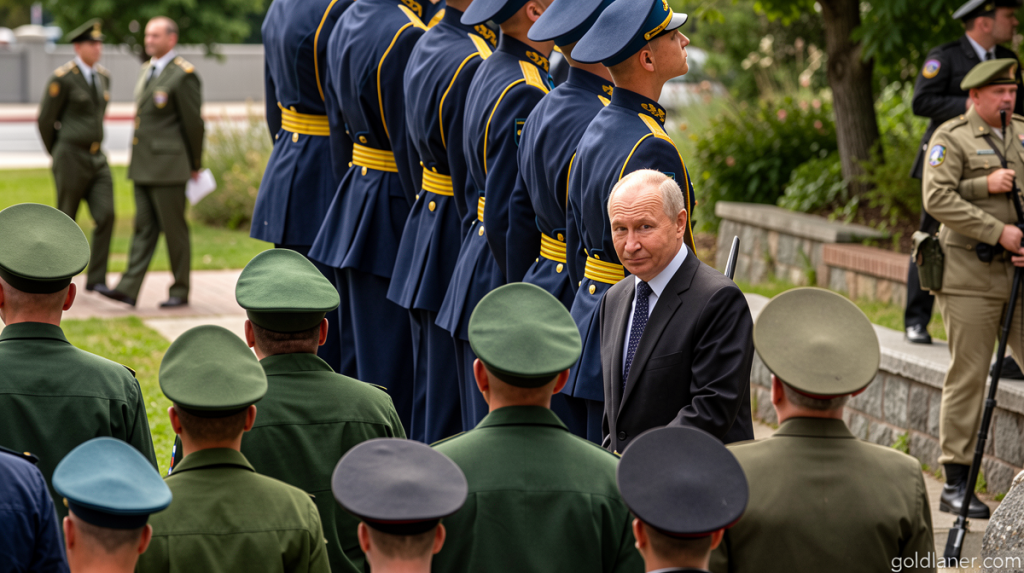
Zelensky Forecasts Massive Russian Mobilization Ahead of Parliamentary Vote
Goldlaner.com – Ukrainian President Volodymyr Zelensky issued a stark warning on Sunday that Moscow plans to conscript at least 300,000 additional soldiers before the calendar year closes, a move he linked directly to Russia’s parliamentary elections scheduled for next month. The announcement arrives amid what Kyiv describes as a grinding Russian push to finish seizing the Donetsk oblast — a goal Moscow has pursued since the full-scale invasion began in February 2022.
In remarks spanning multiple fronts of the conflict, Zelensky projected that Russian forces would finish the year holding roughly the same share of Ukrainian land they occupied at its start, even after suffering what he called staggering personnel attrition.
“Russia has lost 267,000 personnel since the start of the year, including around 155,000 killed to date,” Zelensky stated.
Independent verification of those casualty figures remains elusive, though Western defense officials have offered estimates in a comparable range. The timing of the predicted mobilization echoes anxieties from 2022, when a partial draft sparked street protests and triggered a wave of young men fleeing the country. Zelensky expressed confidence that the new conscription drive would follow the ballot box and would be deliberately kept out of Russia’s largest urban centers to limit visible unrest.
“We are confident that following the elections, they will carry out a mobilization. We believe this will not take place in the major cities,” he said.
The Donetsk Endgame and Northern Threats
Zelensky said he understood that Vladimir Putin had instructed his commanders to complete the occupation of Donetsk by year’s end. Ukrainian forces currently hold approximately 20 percent of the oblast, including a corridor of strategically vital industrial towns such as Slaviansk and Kramatorsk. The president dismissed the feasibility of a full Russian takeover of the region.
“They’ll lose all 300,000 of these newly mobilized Russians there; we’ll wipe them out,” Zelensky asserted.
Beyond Donetsk, Zelensky flagged the possibility of a fresh Russian incursion into the northern oblasts of Kharkiv and Sumy. He noted that while no large troop formations had yet appeared in Russia’s Bryansk region — which shares a border with northern Ukraine — military hardware was visible along the frontier with the Russian Federation, suggesting preparatory logistics.
An Air-Defense Gap Widens
Perhaps the most consequential element of Zelensky’s address concerned Ukraine’s shrinking capacity to intercept ballistic missiles. He drew a sharp contrast between the 675 Patriot interceptor missiles delivered to Kyiv in 2023 and the projected 264 available this year. Because Patriot systems remain the only platform capable of reliably downing ballistic warheads, the shortfall translates directly into higher civilian casualties and greater destruction of energy and transport infrastructure.
“As you can see, there is, unfortunately, a downward trend, and this depends primarily on the American side,” he said.
Last month, US President Donald Trump floated the idea that Ukraine might manufacture Patriot missiles under license, only to retreat from the proposal. Zelensky countered with a narrower ask: if Washington were willing to transfer up to 10 percent of its Patriot stockpile, Kyiv would cover the cost. He argued such a commitment “could make a huge difference, both in terms of saving lives and diplomatically as well.”
European Missiles and the Aster Shortfall
A parallel shortfall exists on the European side. Despite a recent pledge by French President Emmanuel Macron to bolster Ukrainian air defenses, Zelensky said supply of Aster interceptor missiles remains constrained.
“There aren’t enough ‘Aster’ missiles, even though they are being produced,” he noted, adding that a licensing arrangement would speed up deliveries.
Striking Back at Launch Sites
While waiting for additional interceptors, Ukraine is actively hunting the Russian launch positions from which ballistic missiles are fired. Zelensky estimated that Russia’s defense-industrial complex can now produce roughly 1,300 ballistic missiles annually, making sustained counter-strikes essential.
“There are specific objectives regarding strikes on military targets and other anti-ballistic sanctions,” he explained.
Kyiv has built a growing arsenal of long-range drones and domestically produced cruise missiles, now employed against an expanding set of targets deep inside Russian territory — from fuel depots to command nodes.
Starlink Imagery and the Musk Factor
Zelensky also disclosed ongoing efforts to obtain permission to use Starlink satellite imagery over Russian territory. Elon Musk, who controls the Starlink network, reportedly told Kyiv he “believed that this could lead to a major escalation against the Russian Federation on Ukraine’s part,” and added that he favored ending the war rather than prolonging it. Zelensky said talks with Washington on the matter were continuing.
The Negotiation Window
On diplomacy, Zelensky placed the realistic window for a negotiated end to the conflict through the close of next summer, before the US presidential election campaign consumes political bandwidth. American envoys Steve Witkoff and Jared Kushner, he said, had struggled to identify a format under which Moscow would agree to stop fighting without Kyiv being forced to abandon Donbas or accept terms Ukraine considers unacceptable.
“Jared, Steve and I agreed to summarize all these discussions on a single page – setting out the realistic options for ending the war. This is what the Americans want to discuss with us and with the Russians.”
The convergence of a predicted mass mobilization, a narrowing air-defense envelope, and a compressed diplomatic timetable places the coming months under intense pressure on every front of the war.
Related Reading
Frequently Asked Questions
What is Russia likely to mobilize at least 300?
Russia likely to mobilize at least 300 is the main topic of this guide. The article explains the context, practical details, and next steps readers should understand.
Why does Russia likely to mobilize at least 300 matter?
Russia likely to mobilize at least 300 matters because readers are looking for a useful answer, not just a short summary. Good content should match search intent and help them decide what to do next.