
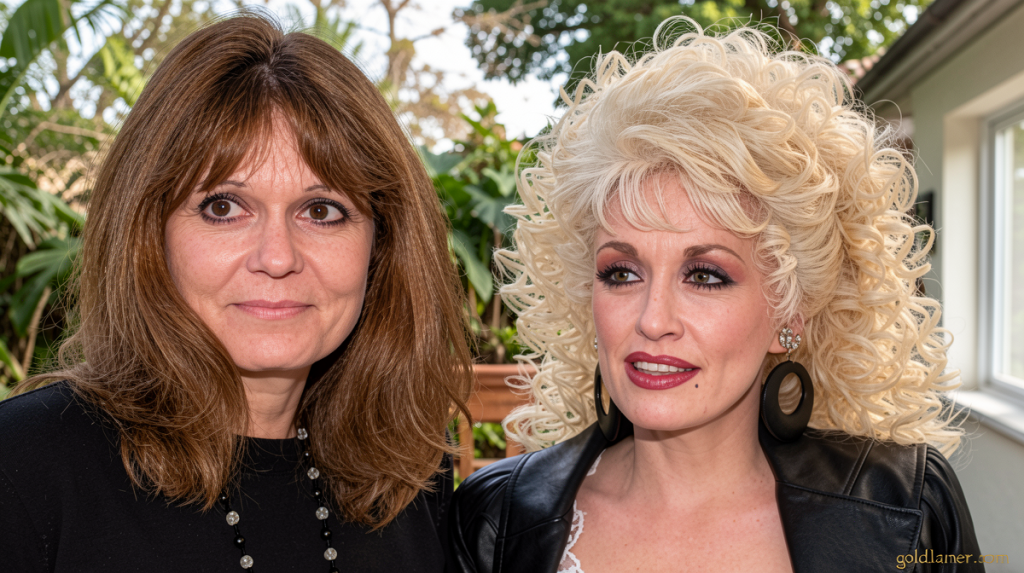
Two Childfree Icons, Two Very Different Legacies
Goldlaner.com – Within the span of a single week, two women who had shaped public conversation about choosing not to have children left the world. Dolly Parton, the country music legend who devoted decades of wealth and energy to helping kids stay in school and reach college, died at age 80. Gloria Steinem, the journalist and feminist organizer whose career centered on reproductive autonomy, died at 92. Their departures arrived close enough together to make the overlap impossible to ignore: two women, both raised by mothers who were often sick and required constant caregiving, both ultimately without children of their own, yet each arriving at that absence through an entirely different corridor and spending the rest of her life answering for it in her own way.
Parton’s Convoluted Road to a Childless Life
Parton’s trajectory toward raising no children of her own was, by her own account, tangled in the way that biology and circumstance so frequently tangle things. She was one of twelve children in a poor Appalachian household, and after she departed the family home, five of her younger siblings came to live under her roof for a stretch of years. She described those years with a kind of weary pragmatism:
“We always have somebody’s children and we don’t want the total responsibility.”
That arrangement gave her a taste of caregiving without locking her into its full weight. Over time, she came to see that remaining childfree was not a deprivation but an enabler. In a 1984 conversation with Andy Warhol, she laid out the calculus plainly:
“I just want to be free to work. I want to think, I want to write better songs, I want to write different styles of music; I want to write Broadway plays, which I am; I want to write books, which I will.”
Warhol pressed her directly: why no children? Her reply was two sentences long and carried no bitterness.
“I couldn’t. But I don’t miss it. I did for awhile, but I realize that I am everybody’s mother.”
Channeling That Freedom Into Institutional Support for Kids
The decision not to parent did not translate into indifference toward children. If anything, it sharpened her focus on them as a category. Beyond her long-running literacy initiatives, Parton literally paid young people to remain enrolled in high school. Last year, the Dollywood Foundation reported awarding college scholarships to twenty-two local high school graduates. Ashley Fetters Maloy, writing in the Washington Post, captured the logic behind the generosity: Parton understood that children who thrive almost always need more scaffolding than their parents can supply alone.
In a country where raising a family is among the most expensive, time-consuming, and emotionally exhausting undertakings available — comparable in grind to medical school or managing a chronic illness — the choice to opt out was never casual. Parton made it, and then spent fifty-plus years proving that the absence of a biological child does not preclude being one of the most consequential forces for children’s welfare in American history.
Steinem’s Intellectual Case for Choosing Otherwise
Steinem’s relationship to parenthood was framed less by personal circumstance and more by political analysis. Her decades of advocacy on abortion were, at their core, advocacy for the right to decide whether to become a parent at all. She saw the traditional package — marriage plus children — as entangled with a broader structure in which women were treated as subordinate to men. In an interview conducted several years before her death, she offered a candid assessment of her own position relative to mothers:
“Especially, I admire women who have raised children maybe not with the equal help of men frequently. I have not had to do that and I think that is huge.”
Asked whether she harbored any regret about never having children, her answer was immediate and categorical:
“No. Absolutely not. No. I’m not sure why.”
A Life That Kept Evolving
Steinem watched the social architecture around gender and family shift over the decades she spent in public life. At sixty-six, she married for the first time, noting that the institution of marriage itself had transformed since her youth. That union briefly made her the stepmother of actor Christian Bale — an odd, affectionate footnote in the histories of both celebrity and parenthood. She observed, too, that the dynamics of men and women co-parenting were improving in scattered places because the spheres each sex occupied in public life were widening. Speaking to a lecture audience in 2015, she offered a pointed observation:
“Raising children or being raised to raise children is the way men become whole people, just as we become whole by being active in the world outside the home.”
She returned to the question of regret more than once, always with the same flatness. In one interview she declared she had not regretted her choice “not for a millisecond,” adding the memorable analogy that “not everybody with vocal cords has to be an opera singer.” Nine years before her death, comedian Sarah Silverman, who was part of that same conversation, joked that she would make “a great fun dad” but did not find the conventional motherhood script particularly appealing.
The Home as Sanctuary Rather Than Nursery
Without children, the domestic space takes on a different character. For Steinem, whose career demanded constant travel and public speaking, a private apartment became a place to decompress. She told Architectural Digest about the Manhattan flat she purchased on East 73rd Street, where she lived for decades:
“Home means safety, shelter, friends, sleep.”
She eventually acquired the unit below to gain a full-size kitchen, even though, by her own admission, “my idea of cooking is dialing.” Where a conventional family home might hold an empty, dusty children’s room, hers held a guest room perpetually occupied by friends, collaborators, and strangers arriving with new stories. Two women, two decades of public life, two very different answers to the question of what a life without children looks like from the inside — and both, in their own fashion, spent that life making the world marginally safer for the children they never raised.
Related Reading
Frequently Asked Questions
What is Remembering Dolly and Gloria childfree icons?
Remembering Dolly and Gloria childfree icons is the main topic of this guide. The article explains the context, practical details, and next steps readers should understand.
Why does Remembering Dolly and Gloria childfree icons matter?
Remembering Dolly and Gloria childfree icons matters because readers are looking for a useful answer, not just a short summary. Good content should match search intent and help them decide what to do next.