
María Corina Machado Returns to Venezuela as Political Transition Takes Shape
Goldlaner.com – Venezuelan opposition leader and Nobel Peace Prize recipient María Corina Machado has returned to Venezuela after spending more than 10 months outside the country, reappearing at a moment when the nation’s political direction is being negotiated without her at the center of the process.
Machado signaled her arrival in a brief message posted Sunday morning on X.
“I am here. With you,”
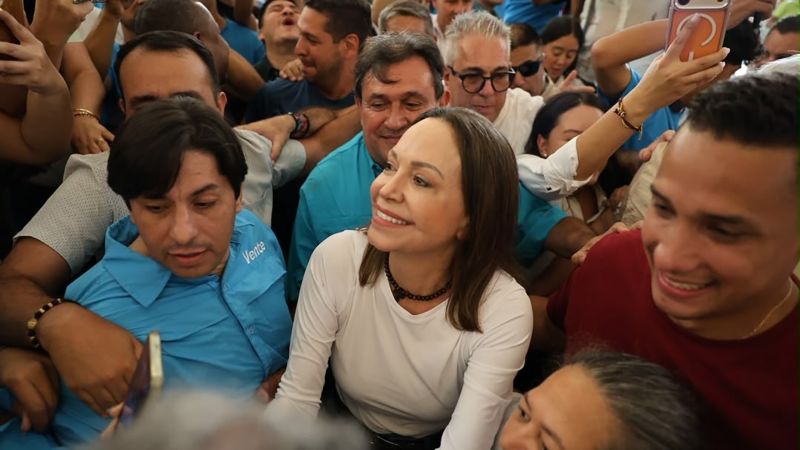
Other opposition figures later confirmed that she had returned, while offering few details about her route or immediate plans. Images circulated by the opposition showed Machado in Lara state, where supporters welcomed her at the Church of Santa Rosa.
Her return follows a prolonged period of exile that began in December, when she traveled to Norway to receive the Nobel Peace Prize. The award recognized her work advocating democratic rights in Venezuela. In the months that followed, Venezuela underwent a dramatic political shift: Nicolás Maduro was removed from power in January, and the United States began working with the acting Venezuelan government on a transition intended to promote democratic reforms and political reconciliation.
A Return Amid an Unsettled Transition
Machado’s arrival places one of Venezuela’s best-known opposition voices back inside the country just as negotiations over its future remain underway. Those discussions have included prominent members of the opposition, but Machado and former presidential candidate Edmundo González Urrutia have largely been left outside the formal process.
González Urrutia, who remains in exile, described Machado’s return as a significant event for Venezuelans and said he expects to come back as well.
“Today is a very important day for Venezuelans. Our sovereign voice returns with her to lead and guide this process!”
He added that he would soon join Machado in Venezuela. Their potential return could give renewed momentum to opposition supporters who have long viewed both figures as central to a future electoral challenge.
Dinorah Figuera, who has led the opposition bloc’s discussions with the government, linked Machado’s return to Maduro’s removal and the reconciliation effort now taking place. The process is aimed at easing Venezuela toward a political system in which an election can be held under freer and fairer conditions.
US Secretary of State Marco Rubio said the United States expects political freedoms to be protected across Venezuelan society and called on all parties to back the talks.
“The United States expects the freedoms of all sectors of Venezuelan politics to continue to be respected. Likewise, we expect all political actors to support these talks which represent the best chance Venezuela has had in thirty years to peacefully achieve not just a free and fair election but an enduring democracy.”
Repeated Attempts to Come Home
Machado had long said that she intended to return. She had also suggested that she would seek the presidency again if Venezuela holds an election. Her advisers said she made seven unsuccessful attempts to re-enter the country in recent months before Sunday’s arrival.
Her first effort came in late June, after two powerful earthquakes caused major damage across Venezuela. Machado wanted to assist with reconstruction, but she said the government blocked her return by shutting Venezuelan airspace.
She made another attempt in late September, when acting President Delcy Rodríguez was attending the United Nations General Assembly in New York. Machado was refused entry three times in one day.
Rubio addressed concerns over Machado’s safety on September 1, emphasizing that her ability to return was a matter of citizenship rather than US permission.
“María Corina Machado, a Venezuelan citizen, has every right to enter her country whenever she wants to return. We have given her advice. For example, during the earthquake, we had many concerns and will continue to have concerns in the future, but we want her safety to be guaranteed,”
Omar González, a close Machado ally, returned to Venezuela in late August after almost three years abroad. At the time, he portrayed his own return as a step ahead of Machado’s planned re-entry.
Washington’s Complex Role
During her time abroad, Machado sought to build international support for Venezuela’s democratic opposition. Her outreach included US President Donald Trump, to whom she gave her Nobel Prize.
Trump said Sunday that he had not been aware Machado had returned, but voiced hope that she would be safe.
“I don’t know anything about it, but I think she’s a very nice woman. She gave me her Nobel Prize, so how can I say anything else? And I hope she’s safe.”
Although the Trump administration has previously expressed support for Machado, it has not made her a central participant in Venezuela’s current transition. After Maduro’s ouster, Trump described her as a “very nice woman” but argued that she lacked sufficient support and respect inside Venezuela to lead the country.
Instead, Washington has worked closely with Rodríguez, Maduro’s successor, on political and economic measures. Rodríguez has met major US requests, including the release of hundreds of political prisoners and steps to make investment by American companies easier.
In late August, Trump announced an agreement under which the United States would take majority control of more than 65 billion barrels of Venezuela’s proven oil reserves. The arrangement underscores how Venezuela’s political transition is also tied to its vast energy resources and to the country’s future relationship with Washington.
What Machado’s Return Could Mean
Machado’s presence in Venezuela does not resolve the questions surrounding the transition, including who will participate in future elections, how opposition groups will coordinate, and whether political freedoms will be consistently protected. It does, however, bring a major opposition figure back into the country at a critical stage.
For supporters, her return offers a visible sign that the political environment may be opening after years of confrontation, repression and exile. For the government and international actors involved in the transition, it creates added pressure to demonstrate that reconciliation includes space for political rivals to organize and compete.
Machado now returns with international recognition, a committed domestic support base and a stated desire to help shape Venezuela’s next chapter. Whether she can convert that position into a formal role in the country’s political future remains one of the defining questions of the transition.
Related Reading
Frequently Asked Questions
What is Opposition leader María Corina Machado returns?
Opposition leader María Corina Machado returns is the main topic of this guide. The article explains the context, practical details, and next steps readers should understand.
Why does Opposition leader María Corina Machado returns matter?
Opposition leader María Corina Machado returns matters because readers are looking for a useful answer, not just a short summary. Good content should match search intent and help them decide what to do next.