
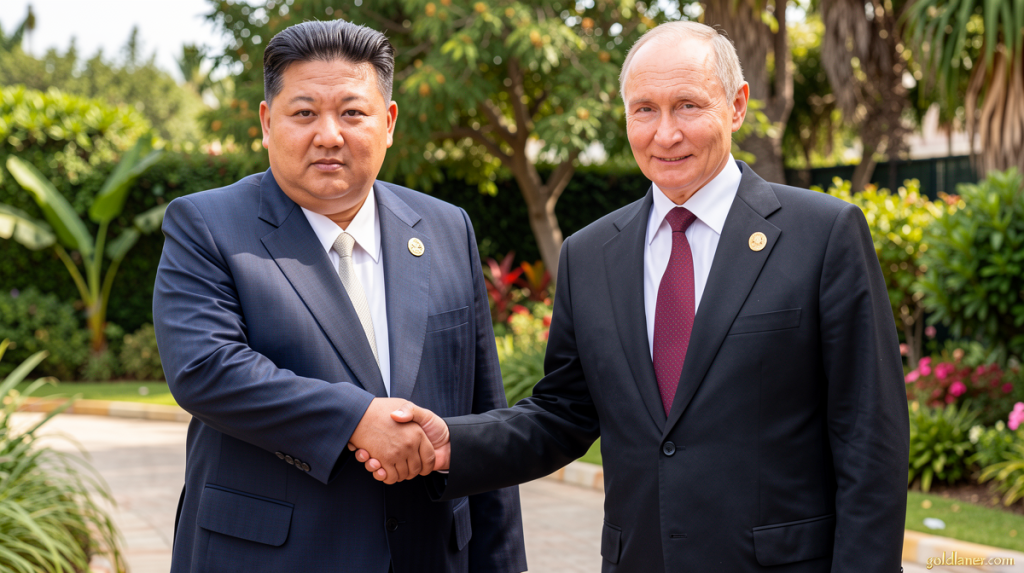
North Korea Boosts Drone Support for Russia
Goldlaner.com – A fresh contingent of 8,500 soldiers arriving in Moscow’s orbit now carries a dedicated drone unit capable of surveying and striking targets inside Ukraine, according to Major General Vadym Skibitskiy, Deputy Head of Ukrainian Defense Intelligence. The deployment marks the latest escalation in a partnership that began with a NATO-style mutual defense pact signed two years ago and has drawn troops into the war since late 2024. Skibitskiy warned that President Vladimir Putin could request up to 50,000 additional personnel when he meets Kim Jong Un in September, a step that would dramatically widen the scope of bilateral military cooperation at a moment when Kyiv’s air-defense inventory is running dangerously low.
Drone Operators Join the Front Line
The troops already on Russian soil are concentrated in the Kursk region and include roughly 1,000 engineers and deminers alongside 400 drone operators. Many of those operators drew practical experience from earlier rotations, and their aircraft are expected to serve both reconnaissance and strike roles against Ukrainian positions. Ukrainian intelligence assessed that the new arrivals will reinforce rear-area positions rather than fight directly on Ukrainian territory, thereby freeing Russian formations for offensive operations on the front.
Skibitskiy noted that approximately 25,000 personnel from the DPRK have been deployed or rotated through Russian military structures to date. The initial wave landed in Kursk in October 2024 to repel a Ukrainian incursion—the first on Russian soil since World War II—and Pyongyang kept the operation quiet for months before confirming its soldiers were engaged in April 2025. An estimated 10,000 of those early deployees suffered heavy casualties after employing mass-assault tactics against Ukrainian positions; the survivors returned home with firsthand knowledge of drone-dominated combat.
Strategic Implications for Kyiv and NATO
The deepening military entanglement has unsettled NATO planners, particularly after President Donald Trump announced on Sunday that joint exercises with Seoul would be scaled back so as not to antagonize Kim. Kim’s sister, Kim Yo Jong, dismissed reports of tens of thousands more troops heading east as a “groundless self-fabricated scenario,” yet Russian state media has aired footage of DPRK soldiers training inside Russia over the past year, and Kim Jong Un unveiled a memorial to fallen troops in April.
Beyond manpower, the partnership now extends to missile technology. Skibitskiy said at least 150 KN-23 or KN-24 ballistic missiles had reached Ukraine before August of last year, with another 120 promised. Those weapons are proving increasingly difficult to intercept: supplies of U.S. Patriot interceptors—one of the few systems capable of downing ballistic missiles—are nearly exhausted, with only 40 delivered so far. Two interceptors were suspected in a 30 July strike on Radushne in the Dnipro Region that killed at least four children from the same family. Around 90 launch-support personnel have been sent to Voronezh, and ten large cargo flights—possibly carrying additional missiles—have landed at the local aerodrome. Skibitskiy added that newer missile variants reach roughly 800 km but still land 15 to 19 km off target, suggesting Pyongyang is using Ukrainian skies as a live test range for targeting and payload refinement.
In return for supplying manpower and munitions, the DPRK has requested the Russian S-400 air-defense system and has already received a Pantsir-1 surface-to-air missile launcher.
Ukrainian analysts view the arrangement as evidence that Moscow’s economic resilience and industrial capacity, long touted in Kremlin rhetoric, are being stretched beyond sustainable limits. Each additional battalion or missile battery that Pyongyang provides buys Moscow time, but it also binds the two regimes to a shared operational fate that neither can easily unwind.
Frequently Asked Questions
How many troops has the DPRK sent to Russia so far? Ukrainian intelligence estimates roughly 25,000 personnel have been deployed or rotated through Russian military structures since October 2024, with the current wave bringing the number on the ground to about 8,500.
Will the new drone unit fight inside Ukraine? Skibitskiy said the operators will likely survey and strike targets within Ukrainian territory, though the broader troop contingent is expected to hold rear positions rather than engage directly on the front line.
What does Pyongyang receive in exchange? The DPRK has asked for the S-400 air-defense system and has already been delivered a Pantsir-1 surface-to-air missile launcher, according to Ukrainian Defense Intelligence.
When could the next major deployment occur? A Putin–Kim meeting is expected in September, at which Moscow could formally request up to 50,000 additional personnel, though Kim Yo Jong has publicly denied such a scale of movement.