
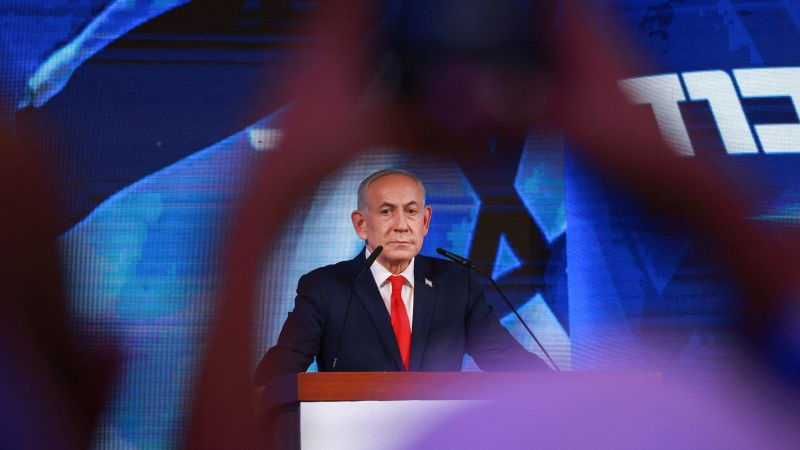
Israel’s Election Leaves Netanyahu Facing Another Test of Political Survival
Goldlaner.com – Benjamin Netanyahu has spent more than 30 years in Israeli politics repeatedly overcoming predictions that his career was nearing its end. This election has again placed his future in doubt, but the final outcome may depend less on who won the most seats than on whether his opponents can assemble a governing coalition.
With most ballots counted by Wednesday night, Netanyahu’s Likud remained the largest party in the 120-member Knesset, with an estimated 26 seats. Yet the broader right-wing alliance led by Netanyahu was projected to secure only 53 seats, leaving it eight short of the 61 required to command a parliamentary majority.
That result has deprived Netanyahu of a straightforward path to another government. Still, it has not delivered a clear defeat. Israel’s coalition system can turn postelection negotiations into a prolonged contest, and Netanyahu’s rivals must overcome their own ideological divisions before they can replace him.
An Opposition Majority With Deep Divisions
Parties opposed to Netanyahu appeared to hold about 67 seats in total. But those numbers do not automatically translate into a governing coalition. Gadi Eisenkot, Netanyahu’s leading challenger, won 21 seats, while Jewish opposition parties together were projected to control only 48.
To cross the 61-seat threshold, Eisenkot’s camp would need backing from both Raam and the Joint List, the two Arab parties expected to win a combined 19 seats. Their projected result reflects unusually strong participation among Arab citizens of Israel, including Palestinian citizens, following four years in which crime in Arab communities rose during the tenure of a far-right national security minister.
Raam, an Islamist party with substantial support among Israel’s Bedouin population, has already broken political precedent. Its leader, Mansour Abbas, became the first Arab politician to participate in an Israeli governing coalition after the 2021 election.
The Joint List is expected to be the larger of the two Arab parties. It brings together several smaller factions, including the Communist Hadash party, the secularist Taal movement and the nationalist Balad faction. On Wednesday, the alliance said it was open to cooperation aimed at ending Netanyahu’s rule.
“Do everything in its power to bring Netanyahu’s rule to an end.”
For the opposition, the challenge is not simply numerical. Two of Eisenkot’s right-wing partners, Naftali Bennett and Avigdor Liberman, have resisted any arrangement that relies on Arab parties. Neither had issued a public statement on the issue after polls closed.
Yair Golan, who leads the left-wing Democrats party, argued that Arab parties should be treated as legitimate members of the anti-Netanyahu camp. He accused Netanyahu of promoting a “racist division between Jewish and Arab votes.”
Netanyahu’s Fight Moves Into Coalition Negotiations
Netanyahu’s immediate objective is expected to be preventing a Jewish-Arab parliamentary partnership from producing a new government. A person close to him said he views a minority administration backed by Arab parties as a major threat and intends to challenge its legitimacy.
The strategy could include efforts to persuade individual opposition lawmakers not to support an arrangement involving Raam or the Joint List. The political pressure is likely to intensify as parties weigh whether they can tolerate a coalition spanning sharply different views on security, religion, the role of Arab citizens and the future of the Israeli-Palestinian conflict.
Likud also raised allegations of election misconduct after campaigning heavily against the Arab parties. The party claimed that Arab parties had influenced the vote through bribery, intimidation, violence and forgery. Israel’s Central Elections Committee said it was reviewing the complaint, although it had already rejected thousands of election-day complaints submitted by various parties.
The allegations echoed fraud claims made by Netanyahu’s closest international ally, US President Donald Trump. In the absence of a decisive winner, claims surrounding the election could further complicate efforts to establish a stable government.
Security Concerns Shadow the Political Deadlock
Opposition figures are also worried that a worsening regional security situation could delay or disrupt the transition to a new government. Netanyahu has previously pressed Trump to support a joint military strike against Iran, but Washington did not proceed before the election. Israeli military chief of staff Eyal Zamir had warned that such an operation could interfere with the vote.
An Israeli security source said operational planning was complete and that action would require Trump’s approval, potentially after the US midterm elections. That prospect has heightened concern among Netanyahu’s opponents that a crisis could reshape the political environment while coalition talks are underway.
“There is no way to know what Netanyahu will do.”
An opposition source said there was awareness that Netanyahu could seek another escalation. Another person familiar with the political tensions said he would do everything possible to remain in the prime minister’s office, including creating domestic or external turmoil.
Eisenkot, a former Israel Defense Forces chief of staff, urged the country’s security leadership to remember on Tuesday night that Netanyahu was serving as a caretaker prime minister. His intervention underscored the sensitive overlap between political uncertainty and decisions involving national security.
The coming weeks may determine whether Netanyahu extends his record as Israel’s longest-serving prime minister or faces removal through an unprecedented coalition of ideological rivals. Likud’s position as the largest individual party gives him influence, but it does not guarantee power. For Eisenkot and his partners, the opportunity is real, yet it depends on whether they can bridge divides that have long prevented a unified alternative to Netanyahu.
Related Reading
Frequently Asked Questions
What is Netanyahu is the ultimate survivor But can?
Netanyahu is the ultimate survivor But can is the main topic of this guide. The article explains the context, practical details, and next steps readers should understand.
Why does Netanyahu is the ultimate survivor But can matter?
Netanyahu is the ultimate survivor But can matters because readers are looking for a useful answer, not just a short summary. Good content should match search intent and help them decide what to do next.