
UK Airports Still Reeling as Air Traffic Control Failure Cascades Across the Sky
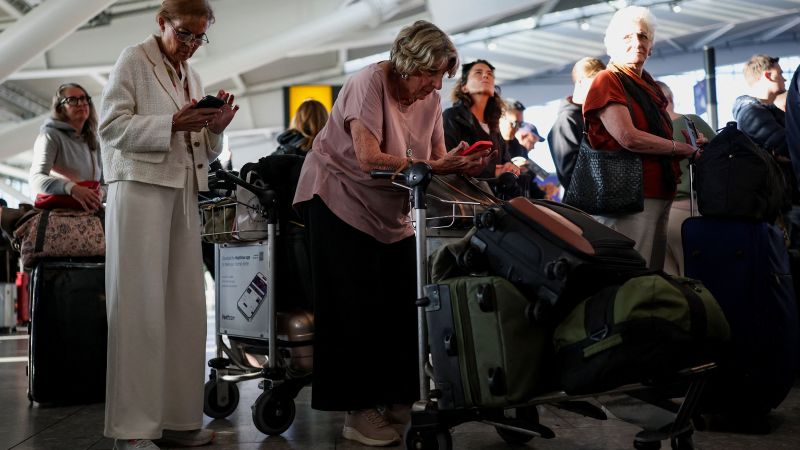
Goldlaner.com – Passengers queued in terminal corridors, staring at departure boards listing one cancellation after another, while the hum of jet engines fell silent over London’s skies. What began as a technical fault in the nation’s air traffic control infrastructure on Tuesday had, by Wednesday, evolved into one of the most severe operational disruptions at British airports in recent memory. Heathrow, Gatwick, and Stansted all displayed dozens of delayed or scrapped departures, and Manchester joined the list of affected hubs as the backlog of stranded aircraft grew through the day.
The scale of the disruption was staggering. Aircraft-tracking data compiled by Flightradar24 placed the total number of flights canceled to or from UK airports on Tuesday at roughly 1,300. By Wednesday, another 177 departures had been axed, nearly all of them at London-Heathrow, the tracker noted. For an airport that handled more than 84 million passengers in 2025 — making it the seventh-busiest in the world by that measure, per Airports Council International figures — even a single day of mass cancellations sends shockwaves through the global travel network.
Passengers Caught in the Crossfire
Ireland-based budget carrier Ryanair announced that approximately 65,000 of its customers had been affected by the outage, with more than 50 scheduled flights canceled outright. At Heathrow itself, departures eventually resumed on Tuesday, but arrivals stayed grounded, the airport confirmed in a statement. “Disruption is expected to continue,” the airport added, a line that became the refrain repeated across terminals for hours.
On the ground, the human toll was immediate and visceral. Social media filled with photographs of serpentine queues snaking through concourses, of families with unopened suitcases, of travelers staring at screens that offered no answers. One user on X described the ordeal as the “single most stressful and disappointing experience” they had ever had with any form of transport, noting that British Airways had offered a replacement routing described as a “24 hour 4 flight transit for a 2 and a half hour flight to Rome.”
Josie Donoghue, a passenger at Gatwick, spent three hours trapped aboard a Ryanair aircraft before her flight to Ireland was ultimately canceled. Describing the ordeal of navigating the packed terminal afterward, she compared the experience to escaping a maximum-security prison.
“Getting through that airport was like trying to get out of Alcatraz,” she said. “It’s just an absolute nightmare down there. It’s the only word I can use to describe it.”
Not every reaction was negative. Several travelers took to social platforms to commend ground staff who worked through the chaos, helping reroute passengers, rebook connections, and manage the physical crowds that overwhelmed terminal capacity.
NATS Apologises as Recovery Stalls
NATS, the UK’s principal provider of air traffic control services, confirmed on Tuesday that the underlying system fault had been repaired. Yet the operational recovery proved far slower than anticipated.
“The recovery from the issue has taken longer than we had hoped,” the organisation stated. “We know this is hugely frustrating and apologise unreservedly.”
NATS said it was operating normally at the time of the statement and was working to clear the accumulated backlog of flights. The gap between a fixed system and a functional airport, however, remained wide — a reminder that air traffic control is not a single switch but a layered ecosystem of radar feeds, communication channels, and procedural handoffs that must all re-synchronise before normal throughput resumes.
Political and Industry Backlash
The disruption landed in a politically charged moment. Ryanair chief operating officer Neal McMahon used a Tuesday statement to call for the resignation of NATS chief executive Martin Rolfe, drawing a direct line to the organisation’s 2023 control failure, which had grounded flights for days and left tens of thousands of passengers stranded.
“Families travelling on holiday, people travelling for work and thousands of visitors to the UK have once again paid the price for NATS’ abhorrent failure,” McMahon said.
Rolfe, speaking to the BBC, pushed back on the characterisation while still offering an apology. He insisted the organisation’s infrastructure remained fit for purpose.
“Whilst we never want these things to happen – and I absolutely apologize for the fact it has happened today – I do think we’re fit for purpose,” he said.
UK Transport Secretary Heidi Alexander weighed in on X, saying she was “seeking assurances that lessons will be learned and systems that support aviation are up to the job.” The remark underscored a growing parliamentary and public expectation that repeated infrastructure failures at the scale now witnessed demand structural reform rather than incremental patching.
A Pattern of Recurring Failure
The Tuesday–Wednesday outage was not an isolated glitch. Since the 2023 incident, UK airports have experienced a major disruption roughly every year. In 2024, a global IT software crash rippled through airports worldwide, producing delays and operational confusion at British hubs among others. Last year, Heathrow itself was shut down entirely after a significant power outage triggered by a large fire in the vicinity of the airport; the closure upended travel plans globally, affected thousands of flights, and generated financial losses estimated in the hundreds of millions of pounds.
Each episode has raised the same question: why does the infrastructure that underpins one of the world’s busiest aviation corridors continue to buckle under pressure? The answer, industry analysts suggest, lies in the intersection of ageing systems, budget constraints on modernisation, and the sheer complexity of managing thousands of daily movements through a handful of tightly packed airspace corridors.
International Knock-On Effects
The disruption did not stop at the UK border. Air India, the country’s flagship carrier, issued a statement on X confirming that the outage had forced it to “divert, delay or cancel multiple flights scheduled to operate to and from UK airports.” Qatar Airways similarly warned of delays and potential re-routing for its UK-bound and UK-departing services. For long-haul operators, a single day of lost slots at Heathrow or Gatwick can cascade into missed connections, hotel costs, and crew-duty violations that ripple across an entire network for days.
As of Wednesday, the full extent of the operational damage remained unclear. Airlines were still working through rebooking queues, airports were managing physical crowds, and passengers faced uncertain timelines for onward travel. The episode reinforced a uncomfortable truth for British aviation: the margin between a routine Tuesday and a national travel crisis can be as thin as a single software fault in a control room.
Related Reading
Frequently Asked Questions
What is Massive disruption hits UK airports after?
Massive disruption hits UK airports after is the main topic of this guide. The article explains the context, practical details, and next steps readers should understand.
Why does Massive disruption hits UK airports after matter?
Massive disruption hits UK airports after matters because readers are looking for a useful answer, not just a short summary. Good content should match search intent and help them decide what to do next.