
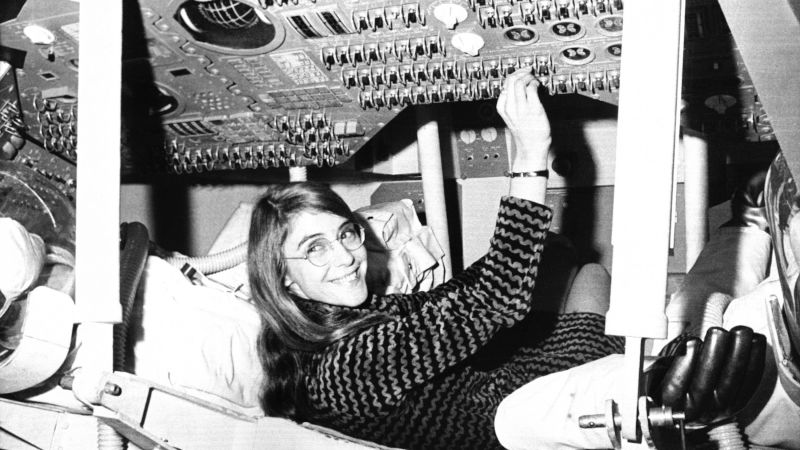
Margaret Hamilton Dies at 90, Leaving a Lasting Legacy in Spaceflight and Software
Goldlaner.com – Margaret Hamilton, the visionary computer scientist whose work was central to the Apollo moon missions and helped define software engineering as a profession, has died at age 90.
The Massachusetts Institute of Technology confirmed her death through its Department of Aeronautics and Astronautics. No cause of death was disclosed.
Hamilton’s career became inseparable from one of the most ambitious scientific and engineering efforts in history: NASA’s Apollo program. The software developed under her leadership helped guide astronauts during missions that culminated in the United States landing people on the moon during the 20th-century space race.
A Career Built During Computing’s Early Years
Hamilton joined MIT in 1959, at a time when computer programming was still emerging as a specialized discipline. She remained at the institution into the mid-1970s and went on to lead the Software Engineering Division at the MIT Instrumentation Laboratory.
That laboratory secured a NASA contract in 1961, placing Hamilton and her colleagues at the center of work on the Apollo guidance systems. She eventually led a team of roughly 100 engineers responsible for creating software used to support the lunar missions.
The task demanded an unusually rigorous approach. Apollo spacecraft depended on computer systems that had to operate reliably in an environment where failure could jeopardize an entire mission. The work required engineers to consider not simply whether a program could function under normal conditions, but how it would respond to timing pressures, unexpected inputs and competing demands on limited computing resources.
Hamilton’s contributions became especially significant because the Apollo program demonstrated that software could be as essential to a mission as the spacecraft’s hardware. The code was not an afterthought to the rockets, navigation instruments or communications systems. It was a core part of the machinery that allowed astronauts to travel, maneuver and return safely.
Helping Create Software Engineering
Beyond the Apollo missions, Hamilton is widely recognized as a foundational figure in the development of software engineering. She coined the term “software engineering” and helped advance the idea that programming required disciplined processes, careful design and professional standards.
In the early era of computing, software was often treated as a secondary element of larger technical projects. Hamilton’s work helped change that perception. By leading teams through the creation of highly complex and mission-critical systems, she showed why software development needed the same degree of planning, testing and accountability expected in other engineering fields.
Her influence can be seen in the expectations now placed on software used in aviation, medicine, transportation, communications and space exploration. Modern digital systems vary enormously in scale and purpose, but the need for reliable code and clear engineering practices remains central wherever errors can have serious consequences.
“To say Margaret Hamilton was a pioneer — to say she was ahead of her time — would be a dramatic understatement,” said Olivier de Weck, the Apollo Program Professor and interim head of the MIT Department Aeronautics and Astronautics.
“She was a software engineer at a time when that field was in its infancy, and she not only developed advanced code herself but also led a team in using that nascent technology to develop one of the most complex systems humanity had ever achieved.”
Leadership Behind a Historic Lunar Achievement
Hamilton’s Apollo work represents a milestone in the story of human spaceflight. The moon landings are often remembered through images of astronauts, launch vehicles and the lunar surface, yet they also depended on teams of mathematicians, programmers and engineers working far from the launchpad.
The Apollo guidance software had to support decisions and operations during missions of exceptional complexity. Engineers were working with computing technology far less powerful than the devices people now carry in their pockets, while facing standards for reliability that were extraordinarily high. Hamilton’s team helped turn those limitations into an operational system capable of supporting NASA’s lunar ambitions.
Her role also remains an important reminder of the many people whose work made the Apollo missions possible. Space exploration is frequently presented through a small group of public figures, but major achievements rely on broad teams with different areas of expertise. Hamilton’s career brought overdue visibility to software specialists and to women whose contributions were often overlooked in accounts of technical history.
In 2016, President Barack Obama awarded Hamilton the Presidential Medal of Freedom, recognizing her achievements in science and space travel. The honor placed her alongside other Americans whose work has had a profound impact on the country and the world.
An Enduring Example for Future Engineers
Hamilton’s legacy reaches beyond a single era of space exploration. Her career illustrates how emerging fields can be shaped by people willing to insist that new forms of work be taken seriously. Software engineering is now woven into everyday life, from banking and public infrastructure to scientific research and personal technology, but it was still a developing concept when Hamilton began advocating for it.
Her story also highlights the value of technical leadership. She did not only write advanced software; she organized and guided a large engineering team tackling a problem without many established models to follow. That combination of invention, discipline and collaboration helped produce systems that served one of NASA’s most demanding goals.
As interest in lunar exploration and human spaceflight continues, Hamilton’s work remains a defining chapter in the history of computing. The success of Apollo showed that software could help humanity reach places once thought unattainable. Her life’s work helped make that achievement possible.
Related Reading
Frequently Asked Questions
What is Margaret Hamilton whose software helped land?
Margaret Hamilton whose software helped land is the main topic of this guide. The article explains the context, practical details, and next steps readers should understand.
Why does Margaret Hamilton whose software helped land matter?
Margaret Hamilton whose software helped land matters because readers are looking for a useful answer, not just a short summary. Good content should match search intent and help them decide what to do next.