
North Korea’s Inner Circle Casts Doubt on Trump’s Claimed Back-Channel Contact with Kim Jong Un
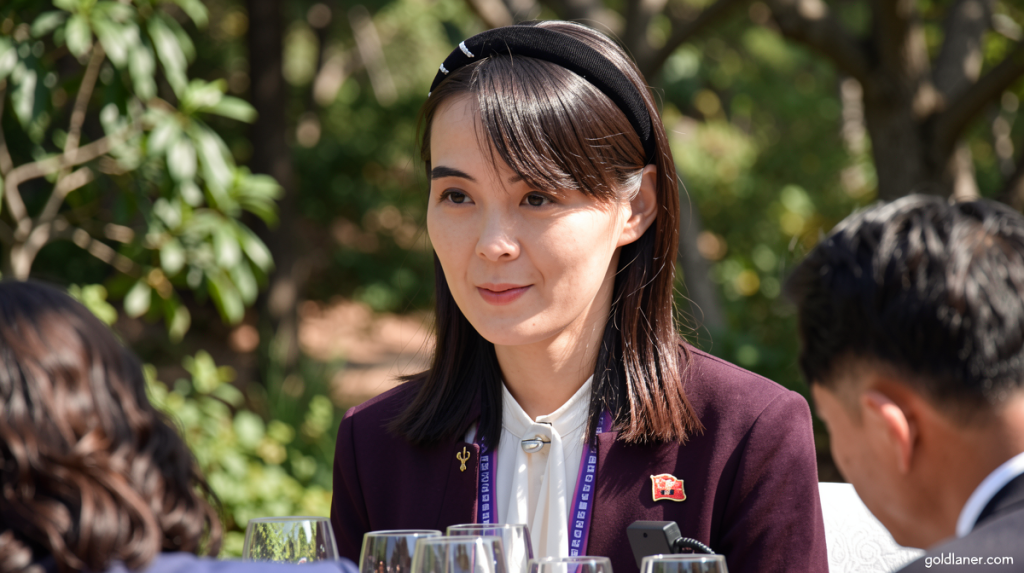
Goldlaner.com – Washington’s assertion that a direct line of communication has reopened between the White House and Pyongyang has run into an unexpected obstacle: the sister of North Korea’s supreme leader says she knows nothing about it. Kim Yo Jong, who occupies one of the most influential positions in the country’s ruling apparatus, issued a statement through state media on Wednesday declaring herself “completely unaware” of any recent exchange between her brother and US President Donald Trump.
The remark lands with particular weight because Kim Yo Jong is far more than a family figure. She routinely appears at Kim Jong Un’s side during diplomatic events, delivers policy pronouncements on behalf of a government that guards its decision-making process with extraordinary opacity, and is widely regarded as one of the few individuals with genuine access to the leader’s strategic thinking. For her to publicly acknowledge a blind spot in foreign policy — however small — is itself a signal that the administration in Pyongyang is managing the narrative carefully.
The Statement Itself
In the full text of her remarks, Kim Yo Jong addressed the reported “communication” between Trump and her brother with pointed language:
“I am not aware of it at all, and perhaps it may be the only thing I do not know as regards the foreign policy of our supreme leadership.”
She stopped well short of confirming or denying any contact. What she did acknowledge was that Kim Jong Un harbors “good memories and feelings” toward Trump and that the two men share a “great relationship.” Yet no confirmation of a recent conversation, letter, or message was offered.
Trump’s Account
The president told reporters on Monday that Kim Jong Un had responded to his request for a conversation. He made the remark shortly after demanding a sudden reduction in the scale of joint military exercises conducted with South Korea, a close and long-standing US ally. Trump did not elaborate on the nature, timing, or medium of the alleged contact. By Wednesday, he added that he intends to meet Kim later this year, though he declined to provide specifics and would not confirm whether any written correspondence has taken place.
“I get along with him,” Trump told reporters Wednesday. “And you know what? The fact that I get along with him — that’s a good thing.”
The president also cited Seoul’s perceived lack of assistance with the ongoing war in Iran as part of his rationale for reshaping the alliance’s military posture.
The Drills Dispute
The annual joint exercises between US and South Korean forces are typically scheduled for ten days. This year, at Washington’s request, they will run for only five. A spokesperson for US Forces Korea explained last week that the exercises are designed to adapt to North Korea’s evolving capabilities and incorporate training against drones, GPS disruption, and cyberattacks.
Kim Yo Jong dismissed the reduction as cosmetic. In her statement she argued that scaling back the exercises does not alter “the provocative and offensive nature of them,” even though both Washington and Seoul have repeatedly emphasized their defensive character. She added that the cut should not be interpreted as a “measure of goodwill.”
Strategic Calculus for Seoul
Analysts have warned that trimming the scope of war games with South Korea may work against Trump’s own stated objective of having Seoul assume greater responsibility for its own defense. Embedded within the full-scale exercises is training that gives South Korea something it has not possessed since the Korean War began in 1950: wartime operational control of the combined South Korean–US forces on the peninsula. That transfer of command authority is a key goal for both governments. Once Seoul demonstrates it can shoulder that burden, Washington can step back in any future conflict, providing limited firepower while letting South Korea bear most of the responsibility and cost of its own defense.
Publicly, South Korean President Lee Jae Myung has welcomed Trump’s request. Speaking on X late Wednesday, he reiterated support for dialogue with North Korea and a desire to take greater responsibility for the peninsula’s security.
“We sympathize with President Trump’s determination and effort to create conditions for dialogue to establish peace regime on the Korean Peninsula, even if it means scaling back the recent South Korea-US joint military exercise and field training exercises, and we pay tribute to that decision.”
Lee added that he “fully agrees” with Trump that South Korea “should take responsibility itself of security on the Korean Peninsula while building sufficient capability to independently defend the peninsula by rapidly increasing defense spending to achieve a defense expenditure of 3.5% of GDP.”
Why the Timing Matters
The drills in question had been months in planning before Trump’s demand to scale them back arrived on the very first day the joint exercises were set to begin. That compressed timeline underscores how abruptly the administration is reshaping a decades-old alliance framework. For North Korea, which has long viewed the exercises as rehearsals for invasion rather than routine readiness, even a halved duration remains an irritant. For South Korea, the question is whether reduced training tempo will erode the very operational-control capability that both allies say is essential to a credible deterrent posture.
The diplomatic picture is further complicated by the fact that Trump’s overtures to Kim Jong Un could delay the very burden-sharing arrangement he says he wants. If Pyongyang interprets reduced drills as a concession rather than a gesture, the incentive structure that pushes Seoul toward greater self-reliance weakens. And if no actual contact has taken place — as Kim Yo Jong’s statement implies — the president’s public framing of a warm bilateral relationship risks outpacing the reality on the ground, leaving both allies and adversaries uncertain about what, exactly, is being negotiated.
Related Reading
Frequently Asked Questions
What is Kim Jong Un s powerful sister?
Kim Jong Un s powerful sister is the main topic of this guide. The article explains the context, practical details, and next steps readers should understand.
Why does Kim Jong Un s powerful sister matter?
Kim Jong Un s powerful sister matters because readers are looking for a useful answer, not just a short summary. Good content should match search intent and help them decide what to do next.