
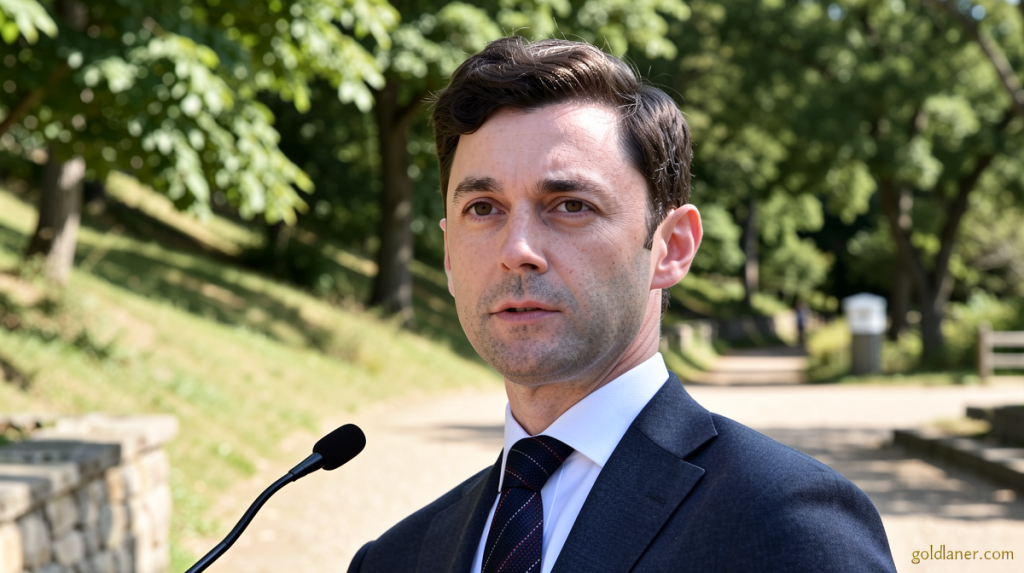
How a Single Rally Line Turned a Senator Into a Social Media Phenomenon
Goldlaner.com – The modern political campaign increasingly lives and dies in thirty-second bursts of video, and few candidates have internalized that reality as thoroughly as Georgia Senator Jon Ossoff. At a rally last Sunday, the 39-year-old Democrat wove a pointed jab into a brief argument claiming that President Trump “doesn’t want to do the job” of the presidency. The line in question referenced Trump’s executive assistant, Natalie Harp, 35, by name — and within hours, the phrase had detonated across every major platform.
Ossoff’s full sentence, delivered with theatrical emphasis, read: “He wants to build his ballroom and travel with Natalie on their apparently defenseless flying palace gifted by the Emir of Qatar.” The phrasing was calculated to land on multiple registers at once: a corruption accusation aimed at the White House ballroom project, a pointed dig at Trump’s reported relationship with Harp, and a vivid image of a Qatari-gifted aircraft. It was, by design, a moment built to be isolated, replayed, and debated in fragments.
The Immediate Aftermath: Search Spikes and Cross-Party Outrage
The numbers confirmed the strategy’s success. Google searches for Natalie Harp’s name surged by 5,000 percent in the days following the rally. Newsrooms scrambled to fill the sudden information vacuum, producing fresh profiles and background pieces on the executive assistant. By Tuesday morning, a story headlined “Who is Natalie Harp?” had climbed to the top of CNN’s most-read rankings.
The reaction split along predictable partisan lines. Liberal commentators praised Ossoff for forcing a conversation about White House spending and personnel choices. Conservative voices, meanwhile, accused him of sexism, which prompted liberal counter-responses citing Trump’s own history of remarks about women. The back-and-forth fed exactly the kind of algorithmic amplification that social media platforms reward: endless, self-perpetuating political bickering.
On Fox News that Tuesday afternoon, host Jesse Watters offered a bemused assessment that itself became a clip. He noted, with visible surprise, that the network had not covered Ossoff on the show in six years — a remark that, ironically, underscored the senator’s breakthrough moment.
“To suggest that Trump surrounds himself with attractive women — yeah, he’s done that his whole life, I don’t think he’s very upset about the comment.”
Watters continued, conceding that Trump had said far worse things about other people and that he himself had defended those remarks. He insisted he was not “all hot and bothered” by the Ossoff line and claimed the president did not care. Fox nonetheless devoted a full segment to the controversy, extending the very attention Ossoff’s comment was engineered to generate.
The Calculus Behind the Clip
Ossoff did not stumble into virality by accident. His campaign has long been structured around what veteran political journalist Jonathan Martin — now a columnist and host at Politico — described earlier this summer as “the Ossoff model”: a weekend rally, clips delivered for social media, and a tight corruption focus. Moments from his speeches have repeatedly broken out on platforms, accumulating millions of views each time.
Amanda Litman, president of Run for Something, an organization dedicated to electing young progressives, told CNN that younger candidates across the political spectrum have become fluent in internet culture. They understand the “lingua franca” of short-form video and know precisely where their strengths lie. For Ossoff, she explained, that strength is delivering speeches specifically architected to be clipped — broken into bite-sized segments for later circulation.
“It’s not just what’s happening in the room, it’s what the room can be cut up into for later use.”
Litman added that winning candidates are shifting their thinking away from individual television appearances or one-off media hits toward sustained social reach and cumulative attention. The rally is no longer merely a live event; it is raw material for a week’s worth of digital content.
A Broader Pattern Across the Spectrum
The strategy is not confined to Democrats. It calls to mind remarks made by Democratic Representative Ritchie Torres about Zohran Mamdani during the latter’s run for New York City mayor last year. Torres told reporter Astead Herndon that Mamdani had mastered what he called the “three threes” — a framework built around 30-second social media units designed to travel independently of their original context.
Ossoff’s “travel with Natalie” moment fits squarely within that emerging playbook. The comment was embedded in a broader but still TikTok-length argument, meaning it could be extracted and circulated without requiring viewers to watch a full speech. Trump critics on X and other platforms shared clips approvingly, many of them having previously questioned the working relationship between the president and Harp. Tommy Vietor, co-host of the podcast “Pod Save America,” wrote that Ossoff was essentially “winking” at the subject and posed the question of whether the moment would trigger a round of substantive reporting. It did — partly because audiences were hungry for context, and partly because the White House responded with aggressive pushback, giving outlets additional material to cover.
What Comes Next
Ossoff is running for re-election in Georgia, and a faction of Democrats already speculates about a 2028 presidential bid. Whether or not that ambition materializes, the “travel with Natalie” episode illustrates a structural shift in how candidates compete for oxygen. The unit of political communication has shrunk from the full speech to the isolated clip, from the television interview to the fifteen-second vertical video. Candidates who understand this compression — who build their rhetoric to survive extraction from context — are gaining a measurable advantage over those who still think in terms of the traditional broadcast cycle.
The Fox News segment, the search spike, the partisan firestorm, and the millions of views on campaign clips all point to the same conclusion: in the clipping economy, a single well-placed sentence can outperform an entire week of conventional media appearances. Ossoff’s rally line was not merely a gaffe or a zinger. It was a product, engineered for distribution, and the market responded exactly as predicted.
Related Reading
Frequently Asked Questions
What is Jon Ossoff s Travels with Natalie?
Jon Ossoff s Travels with Natalie is the main topic of this guide. The article explains the context, practical details, and next steps readers should understand.
Why does Jon Ossoff s Travels with Natalie matter?
Jon Ossoff s Travels with Natalie matters because readers are looking for a useful answer, not just a short summary. Good content should match search intent and help them decide what to do next.