
Xi’s Anti-Corruption Drive Leaves China’s Political Elite on Edge
Goldlaner.com – China’s political establishment is entering another sensitive week in Beijing with a clear understanding of where power lies: the leadership has become increasingly concentrated around Xi Jinping, while senior officials face a widening campaign against alleged corruption.
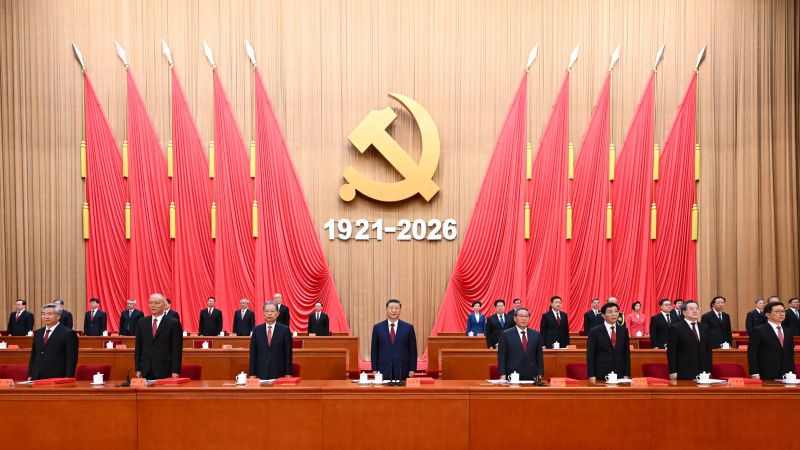
A closed-door gathering of more than 200 top Communist Party figures is expected to reinforce Xi’s authority and his long-running disciplinary campaign. The meeting comes a year before a far more consequential party leadership gathering next fall, when Xi is widely expected to seek an unprecedented fourth term.
For many officials, the atmosphere is likely to be uneasy. Seats at the upcoming meeting are expected to be unusually scarce, not because the importance of the gathering has diminished, but because so many senior figures have been removed, investigated or expelled in the continuing purge.
A campaign with no obvious endpoint
Xi, now 73, has made fighting corruption one of the defining features of his more than 14 years in power. Millions of lower-level officials have been caught up in the campaign since he took office. The focus has also extended repeatedly to the highest levels of the party, the government, security agencies and the military.
In 2022, Xi urged the party to “turn the blade inward,” directing scrutiny toward the officials responsible for enforcing discipline. Yet the campaign has continued to intensify. Earlier this year, he told party cadres that corruption remained a serious problem and warned of “two-faced people” within the organization.
“Never-ending struggle.”
That description has become central to the political message surrounding the campaign. Rather than presenting corruption as a problem that can be definitively resolved, the leadership has framed it as a permanent threat requiring continuing vigilance and repeated investigations.
Official figures show the scope of the effort. From 2012 through 2022, more than 500 ministerial-level officials were investigated, later convicted, dismissed or expelled from the Communist Party over corruption. During the past three years alone, more than 410 officials have been purged.
Once-secure institutions are no longer insulated
The latest wave has reached institutions that had long appeared especially protected from political disruption. China’s Central Military Commission, usually composed of seven members and responsible for the country’s highest military decision-making, has been reduced to two members. Xi is one of them.
The party’s 24-member Politburo has also shrunk, with only 21 members remaining. These gaps are a visible illustration of the consequences of the anti-corruption drive and of the degree to which investigations have reshaped the party’s upper ranks.
In the weeks before the Beijing meeting, the Central Commission of Discipline Inspection, the party’s disciplinary watchdog, has released a near-daily stream of announcements involving arrests, new probes and party expulsions. Such notices are closely followed inside China because an official investigation into corruption almost always ends a senior political career.
Those placed under investigation often disappear from public view well before formal confirmation emerges. Even after serving sentences, officials found guilty generally remain excluded from public life, making the announcement of a probe a decisive political moment.
Prominent names deepen the uncertainty
The investigation into Huang Qifan has caused particular concern in political circles. Huang, a longtime mayor of Chongqing, had acquired a reputation as an exceptionally durable political figure. He served under six different Communist Party secretaries in the major city and saw two of them imprisoned, including a former rival of Xi.
After retirement, Huang became a familiar voice at conferences and on television, where he regularly discussed China’s economy. His sudden fall has prompted people who knew him to remove references to their former colleague from social media, a familiar response when a once-prominent figure comes under official scrutiny.
Beijing deputy mayor Xia Linmao was another recent example of how abruptly fortunes can change. Days before his disappearance from public life, state television showed him attending a meeting with Walmart chief executive John Furner and other American business leaders. Xia took notes as his superior encouraged the executives to expand their activities in the Chinese capital.
Then his public presence abruptly ended, placing him among the latest officials swept into the wider campaign.
Other cases have unfolded more slowly. Ma Xingrui, an aerospace engineer who became a senior party official and previously led the vast western region of Xinjiang, had not appeared publicly for five months before authorities announced an investigation in April.
Political consequences ahead of a pivotal year
The campaign has done more than remove individual officials. It has reduced the room for alternative centers of influence within the party at a moment when Xi is preparing for another crucial leadership transition.
China’s political system does not feature the electoral pressures facing leaders in multiparty democracies. Xi is not constrained by a constitutional two-term limit like that faced by US President Donald Trump, who is confronting midterm elections while seeking to protect his party’s political standing. In Beijing, the central question is instead whether any organized faction could challenge Xi’s dominance within the party.
After years of purges across the bureaucracy, security services, military and party apparatus, few figures appear positioned to do so. The continuing investigations also send a message beyond the individuals directly targeted: political survival depends on remaining aligned with the leadership while avoiding conduct that could invite disciplinary scrutiny.
For China’s elite, the coming party meeting will therefore be more than a routine exercise in governance. It will offer another measure of Xi’s consolidated authority, the diminished ranks of the country’s senior leadership and the continuing force of a campaign that shows no sign of ending.
Related Reading
Frequently Asked Questions
What is It can be lonely at the top?
It can be lonely at the top is the main topic of this guide. The article explains the context, practical details, and next steps readers should understand.
Why does It can be lonely at the top matter?
It can be lonely at the top matters because readers are looking for a useful answer, not just a short summary. Good content should match search intent and help them decide what to do next.