
Inside the epicenter of the Ebola outbreak in DRC as the virus spreads
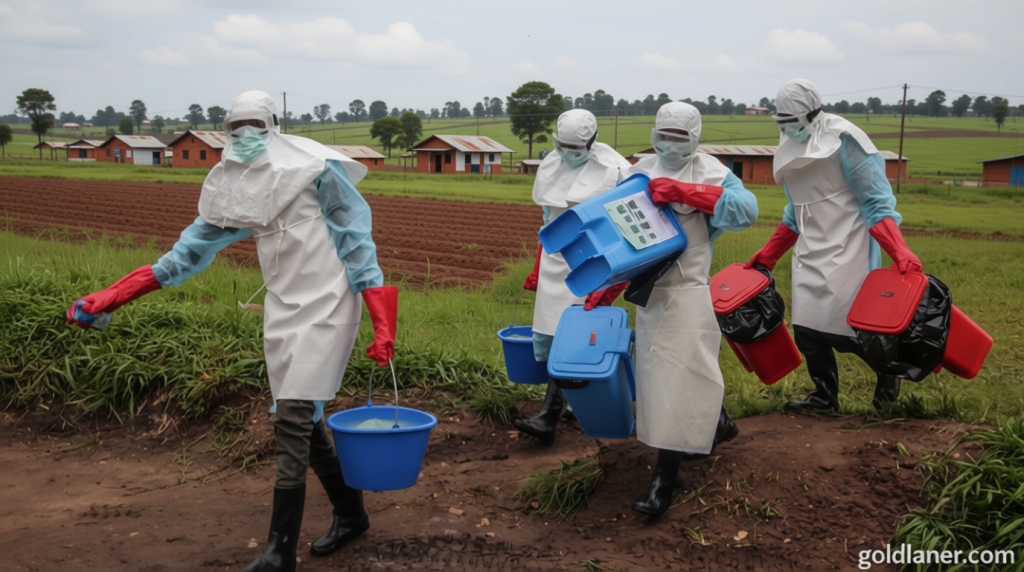
Inside the epicenter of the Ebola outbreak in DRC as the virus spreads
Inside the epicenter of the Ebola – The Democratic Republic of Congo (DRC) remains at the center of a rapidly escalating Ebola crisis, with the virus spreading across regions that have long struggled with limited healthcare resources. In Bunia, a city in Ituri Province, residents like Élie Ilunga are witnessing the consequences of both delayed action and persistent myths about the disease. “As we see people dying, we used to think it was a joke, but now we can see that it’s real,” he said, reflecting the shift in public perception. The outbreak, now affecting over 750 suspected cases and linked to 177 confirmed deaths, has sparked a wave of fear and uncertainty in communities where trust in health measures is still fragile.
A Frontline Seller’s Struggle
Hélène Akilimali, a cocoa seller in eastern DRC, is taking every possible step to protect herself from the virus. She insists on wearing a face mask in public, even though her job requires frequent interaction with customers. “Ebola is a real disease. People need to stop deluding themselves,” she warned a journalist. “I always wear my face mask. But as for the customers, when they come, they may or may not be wearing face masks.” Her caution underscores the challenge faced by many in the region: while individuals like her may adopt protective measures, the broader community often resists, either due to skepticism or lack of access to supplies.
The DRC’s eastern provinces, including Ituri and North Kivu, are the hardest-hit areas, where the outbreak has grown beyond rural origins to reach urban centers. Health officials report that the virus has infected people in Bunia and Goma, two cities with significant populations. Neighboring Uganda has also recorded five confirmed cases and two deaths, indicating the outbreak’s reach extends beyond national borders. Despite these developments, the World Health Organization (WHO) maintains that the global risk remains low, though it has raised the regional threat level to “high” and the DRC’s internal risk to “very high.”
Challenges in Public Compliance
Locals in Ituri and North Kivu say they are not only fighting the virus but also the stigma and misinformation that cloud its reality. Some still believe it is a myth, while others dismiss it as a minor health concern. “Those who doubt are perhaps those who haven’t experienced this (death) yet or whose families haven’t been affected yet,” noted Élie Ilunga, who recently installed a washbasin at home to safeguard his family. His personal efforts highlight the growing awareness among residents, who are increasingly recognizing the gravity of the situation.
However, this awareness has not translated into consistent compliance with preventive measures. Tensions recently erupted in Ituri when relatives of a deceased Ebola patient attempted to remove the body from Rwampara Hospital by force. The clash led to a fire that destroyed two hospital tents, according to officials. Such incidents reveal the deepening divide between community traditions and public health protocols, as families often prioritize cultural rituals over safety precautions.
Traditional Practices and Epidemic Risks
Health experts warn that traditional funerals and mourning practices play a critical role in the virus’s transmission. In Bunia, a community mobilizer explained that a custom involving mourners touching the deceased may have contributed to the spread of infections. “The corpses of Ebola victims are highly infectious,” the official said, emphasizing the need for rapid adaptation of local traditions to contain the outbreak. In response, authorities in Ituri have imposed restrictions on public gatherings and banned wakes, aiming to minimize close contact during mourning ceremonies.
Dr. Tedros Adhanom Ghebreyesus, WHO Director-General, acknowledged the importance of these measures during a press briefing. “Building trust in the affected communities is critical to a successful response, and is one of our highest priorities,” he stated. The organization also highlighted its commitment to preserving essential health services, even as the crisis intensifies. “We are working to ensure that clinics continue to operate effectively,” he added, underscoring the dual challenge of infection control and maintaining access to care.
Conflict Zones and Displaced Populations
The DRC’s eastern region, where the outbreak is concentrated, is also a hotspot for conflict. An estimated two million people have been displaced due to ongoing violence, which complicates the delivery of aid and the enforcement of health measures. “The area is in a conflict zone, and that creates additional barriers,” said Greg Ramm, Save the Children’s DRC country director. “We are in a game of catch-up. There are not enough health resources.” Ramm’s comments reflect the broader struggle of humanitarian teams, who must navigate both physical and political obstacles to provide critical support.
Aid workers have also pointed to the impact of recent funding cuts and the dismantling of USAID programs before the outbreak began. “The Trump administration’s changes have delayed our ability to respond quickly,” one official noted. Yet, a State Department representative countered these claims, asserting that the reductions have not significantly hindered efforts. This debate highlights the political dimension of the crisis, as international support remains a vital component of the response.
Mounting Pressure and a Fragile Situation
As the number of cases continues to climb, the situation in DRC grows more precarious. The WHO warned that the virus is likely to keep spreading, given the time it has been circulating before detection. “The epidemic risk is high because of the extended period of transmission,” the organization stated. With no approved vaccine or treatment available for the strain currently in circulation, containment efforts rely heavily on community engagement and rapid response strategies.
Hélène Akilimali’s daily work as a cocoa seller illustrates the personal toll of the outbreak. She has no control over how her customers behave, yet she remains determined to protect herself. “I always wear my mask, but I can’t force others to do the same,” she said. Her words echo the sentiments of many in the region, who are caught between fear, tradition, and the need for collective action. As the virus spreads, the balance between individual behavior and public health measures becomes increasingly delicate, with the potential for both progress and setbacks.
The crisis in DRC serves as a stark reminder of the challenges faced by countries with underfunded healthcare systems. Historical neglect has left clinics and hospitals ill-equipped to handle large-scale outbreaks. Now, as the situation worsens, the focus is on accelerating the distribution of basic supplies like disinfectant and chlorine to health centers. “Our teams are delivering these essentials alongside local authorities,” Ramm explained. “It’s about creating the conditions for infection prevention, even in the most challenging environments.”
With the virus spreading through cities and displacing populations, the urgency for action has never been greater. The WHO’s recent risk assessment underscores the need for immediate and sustained intervention. Yet, as Élie Ilunga observed, the road to containment is fraught with obstacles. “The disease is definitely here,” he said. “Now we have to act before it’s too late.” The combination of fear, misinformation, and logistical challenges means the battle against Ebola in DRC is far from over, requiring both local resilience and global cooperation to turn the tide.
