
In a city of high-rises, ‘cardboard grannies’ collect waste for cash
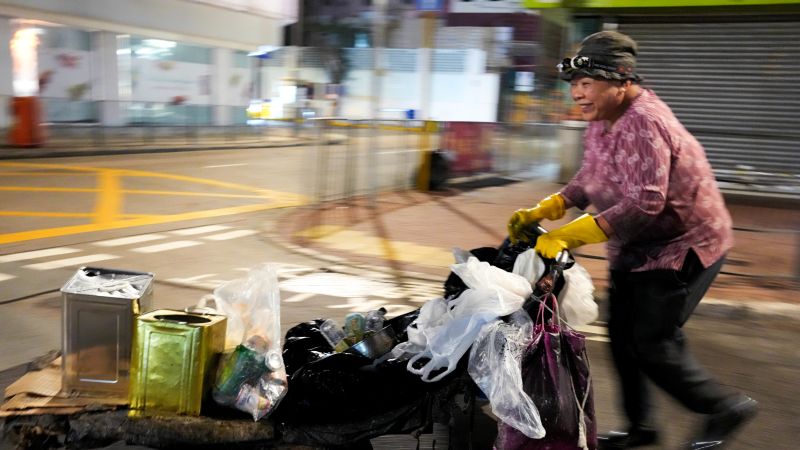
In a city of high-rises, ‘cardboard grannies’ collect waste for cash
The City’s Contrasting Landscape
In a city of high rises – Amid the city’s towering skyscrapers and relentless pace of modern life, a quiet yet persistent group of elderly individuals toils under the sun and rain, navigating Hong Kong’s hilly terrain to gather discarded cardboard. Known as ‘cardboard grannies,’ these women and some men operate in the shadows of prosperity, earning a modest income to sustain themselves in one of Asia’s most expensive metropolises. Their daily routine, though demanding, has become a fixture in the lives of many who rely on this work to make ends meet.
A Hard Day’s Work
At 2 a.m., Wu Sau-jing, 71, begins her nightly mission, pushing a trolley through Hong Kong’s narrow alleys and crowded districts. She meticulously sorts the cardboard she collects—scraping it from businesses, restaurants, and residential areas—into designated categories before transporting it to a local recycling facility. By the time she returns home, often around 11 a.m., the day’s labor has left her exhausted. “I maintain a livelihood and it’s also my hobby,” she tells CNN. “If you don’t like it, it can be quite exhausting.”
For Lai, a woman in her 70s, the income is minimal. She earns approximately HK$100 ($12) per day, a sum barely sufficient for a single meal. “It’s not enough,” she admits. “I need to make more to cover the basics.” The economic pressures are stark: in a 2024 report, Oxfam Hong Kong estimated that 580,000 elderly residents are living in poverty. Despite government-provided allowances, many choose to supplement their income through this work, as the cost of living continues to rise.
The Struggle for Survival
Recent shifts in the recycling market have further strained their efforts. Lai notes that companies once paid HK$0.6 ($0.078) per kilogram, aligning with the government’s minimum rate, but now offer only HK$0.3 ($0.038). This decline has made their work less profitable, with some days yielding nothing at all. “Sometimes strangers or officials toss my collected items into the trash, mistaking them for debris,” she explains. “It’s a huge blow when you’ve invested hours in a single day’s haul.”
Chan Ngai-kan, 95, faced a particularly tough afternoon when her usual recycling center abruptly stopped accepting cardboard. Forced to dispose of her load at a nearby rubbish station, she left empty-handed. “My children are in Canada and I have no money,” she says, reflecting on the financial strain that often accompanies this line of work. For these seniors, the unpredictability of their income is a constant challenge, especially as they balance their labor with other responsibilities.
Waste Management Challenges
Hong Kong’s waste generation rates highlight the environmental and economic pressures these workers face. The city produces about 1.51 kg of waste per capita daily, significantly higher than in neighboring Asian cities like Tokyo (0.88 kg), Seoul (0.95 kg), and Taipei (1.139 kg). Official data reveals that only 30% to 40% of Hong Kong’s waste is recycled, a figure lagging behind Taiwan and South Korea, where over half of waste is repurposed. This inefficient system means that cardboard grannies often have to work harder to secure a decent return, as recyclers prioritize higher-value materials.
Even among the elderly, the demand for income is evident. Wu, who has performed this task for three decades, describes her work as an addiction. “It’s like smoking and gambling,” she quips. “It’s a hobby you can’t get rid of. I’ll do it until the day I can’t do it anymore.” Her words underscore the deep-rooted connection these individuals have with their trade, which transcends mere necessity. For some, it’s a way to stay active and engaged, while for others, it’s a survival strategy in a city where even basic needs come at a premium.
The Few Who Dare to Defy Tradition
While most ‘cardboard grannies’ are women, a handful of men like Cheung, 80, also take part in this unique profession. Cheung’s approach is more fluid; he doesn’t follow a strict schedule, instead gathering whatever cardboard he encounters during his walks. When his collection reaches a sufficient volume, he embarks on a 30-minute journey to the nearest recycling center, often climbing steep roads that test his endurance. “It’s not about timing,” he says. “It’s about what I can find and when I feel like working.”
Despite their dedication, the system remains unforgiving. The minimal earnings, coupled with the physical toll of the job, create a precarious existence. Many grannies speak of the long hours, the repetitive nature of their labor, and the lack of formal recognition. Without an official title, they face the risk of having their trolleys or loads seized by city officials. Yet, their resilience endures. “This is my way of staying connected to the city,” Wu says. “It’s not just about money—it’s about being part of the rhythm of Hong Kong.”
Broader Implications
These workers serve as a microcosm of Hong Kong’s broader economic challenges. In a society where wealth is concentrated and living costs soar, the elderly are disproportionately affected. The government’s allowance, while a small lifeline, is often insufficient to cover essentials like groceries, utilities, or transportation. For many, the decision to collect cardboard is not just financial but also a matter of dignity. “I want to keep working,” Lai says. “It’s better than sitting idle and watching my savings disappear.”
As Hong Kong continues to grapple with its waste management practices and economic disparities, the cardboard grannies remain a testament to human perseverance. Their stories, though individual, collectively reflect the city’s complex interplay of tradition and modernity, scarcity and abundance, and the quiet strength of those who labor in its streets. In a place defined by towering buildings and fast-moving commerce, these elderly collectors are a reminder that not everyone can afford to be forgotten.
