
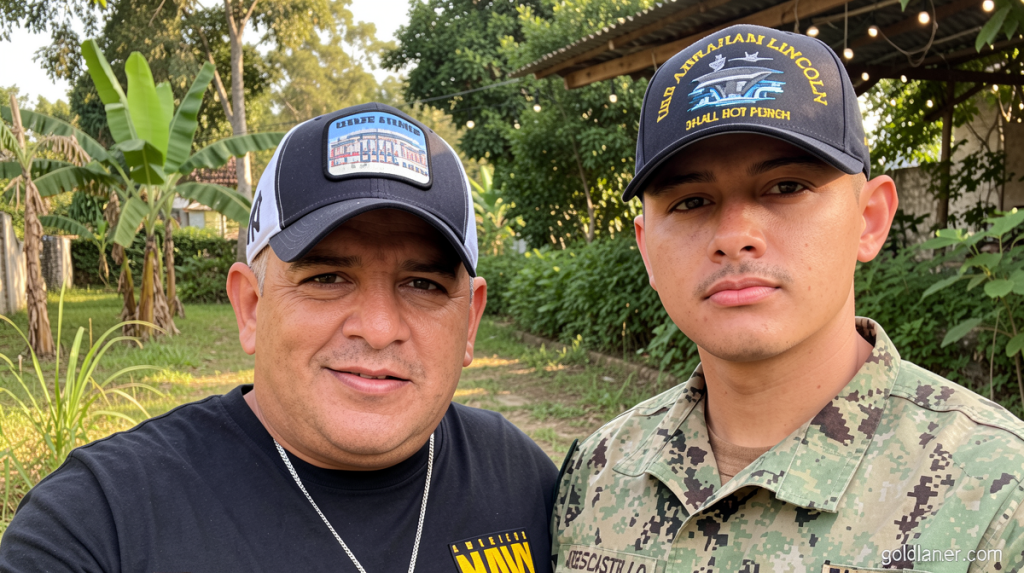
He Was Waiting for His Son When Border Patrol Came
Goldlaner.com – He was waiting for his son to walk back through the front door after nearly a year apart, and instead he found federal agents at his Key West residence one Saturday morning. Luis Manuel Aviles, 48, a handyman who has lived in Florida’s Conch Republic for 19 years and who originally came from Nicaragua, was reportedly heading out to drop his car at a local mechanic when Border Patrol officers detained him. His son, Joshua Aviles, was nine months into a deployment aboard the USS Abraham Lincoln — a warship that had just broken a U.S. Navy record for continuous time at sea — and the two men had not been in each other’s presence since before the ship left port.
Argelia Aviles, 47, Luis’s wife, confirmed the Saturday-morning circumstances and emphasized that her husband holds a valid work permit. The Department of Homeland Security verified the arrest and stated that Luis will remain in Immigration and Customs Enforcement custody while the government proceeds with a deportation case. No further legal details about the specific charge or basis for detention have been made public.
A Record Deployment and a Father in Custody
Joshua had been aboard the Lincoln for more than 250 consecutive days, working shifts that stretched past 12 hours with no day off. The vessel, operating across the Middle East, had drawn sustained scrutiny over crew welfare — from rationed meals to mounting psychological strain on sailors isolated from shore for record stretches. The Pentagon funneled all media inquiries to the Navy, which did not respond to a Sunday-afternoon emailed request for comment. Earlier, Defense Secretary Pete Hegseth had publicly dismissed reports of hardship aboard the ship, calling conditions “completely misrepresented.”
Joshua learned of his father’s detention through a phone call that Saturday morning. He was still on the Lincoln, he said, “fighting for a country that has given me everything,” when the news arrived. That evening he posted on Facebook:
“This is heartbreaking for me. I don’t know how I can mentally continue working 12+ hour days knowing that my dad is somewhere, possibly treated like a criminal.”
He was waiting for his son to return with the same urgency a sailor feels for shore — counting down days, planning a reunion he had not held in nine months. Argelia recalled that when six months elapsed without Joshua coming home, Luis was visibly distraught. He had been counting down the days, eager to embrace a child he had not held since before the deployment began.
The Family’s Long Wait and the Broader Policy Question
Katherine Delgado, 28, Joshua’s sister, described the emotional toll of watching her brother serve while their father faced the constant anxiety of uncertain legal status. She said Joshua entered the military partly because he believed a service record would strengthen his father’s path to citizenship and end what she called a life “living in fear of being arrested.” Delgado, who calls Joshua her “best friend” and her “ride-or-die,” spent weeks unable to confirm where he was stationed. Once contact was reestablished and she learned he was not receiving adequate meals, she began shipping care packages loaded with food and hygiene supplies — spending hundreds of dollars, some of which never reached him.
“And he’s gonna come home without his father,” Delgado said, referring to reports that the Lincoln would soon be pulled out of Middle East service.
The Aviles case lands amid a broader administrative rollback of immigration protections that had historically shielded households tied to active-duty service. Under the current administration’s mass-deportation agenda, at least dozens of parents and spouses of serving troops have been detained. An Associated Press accounting — the first systematic tally of such detentions, which the government does not itself track — found that at least six family members had already been deported and one had self-deported. In one high-profile instance, a spouse of a U.S. soldier who had spent over a month in federal immigration detention was pulled from a deportation flight bound for Brazil after press attention.
Among the most publicized immigration benefits for military households is “military parole-in-place,” a mechanism allowing spouses, children, and parents of active-duty members and veterans to seek lawful status from within the United States. The program, however, carries exclusions: individuals who overstayed visas or who previously applied for status at a port of entry, for example, do not qualify. Whether Luis Aviles’s work permit and 19-year residence would have qualified him under any such pathway remains unclear, and the government has not detailed the specific legal basis for his detention.
“He dedicates himself only to work so he can put food on the table at home. He is a good father. He loves his children with all his soul,” Argelia said.
Frequently Asked Questions
Where was Luis Aviles when he was detained? He was in Key West, Florida, reportedly leaving his home to take his vehicle to a local repair shop when Border Patrol agents arrived on a Saturday morning.
What ship was Joshua Aviles serving on, and how long had he been deployed? Joshua was aboard the USS Abraham Lincoln, which had completed more than 250 consecutive days at sea — a U.S. Navy record — while deployed in the Middle East.
Does Luis Aviles hold legal work authorization? His wife, Argelia Aviles, stated that he holds a valid work permit. The Department of Homeland Security confirmed the arrest but did not publicly dispute the permit’s validity.
What is “military parole-in-place”? It is an immigration mechanism that allows certain family members of active-duty service members and veterans to apply for lawful status while remaining in the United States. It does not cover everyone; prior visa overstays or earlier port-of-entry applications can disqualify an applicant.
How many military-family members have been detained under current policy? An Associated Press tally — the first systematic count, since the government does not track these detentions — identified at least dozens of parents and spouses of serving troops in custody, including at least six who had already been deported and one who self-deported.