
Leipzig Drone Incident Pushes Germany Into Full Hybrid-War Posture
Goldlaner.com – Berlin has formally attributed the discovery of an explosives-laden drone at one of Europe’s busiest cargo airports to Russian intelligence, marking a sharp escalation in the continent’s growing confrontation with Moscow. Interior Minister Alexander Dobrindt elevated Germany’s national threat assessment from “general” to “high” while telling journalists that the country faces a daily barrage of covert operations even though no formal state of war exists.
“We are not at war, but we are a daily target of hybrid attacks,” Dobrindt said.
The accusation lands against a backdrop of mounting unease across NATO’s eastern flank, where a string of sabotage events, signal-jamming episodes, and infrastructure strikes have kept Western intelligence agencies on heightened alert for months. By naming Russia directly, Germany has moved beyond the cautious language of “unidentified objects” that characterized earlier European incidents.
What Was Found at the Airport
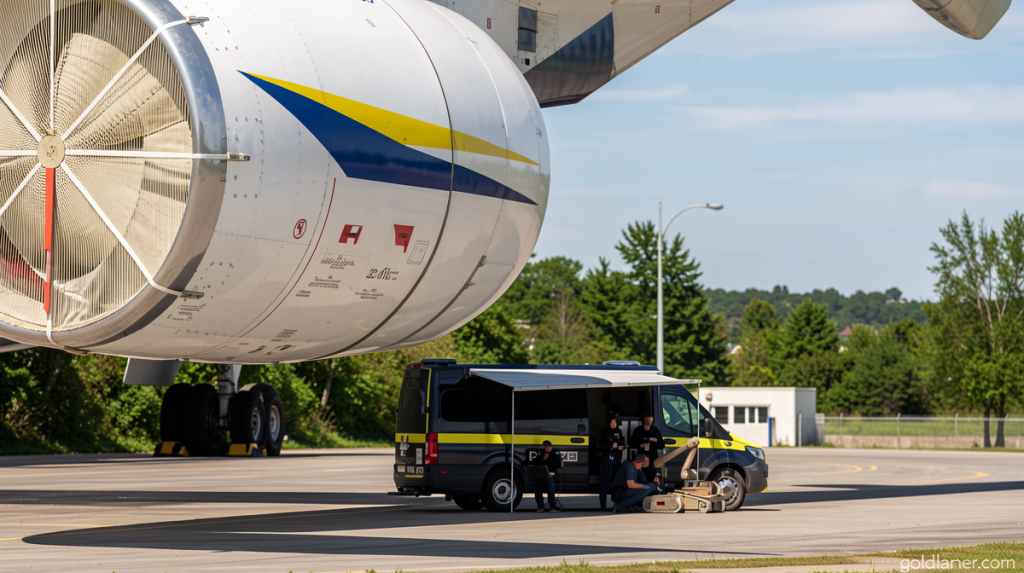
On August 5, personnel inside the secured perimeter of Leipzig/Halle Airport detected an unmanned aerial vehicle resting near the south runway — the strip dedicated to freight operations. A bomb-disposal robot was brought to the site, and technicians carefully detached the detonator mechanism from the craft. Photographs released afterward showed the robot positioned in close proximity to a Ukrainian cargo aircraft parked nearby.
A US defense official stationed in Europe confirmed to reporters that the drone carried military-grade explosives and that Washington’s assessment attributes it to a Russian intelligence service. The same day, a second airborne object struck a freight plane in the vicinity of the airport, inflicting minor structural damage; that aircraft completed its flight and landed without further incident in Hannover.
German media subsequently reported that a third drone was located in a field roughly a week after the initial discovery, fueling speculation that the operation may have involved multiple craft deployed in sequence. The German Federal Prosecutor’s Office, which has opened a formal investigation, declined to provide further detail, citing the ongoing nature of its inquiry.
Berlin’s Package of Countermeasures
In tandem with the threat-level upgrade, Foreign Minister Johann Wadephul directed the immediate closure of two Russian diplomatic and cultural presences: the consulate in Bonn and the Russian House cultural center in Berlin. The government also announced tightened screening procedures for Russian nationals seeking entry into Germany, a step that will affect thousands of travelers, students, and business visitors each year.
The measures collectively signal that Berlin now treats the Leipzig event not as an isolated curiosity but as evidence of a sustained campaign aimed at probing European airfields, logistics corridors, and communication networks.
Moscow’s Response
The Kremlin dismissed the accusation as a manufactured justification for anti-Russian policy. Maria Zakharova, spokeswoman for Russia’s foreign ministry, characterized the closure of the cultural center as long-overdue retribution.
“The Russian House has long haunted them,” Zakharova said. “That’s we were looking for something to latch onto. Moscow will respond to all anti-Russian decisions.”
She added that Germany had fabricated a “pretext” and warned that Moscow would answer any further measures in kind. The Kremlin did not provide substantive comment on the US intelligence assessment linking the drone to Russian services.
NATO Backs Berlin
Secretary General Mark Rutte publicly endorsed Germany’s steps, reaffirming the alliance’s commitment to Ukraine as “unwavering.” He stressed that NATO would continue strengthening its capacity to deter and defend every member against threats of every kind.
“NATO will continue to strengthen our ability to deter and defend all Allies against any threat – including malign actions like those seen in Leipzig,” Rutte stated.
The Airport’s Strategic Weight
Leipzig/Halle is among the continent’s highest-volume freight hubs, handling thousands of cargo flights annually. Its significance for Ukraine grew dramatically in the opening weeks of Russia’s full-scale invasion in 2022, when Moscow destroyed the Antonov Airlines home base at Hostomel, northwest of Kyiv. Since then, the Ukrainian carrier has operated from Leipzig, making the airport a critical lifeline for Kyiv’s military and humanitarian logistics. The proximity of the discovered drone to a Ukrainian aircraft parked on the apron has intensified the sense that the target was chosen with deliberate intent.
Dobrindt framed the event at the time as a qualitative jump in the threat environment.
“Drone sightings, drone threats including in a hybrid context, are something we know from the past. That a drone armed with explosives is at an airport is a new threat scenario,” he said.
A Wider Pattern of Covert Pressure
Western intelligence services have repeatedly linked Russia to a catalogue of apparently disconnected incidents across Europe: arson at warehouses and transit depots, high-profile cyber intrusions into government and corporate networks, GPS interference over Baltic and North Sea approaches, and physical sabotage of undersea telecommunications cables, rail junctions, and logistics centers. Each episode individually invites debate; taken together, they sketch a campaign of sustained pressure designed to test allied cohesion without crossing the threshold of open conflict.
Washington has cautioned that Moscow may seek to push further. According to three sources familiar with recent US intelligence assessments, President Vladimir Putin could attempt a limited strike on an allied territory within the coming years specifically to gauge NATO’s willingness to invoke collective defense. The Kremlin, when approached for comment on both that assessment and the Leipzig attribution, offered no substantive reply.
For European governments already stretched thin by years of supporting Ukraine’s defense, the Leipzig episode crystallizes a dilemma: how to deter a neighbor that operates below the threshold of declared war while avoiding the very escalation that covert operations are designed to provoke. Germany’s decision to name Russia, close its diplomatic facilities, and raise its threat posture suggests Berlin has concluded that ambiguity itself has become a form of concession.
Related Reading
Frequently Asked Questions
What is Germany blames Russia for drone attack?
Germany blames Russia for drone attack is the main topic of this guide. The article explains the context, practical details, and next steps readers should understand.
Why does Germany blames Russia for drone attack matter?
Germany blames Russia for drone attack matters because readers are looking for a useful answer, not just a short summary. Good content should match search intent and help them decide what to do next.