
Germany and France drop joint fighter jet project
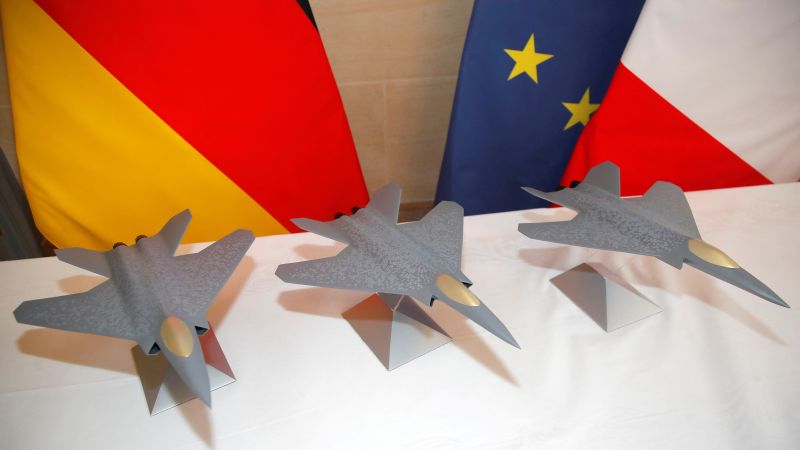
Germany and France drop joint fighter jet project
Germany and France drop joint fighter – Germany and France have decided to end their ambitious collaboration on a new-generation fighter jet, according to officials. The partnership, once seen as a cornerstone of European defense innovation, is now being abandoned due to persistent industrial disputes. The decision was reached after months of deadlock between key aerospace firms, with leaders citing the inability to reconcile competing interests. This marks a significant shift in the region’s military strategy, as the two nations now face the challenge of aligning their defense priorities without a unified platform.
The move came during discussions at the EU-Western Balkans summit in Montenegro, where German Chancellor Friedrich Merz and French President Emmanuel Macron addressed the stalled initiative. Officials stated that the two leaders concluded there was no immediate hope of resolving the conflicts between Airbus, representing Germany and Spain, and Dassault Aviation, France’s primary defense contractor. As a result, Merz has recommended that Macron abandon further development of the joint fighter aircraft, a decision that has drawn mixed reactions from stakeholders.
Ambition and Ambiguity
The project, known as Future Combat Air System (FCAS), had been a flagship effort to modernize Europe’s aerial defense capabilities. Initially launched in 2017 by Macron and former German Chancellor Angela Merkel, it aimed to create a sixth-generation fighter jet integrated with drones and a classified network called the “combat cloud.” This system was designed to enable real-time coordination between manned and unmanned aircraft, positioning Europe as a leader in next-generation military technology. However, the partnership’s collapse has left the project in limbo, with its future uncertain.
Macron’s office emphasized that the decision was not made lightly, noting the extensive discussions between the two leaders. They described the partnership as a vital component of Franco-German defense cooperation, which they argued was essential for maintaining Europe’s strategic autonomy. Despite these efforts, the inability to harmonize technical specifications and control over the project has led to its termination. The 100-billion Euro budget, once a symbol of European unity, now risks being scattered across separate initiatives.
Compromise and Continuity
Officials have hinted at a symbolic compromise to preserve some level of continuity. A European source indicated that the core systems, such as the “combat cloud,” might continue under the FCAS umbrella even if the manned fighter jet is scrapped. This approach allows Macron to retain the project’s name while acknowledging the breakdown in cooperation. While the FCAS designation is generic and not exclusive to this plan, it serves as a way to maintain momentum without fully abandoning the initiative.
The decision to end the core fighter jet project has raised concerns among defense analysts. Douglas Barrie, a senior fellow at the International Institute for Strategic Studies (IISS), remarked that the outcome sends “hardly ideal signaling” to both Washington and Moscow. The US, already pushing for Europe to bolster its military readiness, may view the move as a setback in its efforts to strengthen alliances. Meanwhile, Russia’s growing influence in the region could benefit from the reduced coordination among European powers.
Industry Rivalries and Strategic Divergence
The industrial conflict between Airbus and Dassault Aviation has been a major obstacle. Airbus, with its extensive manufacturing network, has long been a key player in European defense programs, while Dassault, a French firm, has championed its own vision for the aircraft. The disagreements have centered on control of the next development phase, access to intellectual property, and differing technical requirements. These disputes reflect deeper strategic divergences, with Germany prioritizing its role as an aviation hub and France emphasizing national sovereignty in defense matters.
Merz, who has questioned the necessity of a nuclear-capable fighter jet for Germany’s air force, has expressed doubts about the project’s viability. He argued that the country did not require a carrier-qualified aircraft, given its current capabilities and the budget constraints of the program. This sentiment has been echoed by the IG Metall union, which welcomed the decision as a relief for workers. “I would like to thank Friedrich Merz for this difficult but necessary decision, which is in the interests of Germany as an aviation hub and of the workforce,” said Jürgen Kerner, Deputy Chairman of IG Metall.
The breakdown in the project mirrors past tensions between France and Germany, particularly in the 1980s when France withdrew from the Eurofighter program. The current situation highlights the ongoing challenges in aligning European defense priorities, especially as the continent grapples with underinvestment in military infrastructure. Analysts suggest that the split could have long-term implications for the region’s ability to compete with global defense giants like the US and Russia.
Broader Implications for European Defense
With the core fighter jet project terminated, European nations now face the task of re-evaluating their defense strategies. The failure to unite under a single initiative has exposed the difficulties of creating a cohesive military program across diverse industrial and political interests. While France continues to push for the development of its own systems, Germany’s focus on the aviation sector may lead to a different trajectory. This divergence could weaken Europe’s collective response to emerging threats, particularly in light of Russia’s military buildup and the need for a robust defense posture.
Despite the setback, Macron remains committed to advancing European aerospace capabilities. He has defended the project for months, framing it as a necessity for strengthening alliances and technological independence. The decision to end the core fighter jet, however, has left the door open for future collaboration on peripheral systems. As the EU-Western Balkans summit concluded, discussions on the next steps for FCAS were expected to continue, with an emphasis on salvaging parts of the initiative rather than starting from scratch.
Looking Ahead
As the dust settles on this partnership’s collapse, the question remains: what does the future hold for European defense cooperation? With the core fighter jet no longer a shared endeavor, each nation may pursue its own priorities, potentially leading to fragmented efforts. This outcome could also influence the broader European defense landscape, as other countries weigh their participation in similar programs. The challenge for Europe is not just in developing advanced military technology but in fostering the unity required to do so in an increasingly competitive global arena.
Experts like Francis Tusa, a UK-based defense analyst, have noted that the project has been on “life support” for three years, with its survival dependent on the willingness of both nations to compromise. The recent decision to end the partnership underscores the persistent difficulties in achieving consensus. While the FCAS name may endure, its significance as a unified European project has diminished. This marks a pivotal moment for the continent’s defense industry, with implications for future collaborations and the ability to respond to evolving security challenges.
