
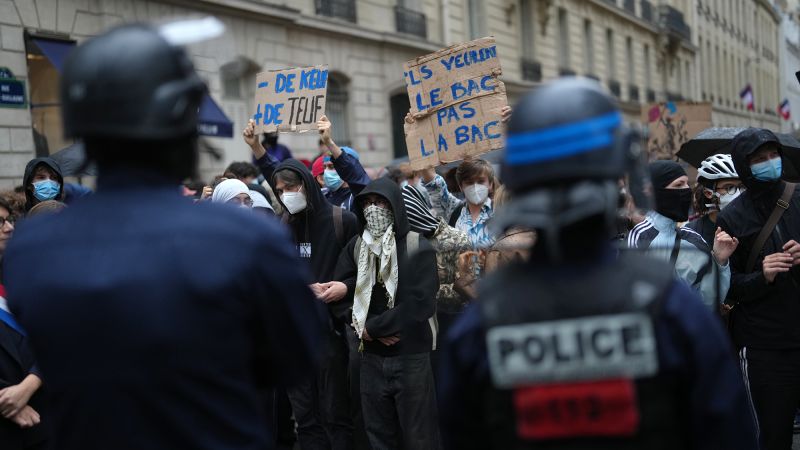
France’s Student Protests Put Pressure on Government to Show It Is Listening
Goldlaner.com – France’s government is trying to ease tensions after a forceful response to student demonstrations triggered anger across the country. Officials have promised a more restrained policing approach, new opportunities for students to voice concerns and modest additional education funding. Yet continuing school blockades and fresh strike calls suggest many young protesters remain unconvinced.
The shift followed days of demonstrations in which students demanded better learning conditions, more staff, smaller classes and school buildings equipped for changing climate conditions. The unrest took on greater urgency after a teenager lost a hand during protests on Monday in an incident involving the type of stun grenade now barred from use by police.
A revised approach to policing
Interior Minister Laurent Nunez said police had been instructed not to use the grenade associated with the injury. He also said officers dealing with teenage protesters should use a different approach from the one applied to adult movements.
“We don’t deal with a movement of highschoolers like we deal with a movement of adults,” Nunez said.
Following an emergency government meeting, Nunez said President Emmanuel Macron had urged police to combine order maintenance with greater care and explanation when confronting students. The interior minister said officers should intervene in cases of serious violence, but in the most proportionate way possible.
“The president recalled the necessity to maintain order, intervene each time there’s serious violence, all while asking us to act with the greatest proportionality,” Nunez said.
The government has rejected accusations that it has repressed the student movement. Prime Minister Sebastien Lecornu condemned violence occurring around some protests while emphasizing that most of Tuesday’s demonstrations were peaceful. At the same time, 18 inquiries into officers’ conduct have been opened by internal police investigators. Nunez said the reviews would consider whether force used by officers was proportionate.
“Police forces are there to protect the high schoolers,” he said.
Schools given time for debate
Lecornu has announced that high schools will set aside regular teaching until the end of the week for what he described as a period of internal democracy. The aim is to give students space to air grievances and discuss potential responses within their schools.
In a national address on Wednesday, the prime minister said lawmakers would examine a budget plan on November 12 containing 64 billion euros, or $71.6 billion, for education. The proposal represents a small increase from the previous year.
He also outlined five initiatives intended to answer student concerns. They include plans to renovate school premises, improve timetables and create more channels through which young people can make their views known.
“We have a duty to listen to them. Taking young people seriously means supporting their engagement just as much as sharing the difficulties, but also the constraints, with them,” Lecornu said.
Public consultation has been a familiar response during Macron’s presidency. In 2019, his administration used a broad listening effort while attempting to defuse the Yellow Vests protest movement. Such exercises can create a route for public concerns to reach policymakers, but their success depends on whether participants see concrete changes afterward.
Blockades persist despite a decline
The scale of school disruption fell on Wednesday, though it remained substantial. More than 500 educational institutions were expected to be fully or partly closed because of blockades, a decline of 41% from Tuesday. The education ministry said 86% of schools would remain open.
Tuesday had brought a much larger national mobilization, with hundreds of thousands of people joining workers’ union marches in support of students. Authorities detained 488 people around the high school protests that day. By Wednesday, the blockades represented only part of the previous day’s wider turnout, but their continuation showed that resentment had not disappeared.
Student groups have scheduled another national protest day for October 17. Five major teaching unions also said they would strike on Thursday in solidarity with students. That combination raises the prospect of further disruption even as the government seeks to lower the temperature.
Students seek larger investment and structural change
At the center of the movement is a demand for a stronger, more adequately resourced education system. Student union leaders have called for a 10-billion-euro, or $11.2-billion, investment covering high schools and universities.
A 10-point platform prepared by student unions goes beyond immediate staffing issues. It calls for a reassessment of student workloads, an end to the disputed university admissions system, an end to police violence against students and more student housing. The breadth of those demands helps explain why a limited set of government initiatives may not settle the dispute quickly.
Sabrine Kharbach, spokesperson for the Student Union federation of unionized students, said blockades would continue until the movement’s demands were met. Anaïs Ella, spokesperson for the student association Les Lycéens, said Lecornu had not addressed the priorities set out by student unions.
Ella also argued that some of the government’s proposals, including filling teaching vacancies in classes preparing for examinations, should be treated as a basic responsibility rather than a major concession. Her criticism reflects a wider concern among protesters: they are seeking not simply emergency measures, but lasting improvements in how schools are staffed, maintained and governed.
The coming days will test whether the government’s promise of dialogue can build trust with students who feel their concerns have been neglected. Banning the disputed grenade and opening space for debate may reduce immediate pressure, but the movement’s demands point to a deeper conflict over investment, safety and the place young people should have in decisions affecting their education.
Related Reading
Frequently Asked Questions
What is French leaders say they re listening?
French leaders say they re listening is the main topic of this guide. The article explains the context, practical details, and next steps readers should understand.
Why does French leaders say they re listening matter?
French leaders say they re listening matters because readers are looking for a useful answer, not just a short summary. Good content should match search intent and help them decide what to do next.