
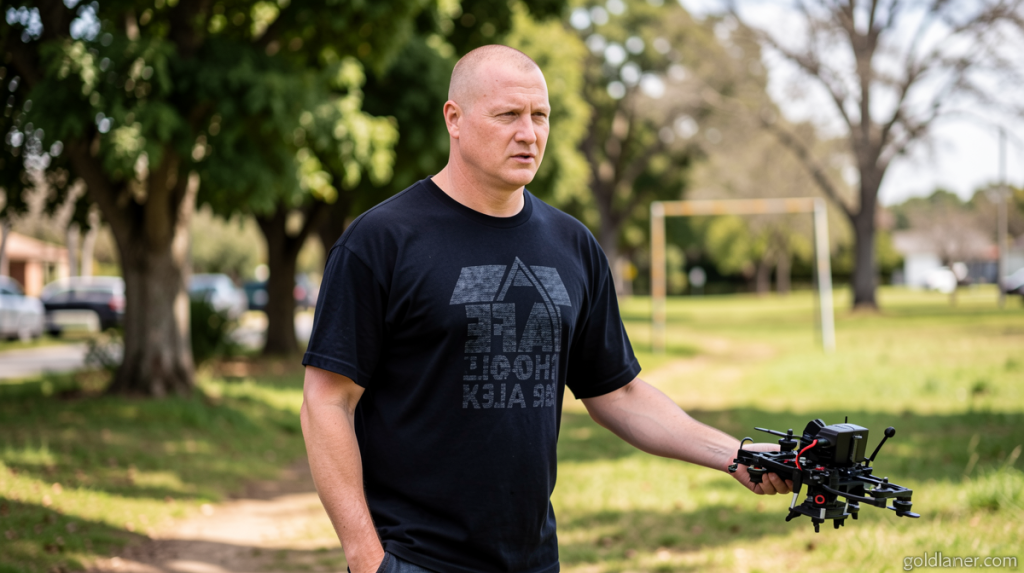
A Billion-Dollar Shield: How Remote-Launched Drones Are Entering American Classrooms
Goldlaner.com – The American school-safety apparatus now swallows an estimated three to four billion dollars every year, according to Justin Marston, co-founder and chief executive of Campus Guardian Angel. That figure encompasses everything from armed resource officers stationed in hallways to metal detectors at entry points and, increasingly, small autonomous aircraft designed to reach a shooter before police can. The Urban Institute, a Washington-based think tank, calculated that school resource officers alone consumed $2.62 billion in fiscal year 2023. Layered on top of that spending sits a newer, faster category of intervention: compact drones that can be fired through a window, sweep a classroom, and communicate with teachers and responding officers through a built-in speakerphone — all within roughly sixty seconds of launch.
What the drones actually do
Marston describes the devices as essentially a “lump of plastic,” yet their operational profile is anything but trivial. Once deployed, they can breach a window pane, navigate interior spaces, and deliver real-time visual intelligence to law enforcement via mounted point-of-view cameras. Their primary tactical function is to disorient and incapacitate an armed individual long enough to buy time for responders. The embedded audio link allows a teacher or dispatcher to speak directly to the person in the room, potentially de-escalating a situation without a single officer crossing a threshold.
“I think every parent will want to feel that there is some type of capability at their child’s school to confront and stop an active shooter threat versus having to wait the five to eight minutes for the police to get there,” Marston said.
That five-to-eight-minute window is the gap these systems are engineered to close. In a district where the nearest patrol unit is several miles away, a drone can be airborne before the first shot echoes down a corridor.
Where they are flying now
Three counties in Florida currently operate the drones, with state allocations contributing more than one million dollars toward the program. Five schools in Georgia have received them under funding approved by the state legislature. This month marks the first deployment in Colorado, and Marston indicated that Texas districts have expressed interest and are exploring financing pathways. Each of those four states carries the memory of a high-profile campus massacre: Parkland, Apalachee, Uvalde, and Columbine.
The Colorado site selected for the initial rollout sits in the same county as a school where, in 2019, two shooters killed one student and wounded eight others. The proximity is not coincidental; district officials are treating the technology as a direct response to a wound that has never fully closed.
The shooting that turbocharged the industry
Jennifer DePaoli, a senior researcher at the Learning Policy Institute, an education research and policy advocacy nonprofit, identifies the June 2018 massacre at Marjory Stoneman Douglas High School in Parkland, Florida, as the inflection point. Seventeen students and faculty members were killed. In the months that followed, states injected at least $960 million into student-safety initiatives, according to The 74, a nonprofit news organization focused on American education. What had been a patchwork of voluntary measures became, almost overnight, a federally and state-funded procurement pipeline.
Parents who lost children in mass shootings have been the most persistent engine behind that pipeline. Their advocacy transformed grief into policy, and policy into budget lines. The result is an industry that now spans hardware, software, staffing, and architecture — and that continues to grow as each new incident exposes another gap.
Parent-written law and the limits of hardening
One of the most visible parent-driven outcomes of Parkland is Florida’s Alyssa’s Law, named for Alyssa Alhadeff, a fourteen-year-old student killed in the shooting. Her parents helped draft the statute, which mandates that public schools install a silent panic-alarm system wired directly to local law enforcement. Proponents argue the system can shave critical seconds off a response time during gun violence or a medical emergency. Lori Alhadeff, Alyssa’s mother, now campaigns nationally for adoption of equivalent systems. Twelve other states — New Jersey, New York, Texas, Tennessee, Utah, Oklahoma, Louisiana, Georgia, Washington, Oregon, Virginia, and West Virginia — have since enacted their own versions.
Alyssa’s Law is one thread in what security planners call “school hardening”: the physical fortification of campus environments. Metal detectors, automatic door locks, and surveillance cameras have been standard fixtures in schools across the country for years. Yet the record shows these measures are not impervious. Students have walked past malfunctioning detectors or simply entered through an unlocked side door. In January 2025, AI-powered gun-detection software — among the newest layers of the hardening stack — failed to flag a student’s weapon before he killed a sixteen-year-old girl at a Nashville school and then fatally shot himself, district officials confirmed at the time.
The lesson drawn from that failure, and from the broader pattern, is that no single technology is sufficient. Drones do not replace officers, alarms, or trained staff; they occupy a narrow slice of the response timeline. What they offer is speed — sixty seconds of autonomous presence in a space where human responders cannot yet arrive. Whether that slice is enough to change an outcome depends on the geometry of the building, the number of shooters, and whether the device is launched before the first round is fired. For the districts now wiring their budgets around the question, the calculus is simple: the cost of a drone program is a fraction of one life, and the industry’s billion-dollar scale reflects how many families have already decided the math.
Related Reading
Frequently Asked Questions
What is Drones are the latest buzzy tech?
Drones are the latest buzzy tech is the main topic of this guide. The article explains the context, practical details, and next steps readers should understand.
Why does Drones are the latest buzzy tech matter?
Drones are the latest buzzy tech matters because readers are looking for a useful answer, not just a short summary. Good content should match search intent and help them decide what to do next.