
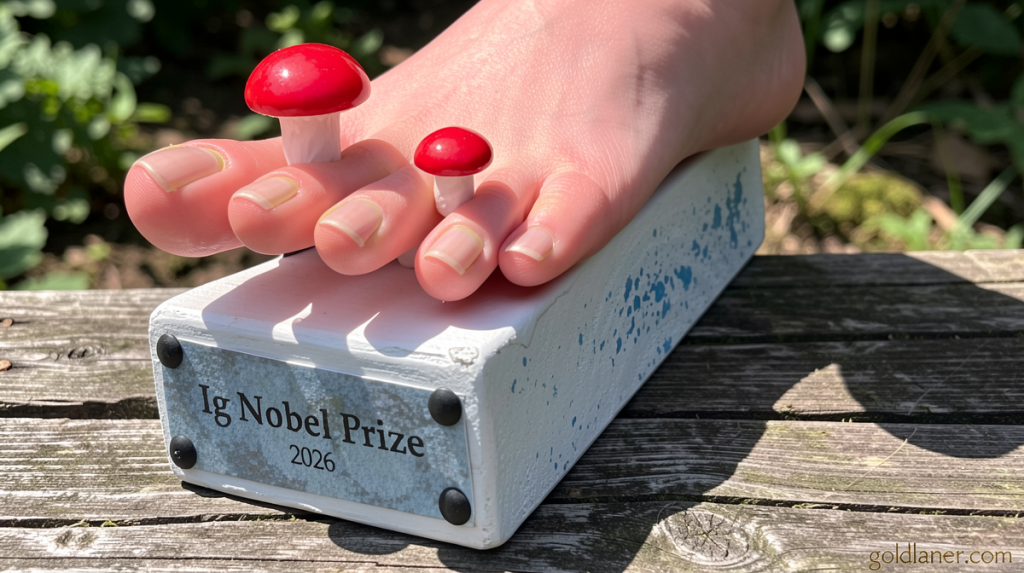
The 2026 Ig Nobel Awards Celebrated Fungi, Frogs, and the Absurd Side of Science
Goldlaner.com – In Zurich this past Thursday, a gathering of scientists, Nobel laureates, and curious onlookers turned their attention to an unlikely subject: mushrooms. The 36th annual Ig Nobel ceremony, staged under the banner of “fungi,” marked another year in which the world’s most improbable scientific achievements were formally recognized. Organized by the publication Annals of Improbable Research, the event has long served as a deliberate parody of the Nobel Prizes, honoring work that, in the words of its organizers, “first make people laugh, and then make them think.”
A Ceremony Built on Absurdity
The Zurich program followed the now-familiar ritual of attendees launching paper airplanes into the auditorium ceiling. But this year’s edition added a theatrical flourish: a newly composed operatic number about fungi, delivered by actual Nobel laureates costumed as mushrooms. The juxtaposition of elite scientific recognition with fungal cosplay underscored the event’s central premise — that rigorous inquiry need not look like a pharmaceutical laboratory to be worthy of celebration.
Ten distinct research projects received recognition across categories spanning economics, chemistry, medicine, biomechanics, physics, technology, and others. One of the honored studies examined venomous snakes by having researchers gently step on various regions of the reptile’s body to determine precisely which pressure points trigger a bite aimed at a human. The finding, while seemingly trivial, addresses a genuine gap in herpetological safety protocols.
Economics, Chemistry, and the Nose
The economics category went to a study documenting that individuals from upper socioeconomic classes were statistically more likely to pilfer sweets from a child’s supply and to commit other small acts of unethical behavior. The chemistry prize recognized work demonstrating that cockroach milk packs roughly three times the caloric energy of bovine milk — a finding with potential implications for alternative protein sources in resource-constrained settings.
In medicine, the award went to a paper titled “How to Blow the Nose — An Aerodynamic Study of the Nose Blowing,” which applied fluid-dynamics principles to the mechanics of nasal exhalation. The biomechanics prize, meanwhile, was granted to researchers who traced the evolutionary history of human kissing, examining how the behavior emerged and spread across species and cultures.
Matilda Brindle, an evolutionary biologist at the University of Oxford in England and co-author of the kissing study, spoke to the significance of such work in the current climate.
“Science has been under attack for a while now, and fields that are less obviously aligned with commercial industry and technology are increasingly deemed to be less important. Of course, applied research is vital, but it would be a grave loss if we stopped looking at the world around us and asking ‘why?’. Curiosity for its own sake is fundamental to how science moves forward.”
Physics, Technology, and the Mosquito Nozzle
The physics award recognized engineering work on designing urinals that eliminate splash-back — a problem long familiar to anyone who has shared a public restroom. The technology prize went to a far stranger project: researchers who fashioned functional 3D-printing nozzles from the proboscises of dead mosquitoes, a process they termed “necroprinting.”
Changhong Cao, associate professor in the department of mechanical engineering at McGill University in Canada and co-author of the necroprinting study, framed the work as an exercise in open-ended inquiry.
“Nobody sets out planning to build a 3D printing nozzle from a mosquito. We got there by paying close attention to something that seems irrelevant, and staying open to where it leads.”
Cao added that the Ig Nobel platform “help legitimize … exploratory thinking,” giving researchers permission to pursue questions that might otherwise be dismissed as too whimsical for a grant application.
Why the Silly Science Matters
Carly Anne York, an associate professor of biology at Lenoir-Rhyne University in Hickory, North Carolina, who was not connected to this year’s ceremony, offered an outside perspective on the awards’ broader significance. York, who authored the book The Salmon Cannon and the Levitating Frog: And Other Serious Discoveries of Silly Science, noted that the Ig Nobels “never fail to highlight research that makes you ‘laugh, and then think.'”
“From dirty underpants for soil science to 3D mosquito models, this year’s award winners took seemingly far-fetched ideas and turned them into legitimate research projects. And yes, these are legitimate scientific endeavors.”
York pointed to a sobering statistic: roughly half of all economic growth in the United States can be traced back to discoveries originating in basic, curiosity-driven research. The mosquito-mouth 3D model, she suggested, might one day inspire a painless method of drug delivery. “What we do know, however, is that gaining knowledge is never a frivolous endeavor, no matter how silly the topic may seem,” she concluded.
The Ig Nobel tradition, now in its thirty-sixth year, continues to occupy a singular niche in the scientific calendar: a reminder that the boundary between the profound and the preposterum is thinner than most funding panels would like to admit.
Related Reading
Frequently Asked Questions
What is Candy stealing nose blowing and splash?
Candy stealing nose blowing and splash is the main topic of this guide. The article explains the context, practical details, and next steps readers should understand.
Why does Candy stealing nose blowing and splash matter?
Candy stealing nose blowing and splash matters because readers are looking for a useful answer, not just a short summary. Good content should match search intent and help them decide what to do next.