
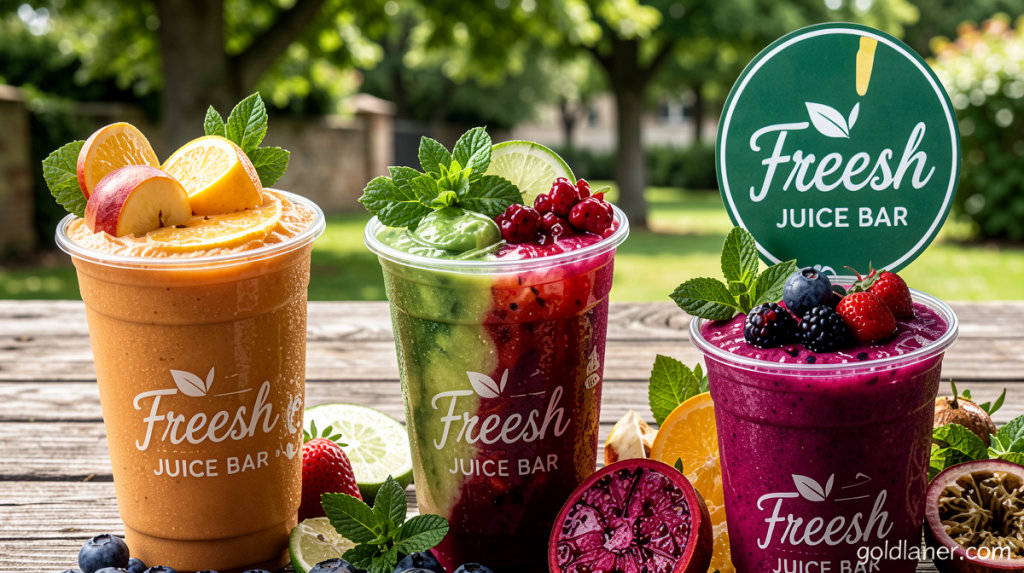
Why AI-Generated Food Photos Are Making the Internet Sick
Goldlaner.com – A wave of grotesque, hyper-saturated images plastered across restaurant menus and street-food stalls has turned into one of the internet’s most reliably disgusting viral trends. What began as isolated screenshots shared by confused diners has snowballed into a global conversation about where the line sits between helpful marketing and something that makes people want to throw up. The trigger is simple: generative artificial intelligence has flooded the food-service industry with menu imagery that looks, at a glance, almost right — and then, on closer inspection, deeply wrong.
The Hollywood Night Market Incident
The latest flashpoint came from Los Angeles in late August. Adaeze Onejeme, a 28-year-old advertising sales professional, was walking through a Hollywood night market with her sister when the pattern became impossible to ignore. Stall after stall — French fries, taquitos, blended drinks — displayed menu cards whose photographs carried an unmistakable synthetic sheen. The textures were too smooth, the colors too electric, the geometry of every item suspiciously uniform.
“I was like, ‘Those don’t look like chicken nuggets. Those don’t look like typical food that we eat,'” Onejeme recalled.
She pulled out her phone, recorded short clips of several affected vendors, and posted them to TikTok. The response was immediate and visceral. Rather than patronize any of the AI-adorned stalls, Onejeme walked past them and bought plain fries and lemonade from a neighboring vendor that still photographed its actual product. Her frustration captured a sentiment now circulating across social platforms:
“Not too long ago, people would just take a picture of the food and that would be on the menu. Now, these AI-generated pictures — the saturation, the coloring, the texture. It’s like you don’t even know what you’re going to get when it comes out. At that point, is it false advertising?”
The Psychology of the Repulsive Plate
The reaction is not merely aesthetic preference. Alexander Diel, a psychologist at Germany’s University of Duisburg-Essen, leads a research team examining how the public responds to machine-generated food imagery. His explanation centers on a deep evolutionary wiring: food sits at the intersection of pleasure and survival threat, so the brain scrutinizes every visual cue for signs of spoilage, contamination, or deception.
“Food is important to us,” Diel explained. “At the same time, it’s something that can easily make us sick, so we are very sensitive to when something is even slightly off.”
That hypersensitivity means a menu photo that drifts even a few degrees from photorealism can trigger the same alarm bells as a genuinely spoiled dish. The result is a category of marketing that, instead of stimulating appetite, actively suppresses it. Online commentators have coined the phrase “AI slop menus” to describe the phenomenon, and the term has stuck with a force that suggests it captures something real about the low-effort, low-quality output these tools can produce when wielded without editorial judgment.
A Global Gallery of Grotesques
The problem is not confined to American street food. In Tokyo, a sandwich advertisement features a bagel whose crumb structure resembles spun cobweb, stuffed with a tuna salad that appears to have been extruded from a pastry piping bag. In Kuala Lumpur, a bowl of spaghetti marinara reads as neatly coiled yarn or strings of modeling clay. In Berlin, a lunch billboard displays a quiche with visible air pockets and a penne pasta that looks molded from soft rubber.
Julia Damphouse, a 30-year-old tour guide based in Berlin, first noticed the offending billboard earlier in the summer but only photographed it last month, after the image had already begun circulating online. Her assessment was blunt:
“I see a lot of AI food and it just looks a bit shiny and strange, but there’s something particularly alien and wrong with this one. There is something wrong with it. It looks too geometric. I imagine that’s it’s like if you take acid and food stops looking like food.”
The Uncanny Valley, Applied to Dinner
The discomfort these images provoke maps neatly onto a concept first articulated in 1970 by Japanese roboticist Masahiro Mori: the uncanny valley. Mori described the dip in human comfort that occurs when a synthetic figure or object approaches — but does not fully reach — lifelike fidelity. The near-miss produces unease, revulsion, or both. Food photography, it turns out, is subject to the same gravitational pull. A plate rendered at ninety percent realism can be more disturbing than one rendered at fifty, because the brain locks onto the gap and fills it with dread.
Some of the most widely shared examples, however, do not merely graze the valley’s edge. They plunge into it. Sam Biddle, a technology reporter at The Intercept, photographed a deli menu in August that advertised a shrimp scampi dish. The “shrimp” in the image were circular, bulbous creatures that Biddle later likened to monsters from the fiction of H.P. Lovecraft.
“It stopped us in our tracks,” Biddle said. “It wasn’t just unappetizing — which, you know, it is — but it was also sort of spiritually unsettling and cosmically unnerving.”
Why Restaurants Are Turning to the Machine
The proliferation of these images does not occur in a vacuum. Operating a restaurant in 2026 means navigating rising ingredient costs, labor shortages, and unpredictable foot traffic. Industry surveys indicate that 42 percent of operators reported their establishments failed to generate a profit during 2025. In that climate, a free or near-free AI image generator offers an attractive shortcut: no photographer, no studio fee, no licensing negotiation. The trade-off, as diners increasingly discover, is that the shortcut produces imagery that erodes trust rather than building it. A menu photograph that misrepresents the dish’s appearance, texture, or composition sits uncomfortably close to the legal and ethical territory of false advertising — a question Onejeme raised and that regulators have yet to answer with clarity.
For now, the internet’s verdict is unanimous and visceral: the plate looks wrong, the appetite dies, and the nearest vendor with a real photograph of a real burger wins the customer. The uncanny valley, it seems, has a very specific flavor — and nobody wants a taste.
Related Reading
Frequently Asked Questions
What is Appalling AI menu pictures keep going?
Appalling AI menu pictures keep going is the main topic of this guide. The article explains the context, practical details, and next steps readers should understand.
Why does Appalling AI menu pictures keep going matter?
Appalling AI menu pictures keep going matters because readers are looking for a useful answer, not just a short summary. Good content should match search intent and help them decide what to do next.