
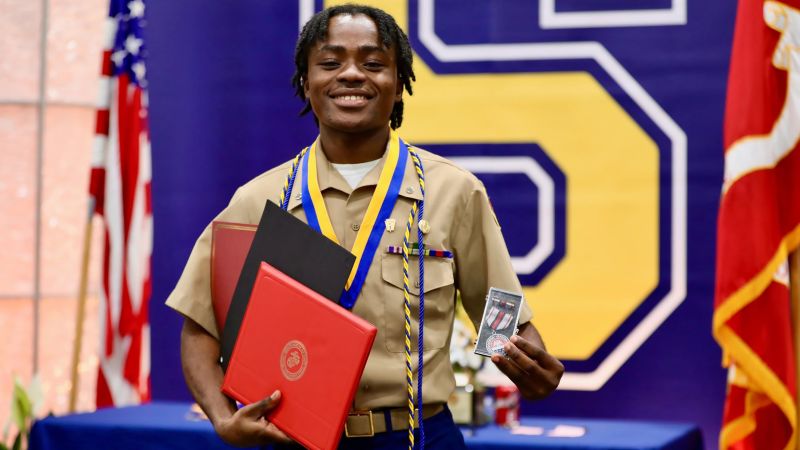
Wright State freshman Pierre Damas Bel dies after weeks of distress over ICE ankle monitor
Goldlaner.com – A 20-year-old Haitian immigrant who had just begun his freshman year at Wright State University in Ohio was found dead on a highway shoulder Monday morning, his family says, after weeks of mounting anguish over a government-issued ankle monitor that, they allege, isolated him from teammates, classmates, and the routines of campus life. The Ohio State Highway Patrol confirmed that Bel exited his Toyota Avalon on the shoulder of Interstate 70 and walked into westbound traffic. The agency’s investigation into the circumstances of his death remains open, though his family has been told he took his own life.
Bel had arrived at Wright State with clear academic ambitions, planning to pursue a degree in neuroscience. Before college, he was a standout soccer player at his Springfield, Ohio, high school and an active participant in the Junior Reserve Officers’ Training Corps, a military-sponsored program that gives students leadership training and physical conditioning. Friends and relatives describe a young man who was energized by the prospect of university life.
The final phone call
On the morning of his death, Bel placed a video call to his father, Pierre Ronal Bel, who was living in Haiti. The conversation, relayed through a written family statement, captured a young man in visible distress.
“He said, ‘Dad, I’m not feeling ok. I’m not thinking right … because of the bullies,’ and I told him, ‘Come home so that we can talk,'”
Minutes later, highway patrol records show Bel pulling over and stepping into the path of oncoming trucks. His father received the news at his own front door.
“Police showed up at my door,” Pierre Ronal Bel said, “to report that my son had thrown himself under a truck.”
How the monitor reshaped daily life
In late July, Immigration and Customs Enforcement fitted Bel with an electronic ankle monitor while his immigration case continued through federal proceedings. The device, a small bracelet-like unit that tracks location and alerts agents if the wearer strays from approved zones, became the focal point of what his family describes as a rapid psychological decline.
Family members say the monitor prevented him from participating in soccer practice, barred him from receiving a new ROTC uniform during a class distribution, and drew mocking from fellow students who noticed the hardware strapped to his leg. On the Friday before his death, Bel told his father that something in ROTC class had broken him emotionally.
“He told me, ‘Dad, I felt humiliated … Everyone got uniforms, except for me, because of the bracelet,'”
The accumulation of small humiliations, combined with the constant physical reminder of his immigration status, left him withdrawn and increasingly isolated in the weeks before Monday.
A growing population under electronic surveillance
Bel’s case sits within a broader shift in how the federal government manages Haitian nationals in the United States. The Trump administration ended Temporary Protected Status, a designation that had allowed hundreds of thousands of Haitians to work legally and shielded them from deportation. With TPS revoked, many former beneficiaries now face removal proceedings, and ICE has expanded its use of ankle monitors as an “alternative to detention” for people who remain in the country while their cases are adjudicated.
Immigrant-rights groups have pointed to Bel’s apparent suicide as evidence that the monitors carry psychological costs beyond their intended function of tracking location. Advocates argue that the devices mark wearers as outsiders in everyday settings — classrooms, locker rooms, dining halls — and that the stigma they attach can compound existing anxiety about deportation.
ICE response
ICE confirmed that Bel applied for admission into the United States at Brownsville, Texas, in March 2024 and was released into the country under the Biden administration. The agency issued the ankle monitor on July 29 while his immigration proceedings continued.
Asked directly about reports that the student died by suicide after enduring bullying tied to the device, an ICE spokesperson issued a written statement noting that the highway patrol’s investigation was still underway.
“ICE does not comment on the cause of death while that investigation is pending, and we will not speculate about unverified claims regarding other individuals,”
The spokesperson reiterated the administration’s position that undocumented residents may choose to depart voluntarily.
“Remaining in the country illegally, while fighting removal, is a choice. Leaving with a free flight home and $2,600 is also a choice,”
The statement closed with a declaration that ICE would continue employing detention or alternatives to detention for what it termed “illegal aliens who stay in violation of the law.”
Campus and community reaction
Wright State University issued a statement on its Facebook page acknowledging the loss. The university did not address the bullying allegations directly but confirmed that counseling and support services had been made available to students, faculty, and staff.
“The safety and well-being of our students is the highest priority, and we remain dedicated to providing a campus community where every student feels safe, supported, included and welcomed,”
University President Sue Edwards described the campus as heartbroken.
“Pierre was an active honors student who was passionate about soccer and was already actively engaged in his classes and the campus community,”
She added that the university mourned Bel and extended its deepest condolences to his family, friends, and loved ones “during this unimaginably difficult time.”
In Springfield, local faith leaders called for an end to the monitoring program. Pastor Carl Ruby of the Central Christian Church spoke at a Tuesday news conference, framing Bel’s death as a direct consequence of federal policy.
“Pierre died as a result of policy. And it’s our immigration policy that took his life,”
Ruby urged Republican lawmakers to speak publicly and
“put an end to the shackling program before other people end up taking their lives.”
As the highway patrol continues its inquiry, Bel’s family and community allies say the question is no longer only about one student’s death but about what electronic surveillance means for the hundreds of thousands of Haitians now living under the shadow of revoked protections, monitored wrists, and the ever-present possibility of removal.
Related Reading
Frequently Asked Questions
What is An Ohio college student died?
An Ohio college student died is the main topic of this guide. The article explains the context, practical details, and next steps readers should understand.
Why does An Ohio college student died matter?
An Ohio college student died matters because readers are looking for a useful answer, not just a short summary. Good content should match search intent and help them decide what to do next.