
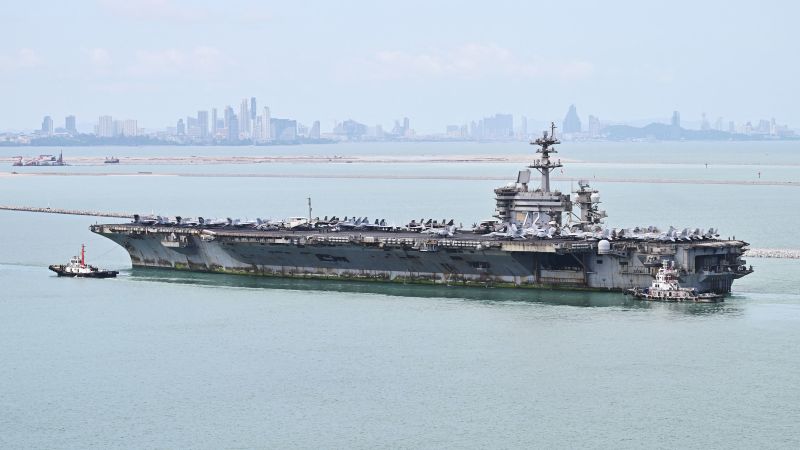
Aircraft Carrier USS Abraham Lincoln Returns to Port
Goldlaner.com – The aircraft carrier USS Abraham Lincoln slipped into Thailand’s Laem Chabang naval facility on Wednesday, ending a deployment of more than eight months in the Middle East. Departing San Diego the prior November, the 100,000-ton vessel had already logged what is emerging as one of the longest continuous wartime assignments in U.S. Navy history. The ship is slated to rejoin its home port in Southern California later this year.
For the roughly 5,000 sailors aboard, the docking represented far more than a routine maintenance stop. It closed a period of sustained combat and blockade operations against Iran that, according to U.S. Sen. Richard Blumenthal, set a modern benchmark for consecutive days spent at sea under active wartime conditions.
Crew Welfare and Congressional Pressure
Concerns about life aboard the vessel surfaced long before it reached Thai waters. Congressional channels carried reports of dwindling supply stocks, contaminated drinking water, recurring plumbing failures, and a broader erosion of morale. At least one possible suicide attempt among the crew was also noted, sharpening the debate over how long a single warship can sustain a wartime tempo without breaking its people.
Blumenthal, a Connecticut Democrat on the Senate Armed Services Committee, pressed the issue in a letter to Defense Secretary Pete Hegseth and the acting secretary of the Navy. He described “serious concern” over the trajectory of deployment lengths and demanded concrete answers about daily conditions on board.
“There have been widespread reports of shortages of basic supplies, water contamination, plumbing issues, deteriorating mental health, deck safety concerns,” the senator wrote, adding that “disruptions in the mail system” had caused numerous care packages bound for the ship to vanish in transit for months.
Hegseth responded by declaring that conditions had been “completely misrepresented,” though he offered no itemized rebuttal to the specific complaints catalogued in the letter. President Donald Trump, asked whether the deployment had run too long, waved aside the concern entirely, remarking that the period at sea was “not nearly long enough.”
Strategic Ripple Effects Across Two Oceans
The extended stay in the Persian Gulf region carried consequences well beyond the ship itself. Once the crew-welfare story broke publicly, the Pentagon moved quickly to announce that the USS George Washington, normally based in Japan, would be redirected to the Middle East to relieve the carrier. The George Washington has since assumed station there alongside the USS George H.W. Bush, preserving a two-carrier posture while hostilities with Iran continue.
Critics noted that pulling the George Washington out of the western Pacific removed one of the Navy’s largest capital ships from the region where it had long served as a visible instrument of alliance reassurance and deterrence against China and North Korea. The episode, they argued, exposed a structural shortfall: the fleet simply does not possess enough carriers to cover every theater simultaneously without thinning another.
Adm. Daryle Caudle, Chief of Naval Operations, addressed the strain directly while speaking to reporters in Virginia the previous week. He acknowledged that prolonged deployments exact a toll on sailors and their families alike, and said the service would strive to introduce greater predictability into rotation schedules, even while conceding that wartime exigencies complicate any fixed timetable.
“I would prefer, you know, seven-month deployments. I typically am not a big fan of extensions, and I push back hard on that. But the enemy gets a vote,” Caudle said, as quoted by USNI News.
Two Additional Warships and a Pattaya Legacy
The carrier was not alone in its Thai visit. The guided-missile destroyer USS Frank E. Petersen Jr. docked at Sriracha, a short distance from Laem Chabang, also on Wednesday. The guided-missile cruiser USS Robert Smalls arrived at Map Ta Phut, situated east of Pattaya. Together, the three vessels constituted a visible American naval presence in the Gulf of Thailand, underscoring that the port call was as much a diplomatic and alliance-signaling event as a maintenance opportunity.
The choice of port carried deep historical resonance. Pattaya, less than an hour’s drive north of the former U-Tapao airbase, had become synonymous with American military rest-and-relaxation since the Vietnam War. At the conflict’s peak, roughly 50,000 U.S. personnel were stationed in Thailand, and the city’s beaches and nightlife became the informal recovery zone for sailors and airmen rotating through the region. Decades later, the same waters that once hosted G.I. downtime now receive a carrier returning from the longest combat deployment of its era.
Frequently Asked Questions
How long was the deployment? More than eight months of continuous operations in the Middle East, beginning with departure from San Diego the previous November. Return to Southern California is expected later this year.
Why did the ship stop in Thailand? The port call at Laem Chabang served as both a maintenance opportunity and a diplomatic signal to Thai and regional partners. Two additional U.S. warships docked nearby the same day, amplifying the alliance-signaling dimension of the visit.
What prompted the congressional inquiry? Sen. Blumenthal cited reports of supply shortages, water contamination, plumbing failures, mental-health deterioration, and mail-system disruptions that stranded care packages for months. The Pentagon’s response characterized the reports as “completely misrepresented” without itemizing specific rebuttals.
How did the Navy replace the carrier in the Gulf? The USS George Washington was redirected from its Japan home port to assume station in the Middle East, joining the USS George H.W. Bush to maintain a two-carrier posture while hostilities with Iran continue.