
A Passenger Jet That Came Too Close to Marine One
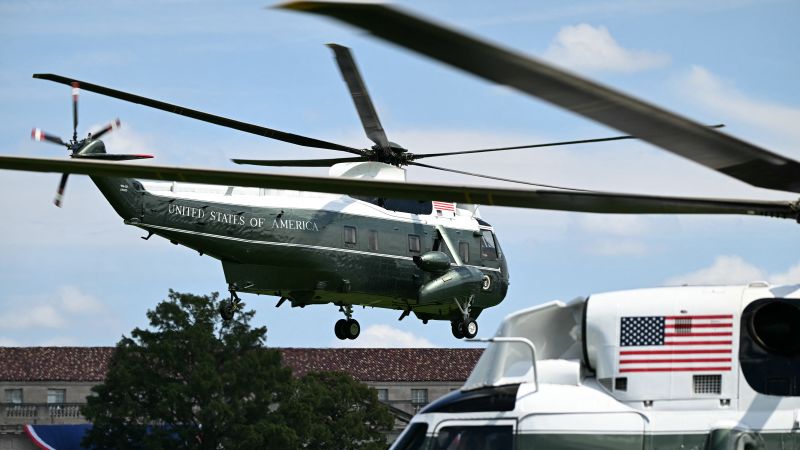
Goldlaner.com – A passenger jet that came dangerously close to President Donald Trump’s Marine One helicopter has once again exposed ongoing air traffic control problems at Ronald Reagan Washington National Airport. The incident occurred just weeks after a routine presidential departure, when an American Airlines regional jet navigated near the presidential helicopter as Trump prepared to board for a flight from the Ellipse, located south of the White House. This close call marks another significant chapter in a series of airspace management issues at the airport, which has faced intense scrutiny following a catastrophic midair collision that claimed 67 lives in early 2025.
Communication Breakdown During Presidential Departure
According to the Federal Aviation Administration, the aircraft experienced what officials termed a “momentary loss of separation” before moving apart safely. The agency emphasized that the President remained unharmed throughout the encounter and that the two aircraft never converged on a collision course. Transportation Secretary Sean Duffy provided additional details during a news conference at Newark Liberty International Airport, explaining that the root cause traced back to communication failures between ground teams.
“We’ve found at a staff level, between the Marine One team and the FAA, there had been some telecom issues,” Duffy told reporters. “We are resolving that, and our teams are working very well together.”
Air traffic control recordings captured the moment when pilots aboard Marine One repeatedly announced their imminent departure, yet the control tower apparently failed to receive these critical transmissions. This technical glitch allowed regular flight operations to continue while the presidential helicopter was preparing for takeoff, contrary to standard protocol that typically halts nearby flights during presidential departures. The passenger jet that came too close was operating under normal flight patterns when the communication failure occurred.
Broader Context of Airport Challenges
The Reagan National Airport sits within visual range of the Capitol and other federal buildings, making it a critical transportation hub with unique security and operational demands. Dave Riley, a veteran air traffic controller with over three decades of experience, noted that the pressure on airport personnel has intensified dramatically since the January 2025 tragedy.
“Post the midair, tensions are high,” Riley said. “Scrutiny is extreme. Everything that (Reagan National Airport controllers) say is under the microscope. Everything they do is being scrutinized. So, there’s a lot of pressure there.”
NTSB investigators subsequently discovered 15,214 near-miss events at the airport between 2021 and 2025, highlighting systemic issues that extend beyond isolated incidents. These challenges stem from a combination of aging infrastructure, staffing shortages, congested airspace, and legislative efforts that have struggled to gain momentum in Congress.
A Pattern of Incidents
The recent Marine One encounter joins a growing list of operational problems at the airport. In March of last year, an air traffic controller faced assault and battery charges following an altercation in the control tower. The following day, Delta Air Lines’ Airbus A319 experienced a close call with US Air Force T-38 jets flying over Arlington National Cemetery at speeds exceeding 350 miles per hour and altitudes of 800 feet above ground level.
May brought another complication when an Army helicopter, directed to fly over the Pentagon helipad, forced controllers to cancel two landing approaches at Reagan National to avoid potential collisions. A subsequent congressional hearing exposed that a dedicated communication hotline between airport controllers and the Pentagon had been nonfunctional since March 2022, with the FAA remaining unaware of the breakdown until the incident occurred.
Looking Ahead
The FAA has established a safety review panel to thoroughly investigate the Marine One proximity incident. Agency leadership has already met with the White House Military Office helicopter unit to discuss improvements. Future enhancements will focus on strengthening the three-minute lift notification process and improving signal frequencies to prevent similar communication failures.
As Congress continues debating new legislation to address airspace safety, the Reagan National Airport remains at the center of national attention. With dozens of safety recommendations issued since the deadly midair collision, officials hope that coordinated efforts between the FAA, military helicopter units, and airport staff will prevent future incidents and restore confidence in the nation’s air traffic management systems.
Frequently Asked Questions
What exactly happened during the Marine One incident? A passenger jet that came too close to Marine One while President Trump was preparing to board at the Ellipse. Air traffic control recordings showed that Marine One pilots announced their departure, but the control tower failed to receive these transmissions, allowing regular flights to continue.
Was anyone injured in the close call? No. The Federal Aviation Administration confirmed that President Trump remained unharmed throughout the encounter and that the two aircraft never converged on a collision course.
What caused the communication failure? Transportation Secretary Sean Duffy explained that there were “telecom issues” between the Marine One team and the FAA at a staff level. This is not the first communication breakdown, as a Pentagon hotline had been nonfunctional since March 2022.
How many near-miss events have occurred at Reagan National? NTSB investigators discovered 15,214 near-miss events at the airport between 2021 and 2025, highlighting systemic issues that extend beyond this recent incident.
What improvements are being implemented? The FAA is strengthening the three-minute lift notification process and improving signal frequencies. A safety review panel has been established to thoroughly investigate the incident and prevent similar occurrences.