
‘A miracle’: Teen murdered nearly 26 years ago identified through genetic genealogy
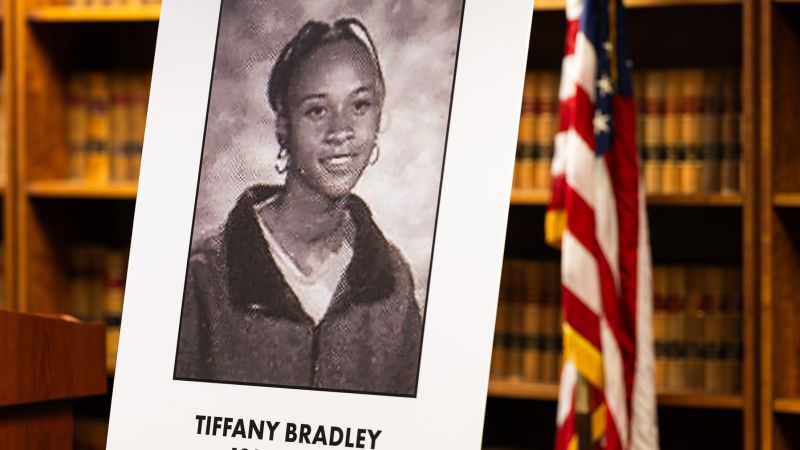
‘A Miracle’: Teen Murder Victim Identified After 26 Years Through Genetic Genealogy
Goldlaner.com – A miracle has finally come for a family waiting nearly three decades. Tiffany Bradley, a teenager murdered in 2000, has been identified through the power of genetic genealogy. Known for years as “Chelsea Jane Doe,” her remains were discovered in a Massachusetts parking lot. Now, investigators have confirmed her identity, bringing closure to a case that spanned more than twenty-six years. This breakthrough represents a miracle for those who never stopped believing she would be found.
From Unknown to Known
Tiffany Bradley was just sixteen years old when she vanished in November 2000. Her family remembers her as a bright, cheerful child with a radiant smile and athletic spirit. While Bradley disappeared from her home, investigators in Chelsea, Massachusetts—approximately three hundred miles away—were piecing together grim fragments of a violent crime. The mutilated remains of a teenage girl had been discovered in a local parking lot, situated just across the river from Boston.
A suspect had already been apprehended and confessed to strangling and dismembering the young victim, yet her identity remained unknown for decades. “The fact that we are here today is a miracle,” remarked Bradley’s niece, Shakirah Wiggins, expressing the family’s overwhelming emotion. “It is totally amazing that after 26 years, people care enough to give her a name and return her to her family.”
The Science Behind the Breakthrough
The identification of Bradley was made possible through the work of Othram, a private forensic science company. Three years prior to the announcement, Othram constructed a DNA profile from the victim’s remains. However, the process was challenging. David Mittelman, the founder and chief executive officer of Othram, explained that because the body parts were discovered in poor condition, the DNA was in “horrible condition.” In missing persons investigations, establishing viable DNA is the crucial first step; without this vital genetic information, the case cannot progress.
Once the DNA profile was successfully created, investigators utilized both genetic analysis and genealogical research to fill gaps in Bradley’s family tree. They examined newspaper archives, social media records, and genetic data to build a comprehensive family history. The FBI employed this profile to construct a detailed family tree, ultimately matching Bradley with her brother. This confirmation validated the identity of the athletic, girly girl and restored her real name to her legacy. For many, this outcome was nothing short of a miracle.
Expanding Horizons in Cold Case Investigations
The resolution of the Chelsea Jane Doe case could not have occurred until recently, thanks to technological advancements and the increasing number of individuals uploading their DNA to public databases. For centuries, genealogists relied exclusively on paper records to construct family trees. However, approximately two decades ago, the field began incorporating DNA analysis to overcome “genealogical brick walls”—points where traditional paper trails come to an end.
CeCe Moore, co-founder of DNA Justice, a nonprofit organization that enables anyone to upload their genetic profile to a database, noted that this approach serves as a valuable resource for law enforcement genetic genealogists. Moore highlighted that the identification of the Golden State Killer in 2018 marked the first time a major public case was solved through genetic genealogy. “That really changed everything,” Moore stated, emphasizing the transformative impact of this technique.
Following this success, the FBI established an investigative genetic genealogy team, recognizing the potential to solve numerous additional cases. This initiative has led to Bradley’s identification, along with dozens of other victims. For instance, last month the nonprofit DNA Doe Project announced the identification of Cheryl Lynn Edwards, a fifteen-year-old girl who was ten weeks pregnant when she disappeared approximately fifty years earlier. Her body was discovered in 1975 in the Mississippi River near Clinton County, Iowa, where she had been killed by a gunshot wound to the head.
The Iowa Department of Public Safety had named her “Jane Clinton Doe” and submitted the case to the DNA Doe Project, a collective of volunteer genetic genealogists. A team of sixteen genealogists collaborated over a single weekend to investigate the case. Within hours, they identified a couple from Louisiana as the girl’s grandparents. They then focused their research on the grandparents’ children and discovered that their eldest son had a daughter who “vanished from the records in the 1970s,” according to Trish Bird, a volunteer g
“Genetic genealogy has given us the ability to solve cases that were once considered impossible,” said a DNA Doe Project spokesperson. “Each identification is a small miracle for families who have waited decades for answers.”
Frequently Asked Questions
What is genetic genealogy?
Genetic genealogy combines DNA analysis with traditional genealogical research to identify individuals and solve cold cases. It uses publicly available DNA databases to build family trees and match unknown victims with living relatives.
How long did it take to identify Tiffany Bradley?
It took more than 26 years. Bradley disappeared in November 2000 and was identified in July 2026 through DNA profiling and genealogical research conducted by Othram and the FBI.
What role did Othram play in the identification?
Othram, a private forensic science company, constructed a DNA profile from Bradley’s remains three years before the announcement. Despite the poor condition of the DNA, they successfully created a profile that enabled investigators to build a family tree.
Are there other cases solved through genetic genealogy?
Yes. The Golden State Killer was identified in 2018 through genetic genealogy. More recently, Cheryl Lynn Edwards was identified by the DNA Doe Project after nearly fifty years. These cases demonstrate the growing effectiveness of this technique.
How can families help in cold case investigations?
Families can contribute by uploading DNA to public databases, supporting organizations like DNA Doe Project and DNA Justice, and sharing information about missing loved ones. Every piece of data can help solve a case.
