
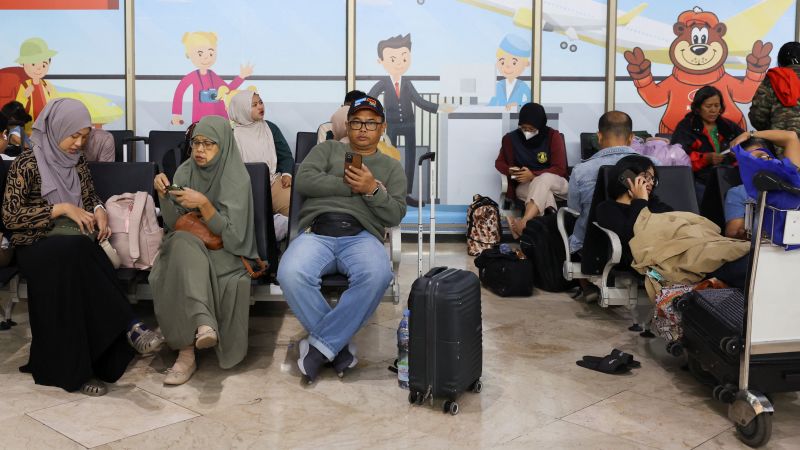
Volcanic Ash From Anak Krakatau Grounds Eight Airports, Stranding 170,000 Travelers Across Indonesia
Goldlaner.com – More than 170,000 passengers found themselves stranded across Indonesia on Monday morning after volcanic ash from Mount Anak Krakatau forced the closure of eight airports, including both facilities serving the capital, Jakarta. The transport ministry confirmed the scale of disruption early Monday, explaining that the ash plume had blanketed the capital and surrounding regions since the volcano erupted late Friday night, prompting safety-driven shutdowns of air traffic.
Airport Closures and Timeline
Operators of Jakarta’s primary international gateway announced via their Instagram account on Monday that the airport would stay shut until 6 p.m. local time. The remaining seven closed airports — which include facilities serving the nearby provinces of Lampung and West Java — were ordered to remain grounded until at least 08:59 a.m., giving airlines and ground crews a narrow window to reassess conditions before any resumption of operations.
Transport Minister Dudy Purwagandhi acknowledged the uncertainty surrounding the timeline in a Monday statement:
“We cannot ascertain when this will end due to the dynamic weather.”
The minister’s remark underscored a recurring challenge in Indonesian aviation: volcanic ash drift is governed by shifting wind patterns at altitude, making precise reopening windows difficult to predict. Airlines operating out of the affected airports faced cascading schedule disruptions, with connecting flights across Southeast Asia and beyond thrown into disarray.
Eruption Intensity and Ash Column Heights
The volcano monitoring agency logged the most recent Anak Krakatau eruption at 8:23 p.m. on Sunday, marking the second consecutive day of major explosive activity. Meteorological agency BMKG reported that ash columns reached approximately 20,000 feet (6,000 meters) above the Java-facing flank of the volcano and soared to roughly 50,000 feet (15,000 meters) on the Sumatra-facing side. Deposition was also recorded in portions of Banten province on Java’s western tip, where fine particulate settled over residential and agricultural areas.
On Monday, the monitoring agency issued a warning that the likelihood of additional eruptions in the coming hours and days remained high, keeping aviation authorities in a holding pattern and leaving passengers without firm departure dates.
Public Health and Educational Responses
With ash drifting over populated areas, Indonesia’s disaster agency urged residents to wear protective masks whenever traveling outdoors, aiming to reduce inhalation of fine volcanic particulate that can irritate lungs and exacerbate respiratory conditions. In Jakarta and the Lampung region, schools shifted to remote-learning arrangements to shield students from prolonged ash exposure, a measure reported by state news agency Antara.
For travelers already in transit, the closures meant overnight waits in terminal lounges, rebooking chaos, and, for some, the need to arrange alternative ground transport across the Java–Sumatra corridor — a journey complicated by reduced visibility and ash-contaminated roadways.
Geological Context: The Ring of Fire and Krakatau’s Legacy
Indonesia’s position along the Pacific Ring of Fire makes volcanic and seismic activity a near-permanent feature of daily life for its 280 million residents. Anak Krakatau — a name translating to “child of Krakatau” — first began rising from the seabed roughly a century ago in the caldera left behind by its parent volcano, Krakatau (historically spelled Krakatoa).
The older Krakatau volcano annihilated itself in a cataclysmic series of eruptions in August 1883, generating tsunamis that swept coastal communities across the Sunda Strait and killing more than 36,000 people. That event remains one of the deadliest volcanic disasters in recorded history and a benchmark against which modern eruption responses are measured.
Anak Krakatau has since produced periodic eruptions of varying intensity, but the current episode — spanning at least two days of sustained explosive activity with ash columns exceeding 15 kilometers — represents one of its more significant recent outbursts. The volcano’s location roughly midway between Java and Sumatra places its plume directly over one of the world’s busiest aviation corridors, amplifying the operational consequences of even short-lived eruptions.
What Comes Next
Aviation authorities will continue to monitor ash concentration at cruising altitudes before authorizing any reopening. Until BMKG and the volcano observatory confirm a sustained lull in eruptive activity and favorable wind directions, the eight airports are expected to remain closed, and the 170,000 affected travelers will face continued delays, reaccommodation, and compensation claims. For now, the sky above Jakarta and the surrounding strait remains a grey, ash-laden canopy, and the volcano’s next pulse remains a matter of hours rather than certainty.
Related Reading
Frequently Asked Questions
What is Volcanic ash leaves 170 000 travelers?
Volcanic ash leaves 170 000 travelers is the main topic of this guide. The article explains the context, practical details, and next steps readers should understand.
Why does Volcanic ash leaves 170 000 travelers matter?
Volcanic ash leaves 170 000 travelers matters because readers are looking for a useful answer, not just a short summary. Good content should match search intent and help them decide what to do next.