
A Decade in the Alps: How One Connecticut Couple Turned Swiss Isolation Into a Family Adventure
Goldlaner.com – Each year, on the date they exchanged wedding vows, Emily and Robert Toole face a question that would unsettle most expatriates: do they pack up and fly back to the United States, or do they plant themselves deeper into Swiss soil? The answer has been identical every single time. They stay.
“We’re happy. We’re settled. We have a… great family. Thus far it’s been a great adventure,” Emily says.
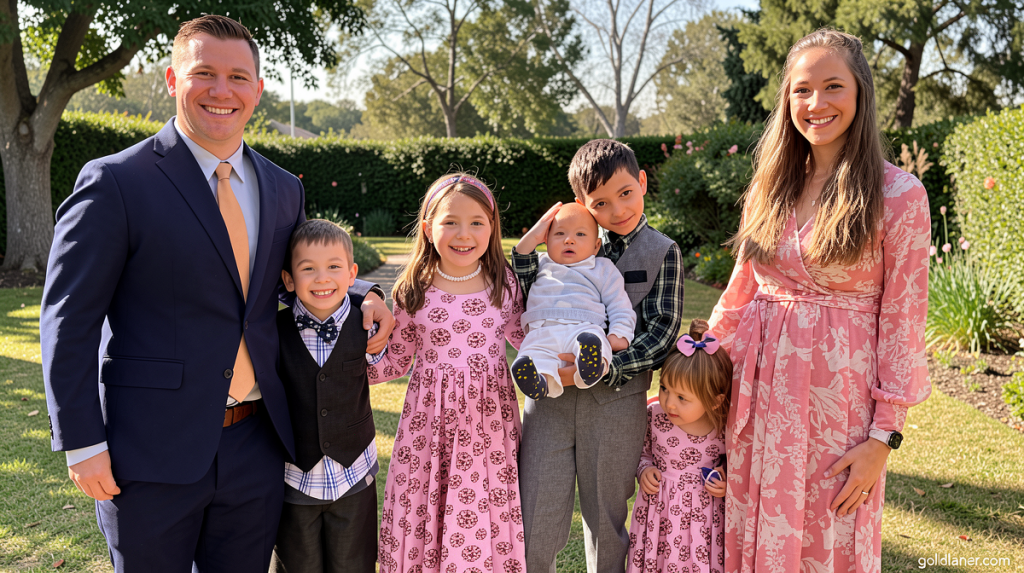
The Tooles are parents of five children — all born on Swiss soil, with ages spanning from 11 years down to 10 months. Their daily life orbits the Bernese Oberland, a stretch of the Swiss Alps where peaks like Eiger and Jungfrau dominate the skyline. Weekends are spent navigating trails around Grindelwald and Interlaken, or tackling what Emily calls “beautiful hikes” near the city of Neuchâtel. Yet the couple’s story is not one of seamless assimilation. It is, by their own admission, a story of years-long friction, cultural whiplash, and slow, hard-won belonging.
How a Job Offer in Geneva Rewired a Long-Distance Romance
Switzerland never appeared on the Tooles’ relocation shortlist until 2013, when Emily received an employment offer in Geneva. At that point, her knowledge of the country amounted to what she describes as a “dreamy reputation” — postcards of chocolate, watches, and alpine scenery. What mattered to her was the language: she had studied French through college and wanted a francophone destination.
The couple’s own history made long-distance logistics feel routine. They first crossed paths at the University of Notre Dame in Indiana, but both had already spent semesters studying abroad in separate countries. Their early romance was stitched together across time zones and borders.
“I couldn’t really ask, ‘Are you going to propose to me?’ So I thought, ‘I just have to accept this job and then see where it takes us,'” Emily recalls.
Robert followed shortly after. The two married the following year, and he secured a work transfer to Geneva, reuniting the household under one roof.
The First Year: A Culture That Does Not Knock
Neither spouse expected the adjustment to be as punishing as it proved. Emily, who had imagined a manageable cultural transition, found herself isolated and unable to form meaningful social ties.
“We both thought, ‘Maybe we’ll try this out for two years,’ and the first year was horrible,” she says. “Feeling like I belonged, it really took some time.”
Robert’s experience was equally jarring, though his frustration took a different shape. Coming from Connecticut, he had grown up in a culture where neighbors appeared uninvited with casseroles and casual conversation. In Switzerland, that social architecture simply does not exist. He describes Swiss residents as tending to “keep to themselves,” and notes that newcomers must initiate every interaction themselves.
“There’s no welcoming committee,” he says flatly.
The couple eventually broke through the social ice by joining a local church and enrolling in recreational clubs. Those memberships became the scaffolding for genuine friendships and, over time, a sense of rootedness.
Clubs, Comedy, and Ultramarathons: Finding Swiss Identity
Robert now performs stand-up comedy at venues across the country, a membership he credits with giving him access to Swiss social circles. Emily runs ultramarathons through a local running club. Both describe their club affiliations as the single most effective pathway into Swiss community life.
“Probably the fastest way to actually meet real Swiss people and become friends with them is to get involved,” Robert observes.
As successive work contracts were renewed, the couple’s tentative two-year experiment calcified into a permanent residence. The arrival of their first child in May 2015 marked, in Emily’s words, the moment they “had roots” in the country. Four more children followed, and the household’s center of gravity shifted entirely toward family logistics.
Raising Kids in a System Built for Autonomy
Switzerland’s education framework is internationally recognized for rigorous academic standards, and the Tooles report being impressed by their children’s intellectual development. But what strikes them more is the cultural emphasis on childhood independence. All five children walked to school unaccompanied beginning at age four — a practice that would be unthinkable in most American suburban neighborhoods.
“They’re able to do so much on their own,” Emily notes, framing the arrangement as a source of pride rather than anxiety.
The Swiss model of physical education, which weaves outdoor activity into the weekly curriculum rather than treating it as an elective, further reinforces the family’s preference for an active lifestyle. For a household that spends weekends above the treeline, that institutional alignment feels less like a policy choice and more like a shared value.
The Rhine Float and the Question That Never Gets Asked
Among the couple’s most cherished annual rituals is a Basel summer tradition: locals strap their clothes, shoes, and phones into a dry bag that doubles as a flotation device, slip into a swimsuit, wade into the Rhine from the Kleinbasel bank, and simply drift downstream until they reach home. It is a small, absurd, deeply Swiss act of communal leisure.
For the Tooles, that spirit of unhurried outdoor participation encapsulates why they keep answering the anniversary question the same way. They are not trapped by circumstance; they are choosing, year after year, a life measured in trail mileage, comedy sets, ultramarathon finish lines, and five children who navigate their own neighborhoods without adult escort. The mountains do not ask them to leave. They have stopped asking themselves, too.
Related Reading
Frequently Asked Questions
What is There s no welcoming committee?
There s no welcoming committee is the main topic of this guide. The article explains the context, practical details, and next steps readers should understand.
Why does There s no welcoming committee matter?
There s no welcoming committee matters because readers are looking for a useful answer, not just a short summary. Good content should match search intent and help them decide what to do next.