
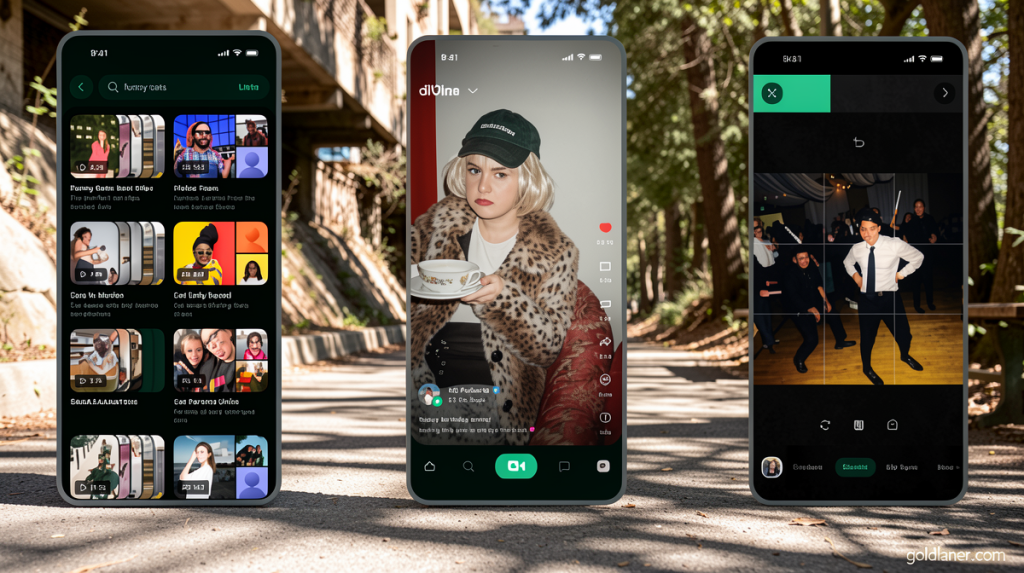
The Six-Second Loop Returns: Divine Bets on Human-Only Video in an Age of AI Noise
Goldlaner.com – A quiet but pointed counter-current is moving through social media in 2026: a wave of platforms and products built around the premise that users are exhausted by algorithmically generated, machine-assisted content and want something made by actual people. At the center of that current sits Divine, a newly launched video app that resurrects the six-second looping format made famous by Vine, the short-form platform that Twitter killed off nearly a decade ago. Divine went live last week following roughly nine months of development and closed beta testing, and it has already attracted approximately 100,000 users according to its founder.
What Divine Actually Is
The app presents a scrolling feed of six-second clips, mirroring the core mechanic of its spiritual predecessor. Users can record and upload their own short videos, and they can also browse an archive containing more than two million original Vine posts preserved by volunteer internet archivists before the platform went dark. Despite the obvious lineage, Divine carries no formal affiliation with Vine or with X (formerly Twitter), which owned the original service. The connection is one of inspiration and format, not corporate continuity.
The founder, who operates under the moniker Rabble, is a former early employee of Twitter. Rabble built Divine with financial backing from Jack Dorsey, the co-founder of Twitter who later stepped away from the company. That pedigree lends the project a degree of institutional credibility, even as the app positions itself squarely against the direction X has taken since its controversial acquisition by Elon Musk.
The Anti-AI Stance
Perhaps the most deliberate differentiator is Divine’s blanket prohibition on AI-generated video content. Rabble explained the reasoning in a conversation with a news outlet:
“I want to see things that are creative and are human and that are weird … there’s a way in which AI generates this sort of mediocrity.”
The team says it employs multiple detection methods to identify and filter out machine-made clips before they reach a feed. That posture aligns with recent moves by Pinterest and LinkedIn, both of which have introduced measures to reduce the volume of synthetic content flooding their platforms. For a generation that grew up watching Vine’s absurdist, low-production-value loops, the promise of guaranteed human authorship carries genuine emotional weight.
Vine’s Brief, Loud Life
To understand why a decade-old format still commands attention, a quick recap helps. Vine launched in 2012 as one of the first services letting ordinary users produce and distribute short videos directly from a phone. Twitter acquired it within months for roughly $30 million. The platform became a cultural lightning rod: it launched the careers of creators like Logan Paul and Shawn Mendes, spawned an endless stream of memes, and established the six-second loop as a recognizable unit of online humor. Yet it never solved the business-model problem. When Instagram rolled out its own short-video features, Vine’s competitive position collapsed. Twitter announced its shutdown in 2016, and the service went offline in 2017.
Before the servers went cold, volunteer archivists scraped and preserved a substantial portion of the video library. Divine’s archive draws on that rescue effort, giving new users access to clips that would otherwise have vanished from the public record.
Decentralization and User Agency
Beyond content policy, Divine is architecturally distinct from the monolithic social networks it implicitly critiques. The platform runs on a decentralized digital infrastructure comparable to Mastodon and Bluesky, the two most prominent alternatives to X. In practical terms, that means a user’s profile and posted content can be migrated to another compatible service without starting from scratch. The underlying technology is also open-sourced, so independent developers can spin up their own communities using the same codebase without ever posting to Divine itself.
On the feed side, Rabble says the app provides a plain-language explanation of how its “For You” ranking works. Users can switch among algorithmic lenses — one weighted toward animal content, another toward style and aesthetics, another toward raw popularity metrics — rather than being locked into a single opaque recommendation engine. The stated goal is transparency: letting people see the machinery and choose which version of the machine they want to inhabit.
A Broader Nostalgia Wave
Divine does not exist in isolation. In a recent documentary, the current owners of MySpace discussed plans to revive the music-sharing site that dominated the early 2000s. Together, these efforts signal a widespread frustration with how mainstream platforms curate, moderate, and monetize user attention — frustrations sharpened, many observers argue, by the post-Musk trajectory of X.
Rabble frames the project in explicitly normative terms:
“I look forward to a place where we can have a better idea of what healthy social media is, and where people think that it doesn’t have to be this sort of nightmarish hellscape. I think this idea of not having human agency over how we make our own norms and rules has created a toxic culture.”
Early Traction and Commercial Signals
The first week of public availability produced a mixed but telling content landscape. Some users recreated 2010s meme formats that defined Vine’s golden era; others posted short, earnest tributes to the feeling of scrolling a feed populated by recognizable human faces rather than synthetic avatars. This week the app announced its first brand partnership, a collaboration with Taco Bell, suggesting that advertisers see the nostalgia angle as commercially viable even at a relatively small user scale.
Whether Divine can sustain growth beyond the initial curiosity wave remains an open question. The six-second loop is a narrow format, and the absence of AI-generated content, while philosophically clean, also caps the volume of material available for recommendation. Still, the project taps a sentiment that has been building quietly across the internet for years: the desire for small, human, slightly stupid, unmistakably alive corners of the web that no algorithm was asked to optimize.
Related Reading
Frequently Asked Questions
What is A new app is bringing Vine?
A new app is bringing Vine is the main topic of this guide. The article explains the context, practical details, and next steps readers should understand.
Why does A new app is bringing Vine matter?
A new app is bringing Vine matters because readers are looking for a useful answer, not just a short summary. Good content should match search intent and help them decide what to do next.