
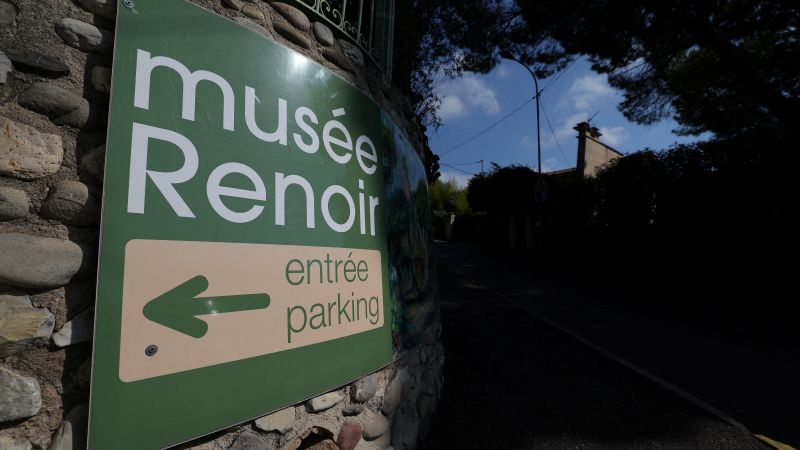
Stolen Renoir Works Recovered After Museum Break-In in Southern France
Goldlaner.com – Two paintings by Pierre-Auguste Renoir that vanished during a fast break-in at a museum in southern France have been recovered, bringing a major art theft investigation to a significant turning point. Authorities have also arrested six people in connection with the case.
The works were taken last month from the Renoir Museum in Cagnes-sur-Mer, a town associated with the final years of the French Impressionist painter’s life. The missing paintings were identified as Portrait of Madame Colonna Romano and Young Woman at the Well.
Bryan Masson, the mayor of the town that hosts the museum, praised the investigators who located both the artworks and the suspects. His statement did not provide details about where the paintings were found or the methods used during the investigation. A news conference was scheduled for later Friday.
A Theft Lasting Less Than Three Minutes
The burglary unfolded with remarkable speed. The regional prosecutor’s office said the entire operation took under three minutes and focused on the Renoir Museum’s most valuable paintings.
Thieves cut through a fence, entered through a window and removed four Renoir works at the outset. However, two paintings were left behind as the intruders fled. The two other works became the focus of a nationwide search for those responsible.
The recovery is particularly important because stolen art can be difficult to trace once it is removed from a museum. Paintings of major cultural value are recognizable and hard to sell openly, but that does not eliminate the risks created by their disappearance. Returning the works to public custody preserves access to pieces that belong within a museum collection rather than in an unknown private setting.
Six Arrests in the Investigation
Six people have been arrested in the case, authorities said Friday. Police and the regional prosecutor’s office did not immediately provide further comment when asked about the arrests, the recovery operation or possible next steps in the investigation.
For Cagnes-sur-Mer, the announcement ends at least one immediate concern: the two paintings that had remained missing have been found. The investigation itself may still need to establish how the break-in was organized, whether others were involved and what happened to the works between their removal from the museum and their recovery.
The Renoir Museum is closely linked to the artist whose name it bears, making the theft more than a conventional property crime. The target was a collection connected to a central figure in French art, and the theft drew attention because the intruders selected works described as the museum’s most valuable.
Renewed Focus on Protection of Cultural Sites
The break-in also revived a wider discussion about security and financial support for cultural institutions throughout France. The country’s landscape includes many museums, historic houses and other sites that preserve art and heritage on both a large and local scale. Their collections can hold objects of major artistic and historical importance even when the institutions themselves are smaller than internationally famous museums.
The Cagnes-sur-Mer theft brought back memories of the high-profile robbery of crown jewels at the Louvre Museum in Paris last year. Though the circumstances and targets were different, both incidents underscored the vulnerability that can arise when valuable cultural objects are accessible to the public yet must also be protected from theft.
“Portrait of Madame Colonna Romano” and “Young Woman at the Well” were the two paintings recovered after the theft.
Public museums face a difficult balance. They are expected to welcome visitors and display their collections, while also maintaining barriers, alarms, monitoring and other safeguards that can deter or interrupt criminal activity. A break-in completed in only minutes illustrates why security planning must account for speed as well as sophistication.
The case has also highlighted the significance of prompt investigative work after a theft. Once an artwork has been taken, recovering it quickly can limit the chance that it will be moved repeatedly, hidden or damaged. In this instance, investigators were able to trace the missing Renoirs and take six suspects into custody within weeks of the heist.
What the Recovery Means
The return of the two works represents a positive outcome for the museum, the town and people who value Renoir’s legacy. While officials had not immediately released details of the recovery, the announcement means the paintings are no longer unaccounted for after the September theft.
The episode remains a reminder that cultural heritage requires continued protection. Famous national institutions often receive the most attention after a major crime, but regional museums also care for irreplaceable works. The events in Cagnes-sur-Mer have reinforced calls to ensure that those sites have the security and resources needed to protect the collections entrusted to them.
Further information was expected at the mayor’s planned Friday news conference. For now, the recovery of both missing Renoirs and the arrests of six people mark a substantial development in a theft that had shaken one of southern France’s notable art museums.
Related Reading
Frequently Asked Questions
What is 2 Renoir paintings recovered from French?
2 Renoir paintings recovered from French is the main topic of this guide. The article explains the context, practical details, and next steps readers should understand.
Why does 2 Renoir paintings recovered from French matter?
2 Renoir paintings recovered from French matters because readers are looking for a useful answer, not just a short summary. Good content should match search intent and help them decide what to do next.