
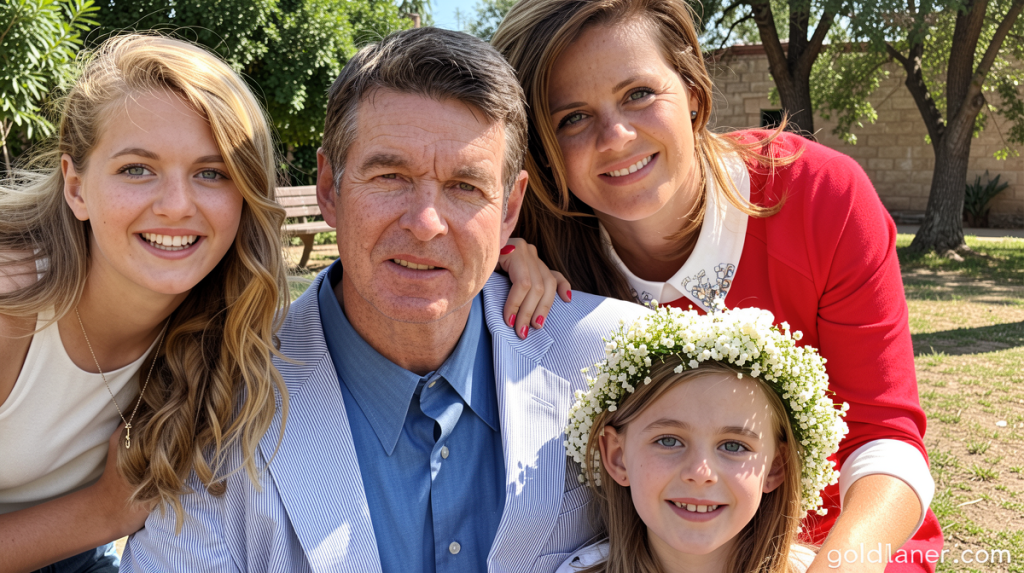
The Quiet Devastation: A Family’s Decade-Long Confrontation with CTE
Goldlaner.com – When headlines announce that roughly one in four former NFL players who passed between 2016 and 2021 carried chronic traumatic encephalopathy in their brains, Maura Horton did not feel surprised. She felt, instead, that the world was finally acknowledging something her family had been living through in silence for years. The statistic, drawn from postmortem analyses at Boston University’s Brain Bank, confirmed what her husband’s own autopsy had already told her in May 2016: Don Horton, 58, had died with CTE. He had never played in the NFL. He had never been a number in any headline study. And yet the disease that researchers now associate with repeated head impacts had dismantled his mind, his body, and the life his family had mapped out together.
Horton’s story sits in an uncomfortable gap that public discourse rarely examines. The vast majority of Americans who follow football will never see a snap in the professional league — the odds for a high school player are roughly 0.023 percent. CTE, in the popular imagination, belongs to the gridiron’s upper echelons. But the pathology does not check a player’s division before it takes hold. Don Horton was an offensive lineman at Wittenberg University, a Division III program in Springfield, Ohio, that has collected five national championships and 799 victories over its long history. Few outside the Midwest football circuit have heard the name. That obscurity made his diagnosis feel, to outsiders, almost implausible.
The Misdiagnosis and the Slow Unraveling
Don was a devoted fitness enthusiast. When he began struggling to lift weights he had managed for decades, physicians pointed to Parkinson’s disease. Family members recalled being told, with a kind of cheerful reassurance, that of all neurological conditions this was the most manageable. “Michael J. Fox,” Maura recalled, laughing through the memory. “Everyone brought up Michael J. Fox.”
The trajectory, however, defied that tidy label. One morning Don would be in the gym completing a full session; the next, he would collapse on the floor for no apparent reason. Mood swings crept in, followed by restless, fragmented nights. Paranoia surfaced. Hallucinations followed. Maura, initially attributing the worst episodes to medication side effects, became what she described as her husband’s self-appointed pit bull — attending every appointment, peppering physicians with questions, researching independently in the margins of her days. As the deterioration accelerated, a question she had been circling for months finally hardened into certainty: Could this be CTE?
She reached out directly to Chris Nowinski, co-founder of the Boston-based Concussion Legacy Foundation, via direct message. The conversation opened a door she had been pressing against for years. She then sat down with Don and proposed that, after his death, his brain be donated to science. He balked. Here was a man who had built his identity around healthy living — who eschewed junk food, who treated the gym as a daily obligation — being told that a decision made as a teenager on a Division III field had set him on a path no amount of discipline could reverse. That football had done this to him. The game was not merely what Don did; it was woven into who he was.
A Coaching Career Built on the Field
After his playing days ended, Horton moved seamlessly into coaching, beginning a peripatetic football life that carried him through various stops in Ohio, New Mexico, and Virginia. In 1997 he landed what he considered the apex of that journey: the offensive line coaching position at Boston College. He spent a decade with the Eagles before concluding his career at North Carolina State. Each assignment deepened his identification with the sport’s culture, its rituals, its physical demands. The cumulative head impacts accumulated over a playing career at Wittenberg — a school so far off the national radar that only devoted football loyalists would recognize its name — proved, in the end, sufficient.
The Earthquake and the Aftermath
Maura had modeled her marriage on her own parents’ union, which stretched past sixty years. She had envisioned decades of shared routine: days in the stands watching their daughter Hadley play soccer, evenings seeing Libby channel her analytical mathematics mind into a demanding career. She had imagined extraordinary walks down wedding aisles for both girls, and ordinary walks around the neighborhood. She had imagined growing old and creaky together. All of it, she says, was rerouted and ultimately destroyed by what she calls the “earthquake” that CTE delivered into her household.
“I’m always thankful that the reports are published and the research is ongoing,” Maura told CNN Sports. “But there is still so much missing. I want to be a conduit that helps open a dialogue to understanding. No one sees the aftermath. No one understands what it’s like on a day-to-day basis. You see these studies and then no one talks about it again until someone dies.”
“But this is an earthquake that shattered my family, and no one understands how shattering it is. I’m 10 years past and it’s still shattering us.”
Her frustration is aimed not at the researchers but at the cycle of attention. A study drops. The public debates whether children should play contact sports, what interventions might reduce cumulative impact, how to reconcile a national pastime with mounting neuropathological evidence. Then the news cycle turns, and the conversation evaporates until the next death forces it back into view. For families like the Hortons, that rhythm is its own cruelty — a reminder that their grief is treated as a seasonal topic rather than a permanent condition.
The broader implications extend well beyond any single household. If CTE can manifest in athletes who never touched a professional field, the screening, monitoring, and intervention frameworks currently shaped around NFL-level exposure may be calibrated to the wrong population. Division III programs, high school leagues, and amateur clubs operate with far fewer resources for concussion tracking, baseline cognitive testing, and long-term neurological follow-up. Don Horton’s case underscores that the absence of a professional pedigree does not confer immunity, and that the families of lesser-known athletes often lack both the visibility and the institutional support to navigate a diagnosis that arrives, as it did for him, mislabeled and late.
Ten years after Don’s death, Maura continues to push for what she frames as a sustained, day-to-day conversation about neurological decline in former athletes — one that does not require a celebrity death to reopen. The research will continue. The statistics will be updated. And somewhere, another family will read a headline, feel the distant sting of recognition, and wonder whether anyone will remember their name after the cycle turns.
Related Reading
Frequently Asked Questions
What is What it s like to live?
What it s like to live is the main topic of this guide. The article explains the context, practical details, and next steps readers should understand.
Why does What it s like to live matter?
What it s like to live matters because readers are looking for a useful answer, not just a short summary. Good content should match search intent and help them decide what to do next.