
When a White Bronco Stopped a Nation: How One Chase Redefined Sports Television
Goldlaner.com – The summer of 1994 marked a turning point in how Americans consumed sport. For decades, the scoreboard had been the story. Then, in a single evening, the narrative fractured. A former football star’s slow crawl down a California freeway eclipsed every arena, every golf course, and every stadium in the country, and the media landscape never fully returned to its former shape. The chase became a cultural watershed, exposing how quickly the appetite for spectacle had outgrown the appetite for competition itself.
The Night Two Stories Collided
On June 17, 1994, Madison Square Garden was at full capacity for Game 5 of the NBA Finals, pitting the New York Knicks against the Houston Rockets. The series stood deadlocked at two wins each, and the victor would sit one game away from claiming the Larry O’Brien Championship Trophy — a prize the Chicago Bulls, led by Michael Jordan, had claimed three consecutive years running. By every metric of importance, it was among the most consequential basketball nights of the decade.
Yet the crowd’s attention was already drifting westward. Ian O’Connor, a columnist at The Athletic, captured the absurdity of the moment:
“You have to understand (that) the Knicks hadn’t won a championship in more than two decades. And here they are, about to take a 3-2 lead in the NBA Finals over the Houston Rockets… and nobody is watching the game.”
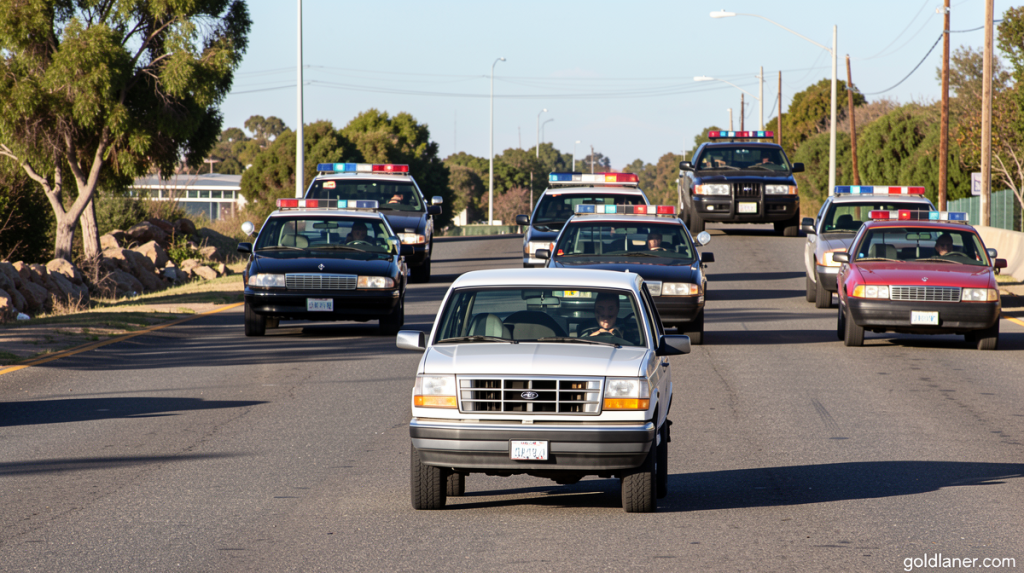
The reason was simple and surreal. Earlier that same day, former NFL running back OJ Simpson had failed to surrender to the Los Angeles Police Department after being identified as a suspect in the killings of his ex-wife, Nicole Brown Simpson, and her companion, Ronald Goldman. The two bodies had been discovered stabbed outside Brown Simpson’s residence just five days prior. What unfolded next was a roughly 90-minute low-speed pursuit through Los Angeles freeways, with Simpson and former teammate Al Cowlings at the wheel of a white Ford Bronco.
Ninety Minutes That Rewrote the Rules
Simpson had once carried a ball for more than 2,000 rushing yards across a single 14-game NFL season. But no run in his career — or in the history of American television — drew an audience comparable to that evening’s crawl. Thousands of spectators climbed highway overpasses to glimpse the vehicle. Broadcast networks across the country abandoned their scheduled programming to carry the pursuit live. NBC, already airing the Knicks-Rockets contest, split its screen to show both events simultaneously, a concession that underscored how completely public attention had migrated to the West Coast.
The chase became one of the most-watched television events in American history, a designation that speaks less to the drama of the pursuit itself and more to the collective hunger for a story that transcended sport.
Sports Events Pushed to the Sidelines
The NBA Finals was far from the only marquee event that lost its audience that night. Ken Griffey Jr. was in the midst of a bid to break Babe Ruth’s career home run record. Arnold Palmer was competing in his final round at the U.S. Open golf championship. The 1994 FIFA World Cup had recently opened its doors on American soil for the first time. Each of those stories carried enormous stakes of its own, yet none could compete with the image of a white Bronco inching along a California highway while police cruisers flanked it.
The coincidence of timing was almost theatrical. Within a single week, the nation’s attention had been commandeered by a single man’s flight from justice, and the sports calendar had been rendered secondary.
The Tabloid Turn in American Media
The Bronco chase did not create the appetite for scandal; it merely confirmed that the appetite had already matured. Timothy Naftali, a CNN contributor, framed the broader shift:
“What we see in the 90s is tabloid television (and) a hunger for stories that we would describe as… the other side of the human experience.”
Americans were increasingly drawn to the personalities, controversies, and personal dramas orbiting the biggest athletes. The January 1994 attack on figure skater Nancy Kerrigan — which propelled the following month’s Winter Olympics to record television audiences — and Mike Tyson’s ear-biting of Evander Holyfield at a June 1997 boxing match both demonstrated that spectacle now rivaled, and often surpassed, athletic performance as the primary draw.
An Era of Unprecedented Visibility
The 1990s also witnessed the rapid expansion of round-the-clock sports television channels. Athletes were now platformed continuously, their lives broadcast in real time rather than confined to game-day windows. Popularity metrics that once peaked after a championship run now accumulated daily, through interviews, reality-adjacent segments, and celebrity crossovers. The boundary between athlete and mainstream entertainer dissolved almost overnight.
John Heilemann, a journalist, described the period’s tone as “wacky,” noting that “sports is getting so big and so all-enveloping” that “the glare of the media is so much brighter by the time you get to that timeframe that things start to get a little twisted in the 90s.”
Van Lathan, a journalist and podcaster at The Ringer, called it an “explosive era of media coverage,” a phrase that captures both the velocity and the volatility of the decade’s broadcast landscape.
The Man Who Embodied the Shift
No figure illustrated the transformation more completely than Simpson himself. Before the Bronco, he had already crossed from gridiron into general celebrity: a Heisman Trophy winner, an NFL Most Valuable Player, a repeat All-Pro and Pro Bowl selection, and a face familiar from film roles and national television commercials. His recognizability had long since outgrown the football field. The chase did not make him famous; it merely made him inescapable, and in doing so it crystallized a decade-long trend in which the story around the athlete became more compelling than the athlete’s work.
The legacy of that June evening is not confined to one case or one chase. It established a template — the idea that a sports broadcast could be interrupted, diluted, or entirely displaced by a human drama unfolding elsewhere — and that template has been repeated, refined, and amplified in every subsequent era of media. The scoreboard still matters. But the story around it now matters more, and the line between the two has never been drawn back.
Related Reading
Frequently Asked Questions
What is How OJ Simpson s infamous Bronco?
How OJ Simpson s infamous Bronco is the main topic of this guide. The article explains the context, practical details, and next steps readers should understand.
Why does How OJ Simpson s infamous Bronco matter?
How OJ Simpson s infamous Bronco matters because readers are looking for a useful answer, not just a short summary. Good content should match search intent and help them decide what to do next.