
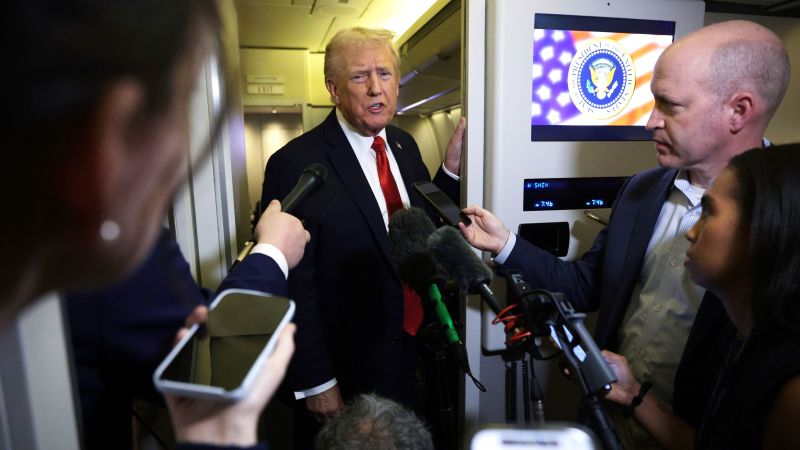
White House Press Pool Faces New Test After Access Restrictions
Goldlaner.com – Covering the US president requires a system built for tight spaces, sudden travel and moments when the entire country needs reliable information quickly. That system, known as the White House press pool, is now facing renewed pressure after President Donald Trump barred CNN, MS NOW and Politico from the White House.
The decision raises questions that reach beyond the three organizations. Pool coverage is designed to let a limited number of journalists represent a much larger press corps when physical access is scarce. If one outlet is prevented from performing an assigned pool role, it can disrupt the rotations and resources that allow other newsrooms to receive reports, photographs and video from presidential events.
Why the pool exists
The modern arrangement dates to the presidency of Franklin D. Roosevelt. It developed as a practical answer to a basic limitation: many presidential settings cannot accommodate hundreds of reporters, camera crews and photographers. The Oval Office, Air Force One and secure travel locations all have strict capacity limits.
Instead of admitting every credentialed journalist, a small group enters as the pool. Its members observe the president, ask questions when opportunities arise, and quickly share their reporting and visual material with the wider group of journalists covering the White House. That information ultimately reaches audiences through many competing outlets.
The system also lowers the cost of maintaining constant presidential coverage. Major networks and newspapers may have substantial Washington staffs, but smaller organizations often cannot afford to send a full team on every trip. Pooling enables a broader range of outlets to follow the presidency without each one duplicating the same travel and staffing expenses.
The pool includes print reporters, television journalists and still photographers. Its exact size changes with the location. Air Force One, for example, has 13 seats in the press cabin, making a representative arrangement essential for reporters traveling with the president.
A record of historic moments
Pool journalists have been present during some of the most consequential events in modern presidential history. Reporters were in Warm Springs, Georgia, when Roosevelt died. They were in Dallas during the assassination of President John F. Kennedy, and outside the Washington Hilton when President Ronald Reagan was shot.
The pool has also traveled with presidents during sensitive overseas missions. Journalists were aboard Air Force One for secret trips by George Bush, Barack Obama and Trump to distant war zones. In 2023, when President Joe Biden made a covert wartime journey to Ukraine, access was sharply limited: a still photographer and a print reporter accompanied him by train from Poland.
These examples illustrate why access matters. Presidential movements and decisions can have immediate consequences, and firsthand reporting provides a public record of what occurred. Restrictions can be necessary for security or logistics, but they also reduce the number of independent observers present.
How pool assignments have traditionally worked
For much of its history, journalists largely managed the composition of the pool themselves. The White House Correspondents’ Association assigned print reporters, who then distributed written accounts to colleagues covering the presidency. Television and radio organizations took turns recording presidential events and supplying the material to other broadcasters.
Newsrooms informed the White House of their designated pool representatives so officials could arrange credentials, transportation and security logistics. The arrangement depended on cooperation: journalists selected participants, while the administration provided access to limited-capacity spaces.
The pool has changed as news consumption has changed. Different forms of media have been added over time, reflecting the growing importance of broadcast, digital and other platforms. Yet its central purpose remains consistent: to ensure that the public has witnesses to presidential words and actions even when not every outlet can be in the room.
Security limits and past disputes
Administrations have sometimes reduced pool access because of extraordinary circumstances. After the September 11, 2001 attacks, the White House cut back the number of journalists traveling with President George W. Bush to undisclosed locations. Pool members pressed for at least some reporters to remain on Air Force One, and Bush’s aides ultimately allowed half of the pool to stay aboard.
There have also been disputes involving particular news organizations. During the Obama administration, officials briefly sought to leave Fox News out of a set of interviews with Kenneth Feinberg, then administrator of the Troubled Asset Relief Program, while offering access to the other four television pool networks. Opposition from the other networks led to Fox News being restored to the interviews. The administration did not exclude Fox from serving as the daily television pool network.
Trump’s return to office in 2025 brought broader changes to pool access. Wire services that had long held permanent places, including Reuters and the Associated Press, no longer received daily access but remained part of a rotating system. The Associated Press sued after its access to venues such as Air Force One and the Oval Office was restricted. A lower court found that Trump had improperly retaliated against the organization, though the case remains unresolved.
What the current ban could mean
CNN had been scheduled to serve as the television pool on Monday and was assigned to accompany Trump on a planned trip to New York for the annual United Nations General Assembly. It remains uncertain how the ban will affect that assignment and future rotations.
The concern is not simply whether one newsroom loses access. Television pool coverage requires personnel, equipment and financial commitments that cannot always be shifted immediately to another outlet. A ban on a scheduled participant could strain the remaining organizations and complicate continuous coverage of the presidency.
At its core, the press pool is a shared public-interest mechanism rather than a privilege for any single publication or network. Its durability depends on stable rules, newsroom cooperation and an administration willing to permit independent witnesses where access is possible. The latest restrictions put each of those elements under closer scrutiny.
Related Reading
Frequently Asked Questions
What is What is the White House press?
What is the White House press is the main topic of this guide. The article explains the context, practical details, and next steps readers should understand.
Why does What is the White House press matter?
What is the White House press matters because readers are looking for a useful answer, not just a short summary. Good content should match search intent and help them decide what to do next.