
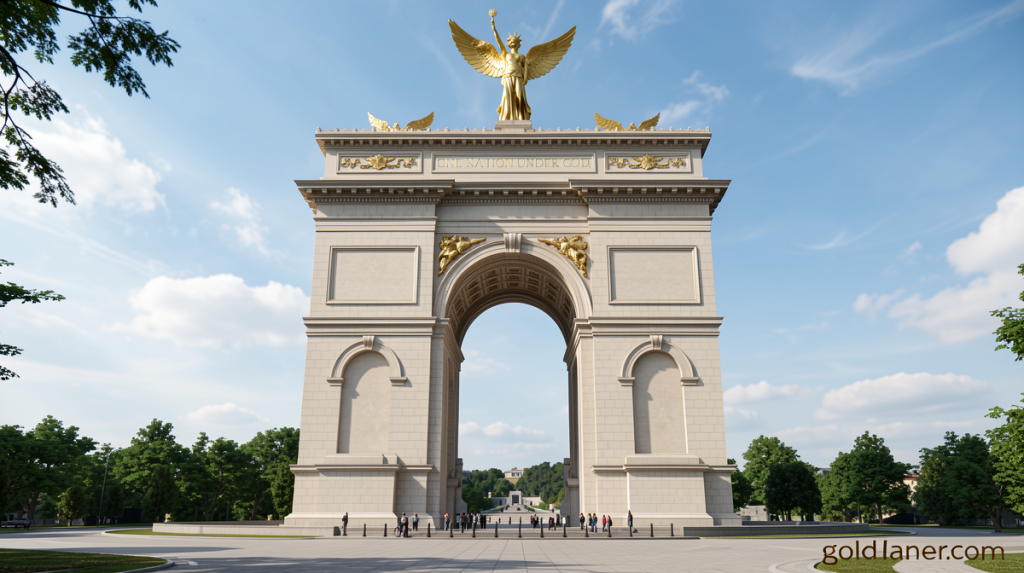
Administration Concedes Trump’s Monument Will Scar the Capital’s Historic Skyline — But Says the Site Cannot Move
Goldlaner.com – The federal agency tasked with protecting America’s most sacred memorial landscapes has formally acknowledged that a colossal 250-foot triumphal arch, championed by President Donald Trump, will inflict measurable damage on dozens of historic landmarks around Washington. Yet in a 133-page environmental review released Friday, the National Park Service simultaneously declared that the structure must remain at its originally proposed location: Memorial Circle, a traffic island in the Potomac River that sits directly between the Lincoln Memorial on the District side and Arlington National Cemetery on the Virginia side.
The report’s central argument rests on a single, repeated premise — that the arch is “inherently location dependent” and “not interchangeable” with any other placement. In the agency’s framing, moving the monument anywhere else in the capital or across the river would transform it into a “materially different commemorative project,” rendering alternative sites “not reasonable avoidance alternatives.”
What the Report Found: Dozens of Landmarks in the Arch’s Shadow
The analysis identified at least three dozen historical landmarks whose character, sightlines, or design continuity would be altered by the arch’s presence. The most severe “adverse” effects were concentrated on six sites in the immediate vicinity, including Arlington National Cemetery itself, the corridor connecting the Lincoln Memorial to Arlington House, and Arlington House — the preserved home of General Robert E. Lee, now a memorial to the Confederate commander who departed from that very residence to lead his army into the Civil War.
Because of the arch’s sheer scale, its silhouette would be visible from vantage points spanning the entire region: the United States Capitol, the Georgetown waterfront, and the Pentagon all fall within its line of sight. The structure would effectively insert itself into the ceremonial visual axis that has linked the nation’s most revered memorials for over a century.
The Location-Dependency Argument
The Park Service, which operates under the Department of the Interior and oversees the federal land where construction is planned, offered a philosophical justification for keeping the arch where it is. The agency argued that the very qualities making Memorial Circle fragile from a preservation standpoint — its role as a ceremonial gateway between two of the country’s most hallowed memorial zones — are precisely what make it the “historically appropriate location” for the project.
“The project’s effects therefore could not be fully avoided without either relocating the Arch away from the historically identified site or eliminating the principal commemorative feature, both of which would fail to meet the undertaking’s purpose and need.”
In practical terms, this reasoning closes the door on any meaningful site change while simultaneously conceding that harm will occur.
Alternatives Weighed and Discarded
The review disclosed that the agency examined several alternatives before settling on the current design. These included scaling the arch down, relocating it entirely, proceeding with no construction at all, and removing the proposed statues that would crown the structure’s apex. None were adopted. The agency concluded that each option would either produce “greater impacts to historic properties” or fail to satisfy what it called the “location-dependent purpose of the undertaking.”
Mitigation: Managing the Damage After the Fact
Alongside its findings, the report proposed a lengthy catalogue of mitigation steps intended to soften the arch’s consequences. Among them: establishing a meadow management program in the adjacent Lady Bird Johnson Park and developing an interpretive program along the Lincoln-to-Arlington House corridor. However, the document itself conceded a critical limitation.
“Mitigation measures that document, interpret, or compensate for adverse effects after they occur do not negate an adverse effect finding.”
That admission — that paperwork and interpretive signage cannot undo a visual scar — has become a focal point for preservation advocates.
Critics Call for Willful Blindness
Ed Stierli, a longtime preservationist with the National Parks Conservation Association, framed the report’s expanding scope as both a concession and a problem.
“Every time the Park Service looks harder at this site – the ceremonial gateway between Washington and Arlington National Cemetery – it finds more historic places this arch would stand in front of. Widening that assessment is the right thing to do, and it makes it that much harder to justify a 250-foot arch here.”
Charles Birnbaum, director of The Cultural Landscape Foundation and one of the project’s most vocal opponents, went further, accusing the administration of choosing ignorance over stewardship.
“If the goal of the federal review is to ‘avoid, minimize, or mitigate’ negative impacts on designated cultural and historic resources, the administration has opted for willful blindness, knowing full well that the Arch will forever disrupt the symbolic and visual connections between the Lincoln Memorial, the Kennedy gravesite and Eternal Flame, and Arlington National Cemetery, and scores of revered sites throughout the area.”
Birnbaum also directed blame at lawmakers, telling CNN: “Congress, through its failure to act, is shamefully complicit.”
Background and Ongoing Legal Battles
Trump first floated the arch concept in 2025, and detailed plans were unveiled in April of this year. Since then, the project has been entangled in a web of litigation, public protest, and institutional pushback. Veterans’ organizations, historic-preservation specialists, and ordinary residents of the capital have all voiced objections, citing preservation law, the visual integrity of the National Mall and its extensions, and questions about whether the president possesses unilateral authority to reshape a federally protected landscape of this magnitude.
The Friday report does not resolve those disputes. It confirms, in the agency’s own language, that the arch will alter the character of the nation’s most protected memorial corridor — and then instructs that the alteration must proceed anyway, because no other location would do.
Related Reading
Frequently Asked Questions
What is Trump s triumphal arch will cause?
Trump s triumphal arch will cause is the main topic of this guide. The article explains the context, practical details, and next steps readers should understand.
Why does Trump s triumphal arch will cause matter?
Trump s triumphal arch will cause matters because readers are looking for a useful answer, not just a short summary. Good content should match search intent and help them decide what to do next.