
Trump is racing to finish his border wall. Here’s how he is planning to do it
Trump is racing to finish his border wall. Here’s how he is planning to do it
Trump is racing to finish his border – President Donald Trump has intensified his campaign to complete the U.S.-Mexico border wall within the final years of his presidency. To meet this goal, his administration is prioritizing the acquisition of private land along the border, a process that relies heavily on the legal mechanism of eminent domain. This strategy comes as federal officials face significant challenges in securing sufficient land for construction, particularly in regions like Texas where much of the terrain is not under federal control.
The Department of Justice has been actively involved in this effort, recruiting attorneys specialized in using eminent domain to seize properties for infrastructure projects. This approach underscores the growing need to bypass traditional land purchase methods and directly obtain necessary parcels. As one former Homeland Security official noted to CNN, “The pace of construction is outstripping the rate at which land can be acquired. Officials are running out of space faster than they can secure it.” Such statements highlight the urgency of the task and the potential for conflict with landowners.
The Scale of the Project
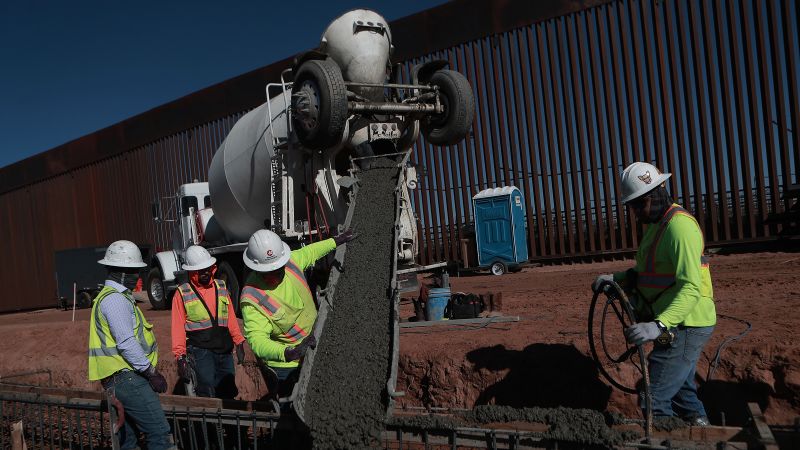
The U.S.-Mexico border spans 1,954 miles, and Trump’s administration aims to cover approximately 1,400 miles of it with barriers by the end of his term. This target includes both primary and secondary walls, as well as the integration of advanced technologies. To achieve this, the government plans to construct roughly 775 miles of new primary barriers by 2027 and an additional several hundred miles of secondary and waterborne defenses by 2028. These figures represent a massive undertaking, requiring coordinated efforts across multiple states and agencies.
Current progress shows that the Customs and Border Protection (CBP) has already added around 80 miles of primary wall and 24 miles of secondary barriers since Trump took office. Officials assert that they are on track to meet their ambitious timeline, with the CBP projecting that approximately 535 miles of the border will be equipped with surveillance and security technology. However, the challenge remains in securing the remaining land, especially in areas where private ownership is prevalent.
Legal and Logistical Challenges
The use of eminent domain has become central to the project’s execution. While this legal principle allows the government to acquire private land for public use, it has sparked debate over its fairness and efficiency. Previously, many border barriers were built in federally owned regions, but Trump’s vision demands extending the wall into private territories. This shift requires navigating complex legal procedures and negotiating with landowners, a process that has been described as both time-consuming and contentious.
Despite these hurdles, federal officials have taken steps to expedite the process. The Department of Homeland Security has waived certain legal constraints to streamline land acquisition, enabling faster project implementation. In addition, the Department of Justice has filed 39 land condemnation cases in Trump’s second term, with a focus on the Southern District of Texas. These cases are part of a broader initiative to secure properties in key states such as New Mexico, Arizona, and California.
“The only places we’re not building border wall is places where we’ve made a conscious decision that we don’t need it,” said CBP Commissioner Rodney Scott, emphasizing the targeted nature of the expansion. His remarks reflect a strategy to prioritize areas with higher security needs, such as urban zones and regions with significant cross-border activity.
Scott’s comments align with the administration’s plan to complete the primary wall from San Diego to the Gulf of Mexico, with minor gaps in certain locations. The inclusion of technology in the barrier system, such as sensors and cameras, aims to enhance monitoring capabilities. However, some areas, like Big Bend National Park and the Black Gap Wildlife Management Area, will not see the construction of a 30-foot-high wall due to environmental and logistical considerations.
Progress and Future Outlook
According to sources familiar with the planning, the administration expects to build around 10 miles of barrier per week in August, with plans to increase this rate as the project gains momentum. This acceleration is crucial to meeting the deadline, as delays could jeopardize the completion of the wall before Trump’s term ends. The CBP has also confirmed that construction contracts are being finalized, ensuring a steady pace of development.
The federal government’s approach involves a combination of legal, financial, and operational strategies. By leveraging the “big beautiful bill” of $46.5 billion allocated for border construction, officials hope to maintain budget efficiency while meeting aggressive timelines. This funding, combined with the waiver of certain laws, positions the administration to overcome obstacles and finalize the wall’s construction.
As the project moves forward, the emphasis on speed and scale is evident. The U.S.-Mexico border, once a patchwork of existing barriers and open spaces, is now being transformed into a comprehensive security network. While challenges persist, the administration’s commitment to completing the wall by the end of its term has galvanized efforts to streamline the process. Whether this goal will be achieved remains to be seen, but the progress thus far demonstrates a clear determination to make it happen.
