
Trump Asks Supreme Court to Let White House Ballroom Project Proceed
Goldlaner.com – The White House faces another legal crossroads as President Donald Trump petitions the Supreme Court to allow construction of a massive ballroom to continue. In an emergency filing submitted Friday, the administration sought immediate relief from lower court injunctions, arguing that national security imperatives and historical executive powers warrant congressional bypass. This appeal centers on whether the president can unilaterally move forward with the $400 million renovation.
Lower Courts Block Construction Progress
Recent judicial decisions have created significant obstacles for the ballroom initiative. On August 7, the United States Court of Appeals for the District of Columbia issued a 2-1 ruling halting above-ground work at the former East Wing location. The appeals court found that the president exceeded his legal authority by proceeding without legislative consent. Despite this setback, the court granted a 14-day window for the administration to seek Supreme Court intervention.
Notably, both the DC Circuit and a federal judge allowed underground bunker construction to continue beneath the ballroom site. However, Solicitor General John Sauer argued this partial allowance proved inadequate. He maintained that the entire structure functions as a protective shield for the military installation below, and any delay would compromise both timeline and security objectives.
“The President of the United States of America is not a tenant, but rather the sole, elected head of the Executive Branch, and Congress has authorized him to renovate, secure, and protect the White House and its grounds, as other Presidents have been allowed to do, without exception,” Sauer wrote in the petition.
Security Concerns Drive Legal Strategy
The administration’s case emphasizes the critical importance of presidential protection. Sauer’s filing highlighted that recent years witnessed multiple assassination attempts against Trump, transforming the ballroom’s security features from architectural choices into essential safeguards. The solicitor general described the lower courts’ injunction as exceeding the proper boundaries of federal judicial authority.
Trump’s legal team relies on historical precedent suggesting Congress has consistently granted presidents wide latitude to modify the White House complex. The petition argues that legislative delegation provided sufficient independence for the president to execute such renovations without seeking fresh approval for each phase of construction.
Architectural Scale and Preservation Debate
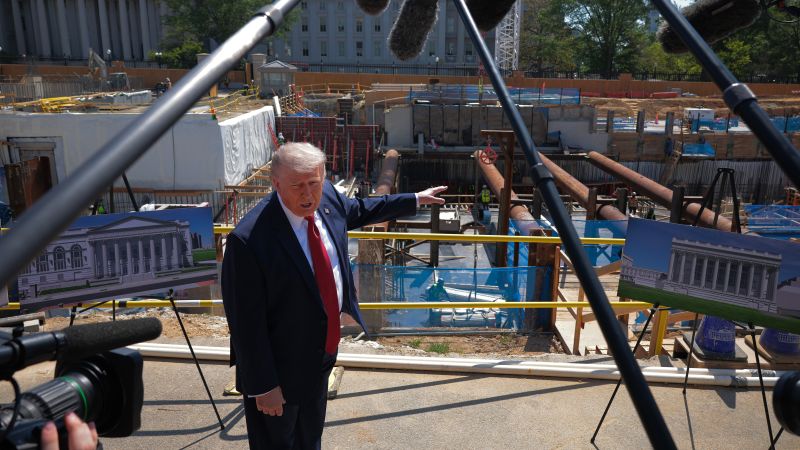
The proposed ballroom represents a substantial expansion of the Executive Mansion. Lead architect Shalom Baranes estimates the new space will encompass approximately 89,000 square feet, significantly larger than the current 55,000 square feet of the White House. Work began in spring, and progress is visible through photographs showing concrete columns, metal rebar networks, and a prominent construction crane.
Updated architectural renderings included in the petition reveal stylistic refinements, including at least two gold presidential seals added to the exterior facade. These modifications reflect efforts to balance modern functionality with historical aesthetic considerations.
The National Trust for Historic Preservation initiated the original legal challenge, contending that Congress never surrendered complete authority to redesign the iconic residence. The appeals court agreed, noting that the People’s House should not be fundamentally altered to suit individual presidential preferences.
“The National Trust has shown, compellingly, that Congress has not ceded unfettered authority to the Executive Branch to dramatically redesign, reshape, and reconstruct the White House – the People’s House – to fit a particular President’s desires,” the appeals court concluded.
Next Steps in the Legal Battle
This petition marks the first time one of Trump’s major domestic projects has reached the Supreme Court. While lower courts have expressed skepticism toward the administration’s arguments, the White House hopes the justices will acknowledge the unique constitutional and security dimensions involved. The National Trust for Historic Preservation has until noon on Tuesday to file its response to the emergency petition.
Frequently Asked Questions
What is the total cost of the White House ballroom project?
The ballroom renovation is estimated at $400 million, making it one of the most expensive White House construction projects in recent history.
Why is the ballroom considered a national security priority?
The administration argues the ballroom houses critical security infrastructure, including an underground bunker, and protects against potential threats to the president following multiple recent assassination attempts.
What would happen if the Supreme Court denies the petition?
A denial would allow the DC Circuit’s injunction to take full effect, requiring a complete halt to all above-ground construction at the former East Wing site.
How large is the proposed ballroom compared to the existing White House?
The new ballroom will measure approximately 89,000 square feet, compared to the current White House structure of 55,000 square feet.