
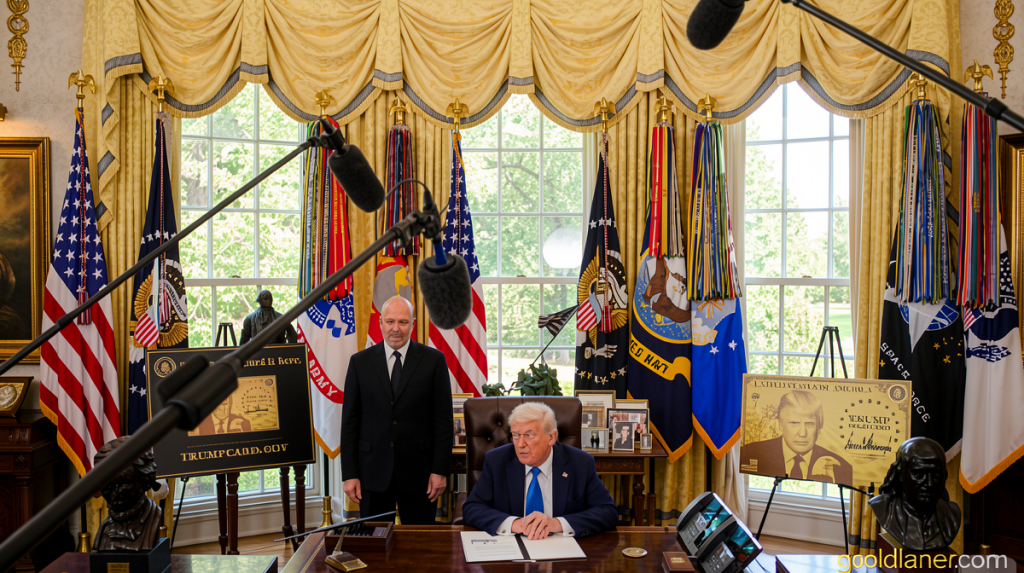
White House Returns to H-1B Fee Fight With $103,000 Proposal After Court Reversal
Goldlaner.com – Just months after a federal judge struck down the administration’s first attempt to impose a six-figure surcharge on skilled-worker visas, the Trump White House has unveiled a new regulatory proposal that would levy a $103,265 fee on every H-1B petition filed by employers seeking to bring foreign professionals into the United States. The move, laid out in a proposed rule published Monday, lands squarely in the middle of an ongoing legal and political battle over how much the executive branch can reshape immigration policy without congressional approval.
The administration frames the surcharge as a cost-recovery mechanism. In its own words, the fee is intended toward “recovering” the expenses of operating the federal immigration system while simultaneously nudging employers away from foreign labor and toward hiring and compensating American workers at higher wages. The proposal is not yet binding. It enters a public-comment window of 30 days, after which the rulemaking process could stretch for many additional months — a timeline that will lengthen considerably if the measure draws lawsuits from employers, industry groups, or affected workers.
What the H-1B Program Actually Does
For readers unfamiliar with the mechanics, the H-1B visa is the primary legal pathway through which U.S. companies sponsor foreign nationals for temporary work in occupations deemed to require specialized knowledge. An applicant must hold at minimum a bachelor’s degree or a recognized equivalent in the relevant field. Once granted, the visa is valid for an initial three-year period and may be extended once for an additional three years, giving the worker up to six years of status before a reset or departure is required.
Annual caps constrain the program’s scale. Federal law authorizes 65,000 H-1B visas per fiscal year, with a separate allocation of 20,000 reserved for individuals who earned advanced degrees from American universities and colleges. In practice, demand routinely outstrips supply, and a lottery system determines which petitions are selected when applications exceed the ceiling.
Economists and labor-market researchers have long debated the program’s net effect. Proponents argue that access to globally trained engineers, data scientists, physicians, and other specialists helps American firms stay competitive, expand operations, and ultimately generate domestic employment. Critics, including senior figures in the current administration, contend the scheme is exploited to suppress wages and displace native-born workers in fields where qualified Americans are available.
A Brief History of the Fee Dispute
The current proposal is not the administration’s first foray into this territory. In September 2025, President Donald Trump signed an executive action imposing a flat $100,000 fee on H-1B applications — a dramatic jump from the roughly $3,000 fee that had been in place previously. The stated objective was to rein in what the White House characterized as an overused program that discouraged companies from recruiting domestic talent.
The executive-order approach did not survive judicial scrutiny. In June, U.S. District Judge Leo Sorokin, a Boston-based jurist appointed by former President Barack Obama, vacated the fee. Sorokin concluded that the president possessed neither inherent nor delegated statutory authority to impose what he characterized as a tax on immigration petitions. In his written opinion, the judge was blunt:
“The President had no power or delegated authority to impose a tax on H-1B petitions.”
Sorokin’s reasoning rested on the principle that altering the financial architecture of federal immigration policy — particularly in a way that functions as a levy — is a power reserved to Congress. The ruling sent the administration back to the drawing board, where it apparently opted for the slower but procedurally more defensible route of notice-and-comment rulemaking.
Political Signaling and Industry Reaction
Vice President JD Vance amplified the new proposal on Monday with a post on X, distilling the administration’s rhetorical position into a single sentence:
“If an American corporation needs workers, it should hire and train Americans.”
The remark encapsulates the broader populist labor narrative the White House has pressed across multiple policy fronts. For the technology sector, pharmaceutical companies, financial-services firms, and higher-education institutions that rely heavily on H-1B sponsorship, a fee exceeding $100,000 per petition would represent a material cost increase. Smaller employers and startups, which often sponsor only one or two foreign workers per year, would feel the impact most acutely. Industry associations have signaled that they intend to participate in the comment period and, if necessary, challenge the final rule in court.
What Happens Next
The proposed regulation now enters a 30-day public-comment phase during which employers, workers, advocacy groups, and members of Congress may file written objections or suggestions. After the comment window closes, the Department of Homeland Security — which administers the visa program through its U.S. Citizenship and Immigration Services component — must review submissions, revise the rule if warranted, and publish a final version. That finalization process, absent litigation, typically spans several months. If the measure is challenged in court, as the predecessor fee was, the timeline extends further and the outcome becomes uncertain.
Whether Congress ultimately steps in to codify, modify, or repeal any executive-branch fee structure remains an open question. The Sorokin decision underscored that the separation-of-powers boundary between presidential immigration management and legislative taxation authority is a live legal question, and the administration’s pivot from executive order to proposed rule suggests it is attempting to build a more durable administrative record. The result, for the hundreds of thousands of foreign professionals and American employers who depend on the H-1B pipeline each year, will hinge on how that record withstands both public scrutiny and judicial review.
Related Reading
Frequently Asked Questions
What is Trump administration proposes 103 000 fee?
Trump administration proposes 103 000 fee is the main topic of this guide. The article explains the context, practical details, and next steps readers should understand.
Why does Trump administration proposes 103 000 fee matter?
Trump administration proposes 103 000 fee matters because readers are looking for a useful answer, not just a short summary. Good content should match search intent and help them decide what to do next.