
Trump administration imposes sanctions on Cuban president
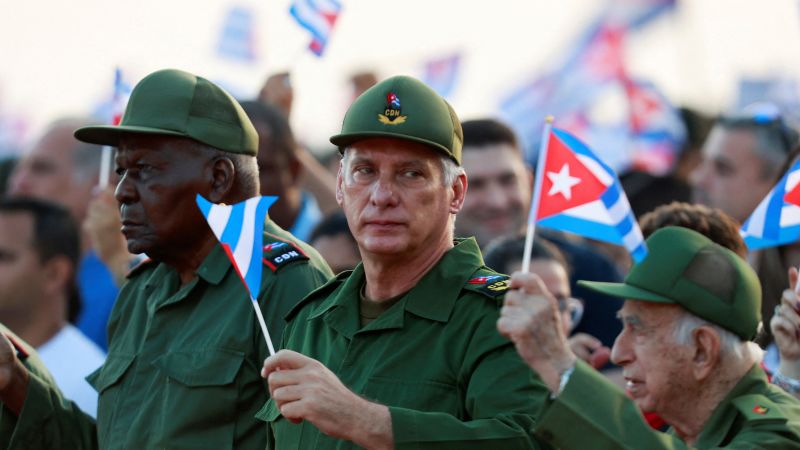
Trump Administration Targets Cuban Leadership with New Sanctions
Trump administration imposes sanctions on Cuban – On Thursday, the Trump administration announced sweeping sanctions against Cuban President Miguel Díaz-Canel, marking another step in its strategy to intensify pressure on Havana’s government. The measures also encompass Raul Castro’s son, his grandson, Díaz-Canel’s spouse, and his stepson, alongside the Ministry of the Revolutionary Armed Forces of Cuba and three other entities linked to the Cuban state. These actions aim to weaken the economic foundation of the country and push for political reforms, potentially leading to a shift in leadership.
Expanding the Scope of Economic Pressure
The sanctions, which target a range of individuals and organizations, are part of a broader effort to destabilize the Cuban economy. US Secretary of State Marco Rubio emphasized the goal of undermining the regime’s efforts to challenge U.S. national security. “These sanctions are designed to disrupt the Cuban regime’s radical action network and the actors who support its operations,” Rubio stated in a recent statement. The administration has long criticized Havana for its role in fostering leftist movements that threaten American interests, particularly in the Western Hemisphere.
Rubio highlighted the historical context of the sanctions, linking them to Fidel Castro’s early initiatives to globalize the Marxist revolution. “Havana has functioned as a strategic hub for irregular warfare against U.S. interests, training and equipping militant groups across the region,” he said. The Cuban government, under Díaz-Canel’s leadership, is accused of continuing this legacy by funding and supporting leftist organizations, including Marxist terrorist groups within the United States.
Reactions from Cuban Officials
Cuban President Miguel Díaz-Canel responded to the sanctions via a post on X, asserting that the measures are part of an ongoing effort to deepen the economic blockade. “The U.S. government’s aggressive policies will collide with our resolve to confront the most severe challenges and resist external pressures,” he wrote, with the translation provided by the Cuban embassy in Washington. This statement underscores the administration’s perception of Cuba as a strategic adversary, even as it acknowledges the Cuban people’s resilience in the face of hardship.
The sanctions also include secondary measures targeting anyone collaborating with entities controlled by GAESA, the Cuban military conglomerate that oversees significant portions of the country’s economic infrastructure. A separate State Department document warned that foreign banks and companies providing services to these designated groups face the risk of penalties. “The Trump Administration will persist in isolating the Cuban regime’s subversive apparatus and those who benefit from its operations,” the fact sheet stated, emphasizing the punitive approach.
Broader Strategy and Military Preparedness
While sanctions remain a central tool, the administration has also kept the option of military action open. A U.S. military carrier was recently deployed to the Caribbean region, signaling readiness for escalation. Rubio, during a speech to lawmakers on Capitol Hill, reiterated Cuba’s role as a threat to American security. “The Cuban regime’s activities have consistently posed risks to U.S. interests, requiring a multifaceted response,” he said, outlining the combination of economic, diplomatic, and military tactics in play.
Rubio’s remarks reflect a long-standing view of Cuba as a leftist stronghold that requires systemic change. He compared the current situation to the transformation of Venezuela under the influence of Delcy Rodriguez, a former associate of Hugo Chávez. “Our goal is to identify individuals within Cuba who can lead a transition toward stability and democratic governance,” Rubio explained. However, he admitted that such a figure has yet to emerge, leaving the administration without a clear partner for reform.
Historical Context and Diplomatic Tensions
The new sanctions build on a history of U.S.-Cuba relations marked by shifting alliances and strategic interventions. Since the 1960s, the United States has imposed economic restrictions on Cuba, initially as a response to the Cuban Revolution and later to counteract the spread of communism. The Trump era has intensified these measures, with a focus on isolating the Cuban government and its allies. This approach has been criticized for its harshness, but supporters argue it is necessary to pressure Havana into change.
Rubio’s comments also reveal a strategic emphasis on finding institutional allies within Cuba. He suggested that transitions in other Eastern European nations, such as the Czech Republic and Poland, could serve as models. “These countries maintained key institutions while gradually adopting more democratic practices, ensuring long-term stability,” he noted. This analogy implies that the Trump administration sees Cuba as a potential candidate for a similar evolution, despite its current ideological framework.
Challenges and Uncertainties Ahead
Despite the administration’s assertive stance, challenges persist in achieving its objectives. Rubio acknowledged the difficulty of aligning with Cuban officials who may not share the same vision for reform. “There are technocrats within the system who recognize the need for change, but ideological barriers limit their effectiveness at higher levels,” he said during a House Foreign Affairs Committee hearing. This sentiment highlights the tension between pragmatic allies and hardline supporters of the current regime.
The lack of a clear “Delcy number two” in Cuba has been a point of frustration for U.S. diplomats. “We haven’t identified an individual who can serve as a bridge to facilitate a transition, unlike the situation in Venezuela,” Rubio stated. This absence of a potential collaborator complicates the administration’s ability to negotiate a path toward Cuban normalization. Nonetheless, the Trump team remains committed to its strategy, with Rubio emphasizing that the Cuban government’s current structure is not sustainable.
As the sanctions take effect, the focus shifts to their impact on both the Cuban economy and its political landscape. While the immediate effects may be financial, the long-term goal is to erode support for the regime and encourage a shift toward a more open system. The administration’s continued engagement with military assets and diplomatic channels suggests that it is prepared to escalate its efforts if necessary, ensuring that Havana remains under pressure for the foreseeable future.
