
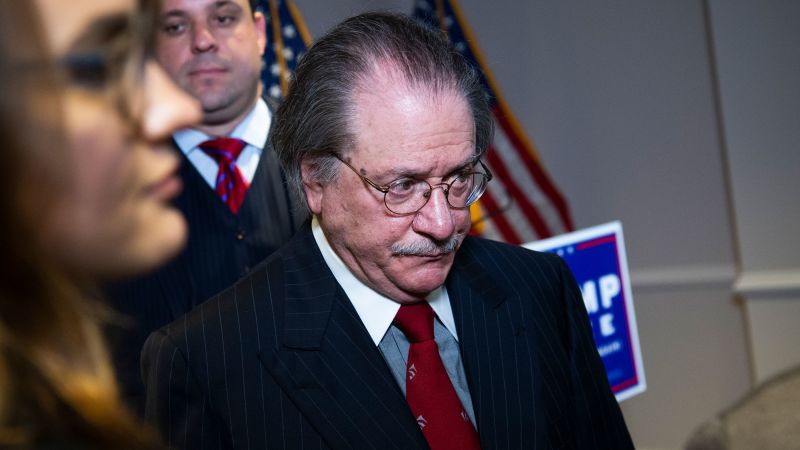
Joe diGenova Leaves Justice Department Role Amid Disputes Over Florida Investigation
Goldlaner.com – Joe diGenova has resigned from a Justice Department position overseeing a wide-ranging investigation focused on government actions involving President Donald Trump and several of his political adversaries.
His departure follows internal disagreements over the direction and speed of the south Florida-based inquiry, which was created to examine potential criminal cases tied to earlier investigations of Trump. People briefed on the matter said diGenova had clashed with senior Justice Department officials and was recently told that he no longer had the confidence of his superiors.
“It was an honor and privilege to serve the president and the department,”
diGenova said in a brief telephone interview. He did not discuss the disputes that preceded his resignation.
An Investigation With Broad Ambitions
The inquiry has been examining what Justice Department officials view as possible wrongdoing connected to a series of government investigations reaching back to the 2016 examination of Russian election interference. Its scope also includes the federal cases brought against Trump over the January 6, 2021, attack on the US Capitol and the handling of classified documents at Mar-a-Lago.
Former CIA Director John Brennan and former FBI Director James Comey are among the former government officials whose actions have drawn scrutiny. The investigation has been described as an effort to determine whether decisions made across multiple years and agencies could support criminal charges.
That breadth has also made the case difficult to manage. The probe encompasses separate events, different investigative teams and a range of potential legal theories. For prosecutors, turning a broad political and institutional review into a focused criminal case requires identifying specific conduct, evidence and applicable laws.
DiGenova took control of the matter in April after Maria Medetis Long, an experienced career prosecutor, was removed from the role. Medetis Long had resisted pressure to bring charges more quickly. When diGenova was appointed counselor to the attorney general, he said he believed charges could be filed within 30 days.
That timetable did not produce immediate public action. While the investigation saw more witness interviews under diGenova’s leadership, witnesses also recently appeared before a grand jury. Even so, the case remained unfinished despite expectations at Justice Department headquarters that charges might be filed as early as this month.
Focus of the Case Became a Central Dispute
Early indications suggested prosecutors might begin with a narrower case involving Brennan and allegations of false statements made during congressional testimony. DiGenova instead pushed to examine additional people and matters as part of a larger effort.
“Joe came in pretty hot,”
one person familiar with the investigation said, adding that he had many issues he wanted to pursue.
Another person briefed on the case characterized the expanding approach as “going down 900 rabbit holes.” The same person said diGenova was “missing the forest the trees,” reflecting concerns that the investigation was losing sight of its most viable potential cases.
The disagreement illustrates a recurring challenge in politically charged investigations: a broader inquiry can uncover more information, but it can also delay decisions and divide a team over priorities. A more limited case may be easier to present to a grand jury, while a larger theory can require substantially more evidence and coordination.
Tension Inside the Prosecutorial Team
DiGenova largely worked from an office in Fort Pierce, Florida. More than a dozen prosecutors were assigned to pursue various targets, but the investigation has struggled with leadership and cohesion, people familiar with the work said.
Career attorneys on the case faced angry outbursts from diGenova and were sometimes pushed aside, one person familiar with the inquiry said. The lack of a clear focus fueled friction within the team and created uncertainty over how the investigation would proceed.
Concerns at Justice Department headquarters also extended to US Attorney Jason Reding Quiñones. Quiñones, the Senate-confirmed chief prosecutor for the district, had repeatedly indicated since last year that charges would be brought in the matter.
Justice Department leaders had intended for Quiñones to retain oversight because he was the district’s top confirmed prosecutor. The decision to bring in diGenova signaled doubts within department leadership about whether Quiñones could move the case forward.
In a recent dispute with senior Justice Department officials, Quiñones sought to distance himself from problems that had affected the investigation. DiGenova’s resignation now adds another disruption to a case that has already seen a change in leadership and shifting investigative priorities.
What Comes Next
The Justice Department has not publicly detailed who will assume day-to-day control of the investigation or whether its strategy will change. The next leader will face a practical question: whether to pursue a narrower allegation that may be closer to charging decisions, or continue a broader examination involving multiple former officials and years of government activity.
For now, the investigation remains active, with witness interviews and grand jury activity showing that prosecutors are still gathering evidence. DiGenova’s exit, however, leaves the department to determine whether the case can regain direction after months of internal conflict and unmet expectations.
Related Reading
Frequently Asked Questions
What is Trump admin pick to oversee a conspiracy?
Trump admin pick to oversee a conspiracy is the main topic of this guide. The article explains the context, practical details, and next steps readers should understand.
Why does Trump admin pick to oversee a conspiracy matter?
Trump admin pick to oversee a conspiracy matters because readers are looking for a useful answer, not just a short summary. Good content should match search intent and help them decide what to do next.