
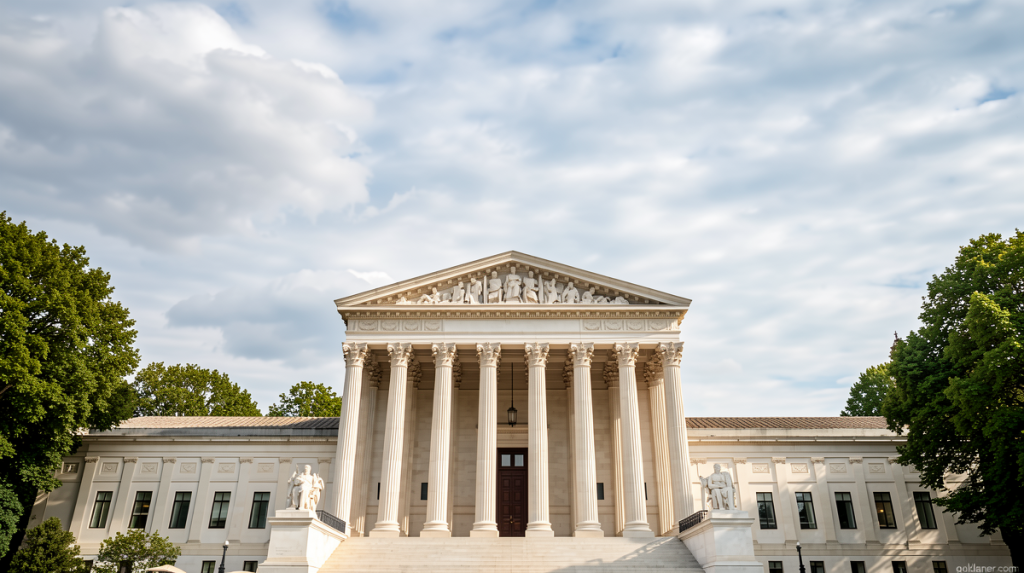
Supreme Court Clears Path for Trump’s Mail-Ballot Restrictions, But Legal Battles Are Far From Over
Goldlaner.com – The nation’s highest court issued a 10-page unsigned opinion on Monday granting the Trump administration permission to begin executing portions of a sweeping executive order aimed at reshaping how Americans cast ballots by mail. The ruling, delivered over the objections of the court’s three liberal justices, opens the door for the Department of Homeland Security and the U.S. Postal Service to assume roles in election administration that neither agency has previously held. Yet the decision stops well short of endorsing the order’s substance, leaving the full scope of Trump’s mail-voting agenda entangled in litigation that will likely continue through the November midterm elections.
A Narrow Green Light, Not a Blank Check
The court’s order carefully confines its holding to procedural timing. It does not rule on whether the March executive order is lawful under the Constitution or federal statute. Instead, the justices determined that Democratic-led states challenging the plan in lower courts must wait before pressing their claims to the Supreme Court. That procedural posture, while seemingly technical, carries enormous practical weight: it allows the administration to move forward with at least one component of its election-reform blueprint while the merits questions remain unresolved.
Specifically, the ruling permits the administration to advance a proposal under which DHS would assemble state-by-state rosters of individuals it deems eligible to vote, targeting the Democratic-led states that filed suit against the plan. Separately, the justices authorized the Postal Service to enforce new requirements on states wishing to mail ballots — including mandatory submission of voter-eligibility lists to the agency and the inclusion of tracking identifiers on ballot envelopes.
“If the Postal Service’s final rule harms the states, they may challenge that rule,” the court wrote in its order.
That language signals the justices’ awareness that the USPS mandate, once finalized, will face fresh litigation. Indeed, a lower federal court has already blocked the Postal Service’s nationwide implementation of those tracking requirements in a separate case, meaning additional judicial action — potentially emergency appeals reaching the Supreme Court within days — will be required before the agency can proceed.
The Broader Election-Security Agenda
The March executive order represents the most aggressive federal intervention in state-run elections in decades. It assigns the Postal Service and DHS unprecedented operational roles in the mechanics of voting, from voter-eligibility verification to ballot-envelope tracking. Critics argue the order effectively rebuilds a federal election-security infrastructure that the administration itself dismantled in earlier years, now repurposed to impose uniform federal standards on states that have long administered elections under their own statutes.
Trump has spent years publicly asserting that mail voting is rife with fraud, a claim that election officials and multiple studies have repeatedly disputed. The executive order translates those assertions into concrete regulatory mandates, giving federal agencies the tools to scrutinize and, in some cases, override state-level voting procedures.
“The court’s disposition of this application does not mean that any measure taken by the government to implement the order will necessarily be lawful,” the court wrote. “On that score, time will tell.”
Dissenting Voices and the Anti-Chaos Doctrine
The three liberal justices filed dissents that sharply criticized the majority’s willingness to let the administration proceed before the merits are settled. Justice Sonia Sotomayor, joined by Justice Elena Kagan, argued that lower courts possessed the authority to rule in favor of the challenging states immediately, and stressed that the majority had not addressed whether the President holds any constitutional or statutory power to direct state election administration.
“Today’s decision does not address whether the President’s attempts to interfere with States’ administration of the November 2026 elections are lawful. Nor does it suggest that the Executive Branch has any constitutional or statutory authority to implement the President’s directives,” Sotomayor wrote. “Instead, today’s decision merely postpones adjudication of those challenges.”
Justice Ketanji Brown Jackson authored a separate, lengthy dissent employing more pointed language. She characterized the ruling as needlessly injecting chaos and uncertainty into the upcoming midterms and accused the conservative majority of applying inconsistent standards when deciding when election-related challenges may reach the court. Her dissent invoked what commentators have called the Court’s “anti-chaos” election rule — the principle that courts should avoid decisions that create confusion in the run-up to an election — arguing that the majority had inverted that principle by allowing federal agencies to alter voting procedures while the underlying legality questions remain open.
Implications Heading Into November
The practical upshot for voters and election officials is a period of heightened uncertainty. Democratic-led states, which had warned they would need to divert time and resources from routine election preparation to respond to the order, now face a compressed timeline in which federal agencies may begin implementing new rules while parallel litigation continues in district and circuit courts.
Steve Vladeck, a Supreme Court analyst and professor at Georgetown University Law Center, characterized the ruling as a temporary advantage for the administration rather than a definitive victory.
“The ruling is a win for Trump for the moment, but it doesn’t fully clear the way for his effort to limit mail-in ballots to go into effect,” Vladeck said. “As soon as tomorrow, a Massachusetts district court may block the underlying USPS rule at issue — which is the real thing to watch heading into November.”
The decision arrives against the backdrop of an already turbulent election-law season at the Supreme Court. In late April, the court’s 6-3 conservative majority struck down key provisions of the Voting Rights Act in a landmark ruling concerning Louisiana’s congressional districts, a decision from which the liberal justices dissented. That ruling, combined with Monday’s order, underscores a pattern in which the conservative majority has expanded executive latitude over state election processes while narrowing federal protections for minority voters.
For the millions of Americans who rely on mail ballots — including elderly voters, military personnel stationed overseas, and residents of rural counties where in-person polling places are scarce — the coming weeks will determine whether the November elections proceed under state-established rules or under a hybrid federal-state framework whose constitutionality has yet to be tested on the merits. The Supreme Court’s Monday order, in other words, is a procedural waypoint, not a destination. The substantive fight over who controls the mechanics of American elections is still unfolding.
Related Reading
Frequently Asked Questions
What is Supreme Court backs Trump s order?
Supreme Court backs Trump s order is the main topic of this guide. The article explains the context, practical details, and next steps readers should understand.
Why does Supreme Court backs Trump s order matter?
Supreme Court backs Trump s order matters because readers are looking for a useful answer, not just a short summary. Good content should match search intent and help them decide what to do next.