
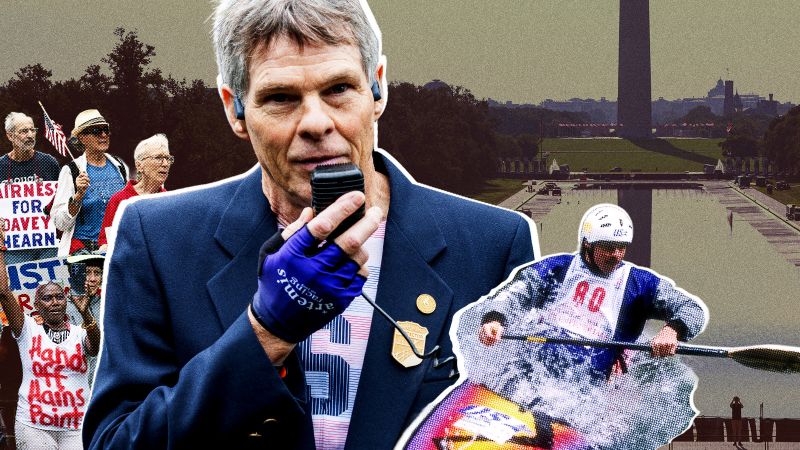
David Hearn’s Long Journey From Olympic Canoeist to Washington Flashpoint
Goldlaner.com – David Hearn spent decades representing the United States in canoe slalom competition, but the 67-year-old Maryland native has found himself in a far different kind of spotlight in Washington. Once known primarily as a three-time Olympian and respected coach, Hearn has become a prominent figure in the political fight surrounding the Lincoln Memorial Reflecting Pool and President Donald Trump’s vision for the capital.
The controversy centers on problems at the 2,000-foot pool, which has remained closed behind fencing after a $14 million renovation project went wrong. Federal prosecutors accused Hearn of deliberately damaging the site, allegations that exposed him to a possible 10-year prison sentence. A federal judge later threw out the case with prejudice, ending the prosecution.
To Trump and supporters who view the Reflecting Pool as part of a major effort to beautify Washington, Hearn became a symbol of alleged hostility toward a high-profile project. For critics of the administration, he became an example of someone unfairly drawn into a political conflict and blamed for failures surrounding the renovation.
A connection to the Reflecting Pool that began in 1977
Hearn’s relationship with the landmark began nearly 50 years earlier under far more celebratory circumstances. In the summer of 1977, when he was 18, he placed a yellow canoe in the shallow pool and paddled its length with friends.
The outing was authorized and served as a sendoff for Hearn and several fellow athletes before they departed for Austria to enter their first Canoe Slalom World Championship. What would be nearly unimaginable at the monument today was then a public moment tied to the start of an international athletic career.
That career eventually included appearances at the 1992, 1996 and 2000 Summer Olympics. Hearn competed around the world, collecting gold, silver and bronze medals, and became a familiar name in whitewater canoeing.
“I’ve been used to representing my country over many years in the canoe kayak arena and three Olympics, and yet this has been an experience that surpassed that in many ways,” Hearn said.
He made the remark recently at East Potomac Park, where people gathered around him and chanted, “Davey! Davey! Davey!” The event focused on resistance to plans to remake the public golf course, another Trump-backed Washington renovation project. The park’s views of the Potomac River have made the proposed conversion to a championship-level course a subject of public debate.
Built by the Potomac
Hearn’s life in paddling began long before Olympic competition. As a teenager, he and friends would canoe on the Potomac River after school. His father, Carter Hearn, paddled whitewater, as did his older sister, Cathy Hearn.
The family lived near Great Falls Park, where the river’s powerful flow has long attracted whitewater enthusiasts. That setting shaped Hearn’s identity as both an athlete and member of a tight-knit outdoor community.
His commitment to canoe slalom was extensive. While in college, he took time away every other spring to train for the World Championships, then held every two years. His competitive travel brought him to dozens of countries and helped establish him as a leading figure in the sport.
“There was not a whitewater canoer or kayaker in the DC region or nationally or internationally that didn’t know or revere Davey Hearn,” said Adam Van Grack, one of Hearn’s students.
After his Olympic years, Hearn coached other paddlers and remained closely connected to the regional whitewater scene. The appreciation for his work in that community helps explain why the Reflecting Pool case resonated beyond the immediate legal dispute.
Risk, rescue and a lifetime on the water
Hearn’s public profile had intersected with the Potomac before. In 1996, shortly before his second Olympic appearance, he was arrested for canoeing in dangerous river conditions despite a closure sign. The incident happened during heavy rain, when the Potomac was running fast.
He faced a potential $5,000 fine and up to six months in jail, but the charges were later dismissed. The episode illustrated both the hazards of the river and Hearn’s determination to paddle even in demanding conditions.
Only four months later, Hearn and his sister were training near Little Falls Dam when fishermen became stranded in rough water. The pair helped authorities bring the men safely back to shore.
“They were kind of stranded out there,” Hearn said. “They could’ve stayed there indefinitely, but I’m not sure how they would’ve gotten back.”
The rescue reinforced Hearn’s standing among people who knew him through the whitewater community: an athlete deeply familiar with the Potomac’s risks and willing to help when others were in trouble.
A new role in a changing capital
Before the Reflecting Pool controversy turned him into an unlikely political figure, Hearn was still pursuing demanding athletic goals. Earlier this year, on a mild June afternoon, he left his Bethesda home for a 52-mile bicycle ride through Washington. The route was part of his preparation for the UCI Gran Fondo World Championships.
That continued drive for competition has now been joined by public advocacy. Hearn’s appearance at East Potomac Park placed him among local people who have become nationally visible through conflicts involving Trump’s policies and redevelopment agenda in Washington.
His story is unusual because it combines a long athletic career, a deeply personal connection to the Potomac and the city’s monuments, and a legal case that became entangled with a larger argument over who gets blamed when public projects fail. For Hearn, the Reflecting Pool is not simply a political symbol. It is also part of a Washington landscape that has framed his life since he was a young canoeist preparing to compete for his country.
Related Reading
Frequently Asked Questions
What is Olympic canoeist at center of Reflecting?
Olympic canoeist at center of Reflecting is the main topic of this guide. The article explains the context, practical details, and next steps readers should understand.
Why does Olympic canoeist at center of Reflecting matter?
Olympic canoeist at center of Reflecting matters because readers are looking for a useful answer, not just a short summary. Good content should match search intent and help them decide what to do next.