
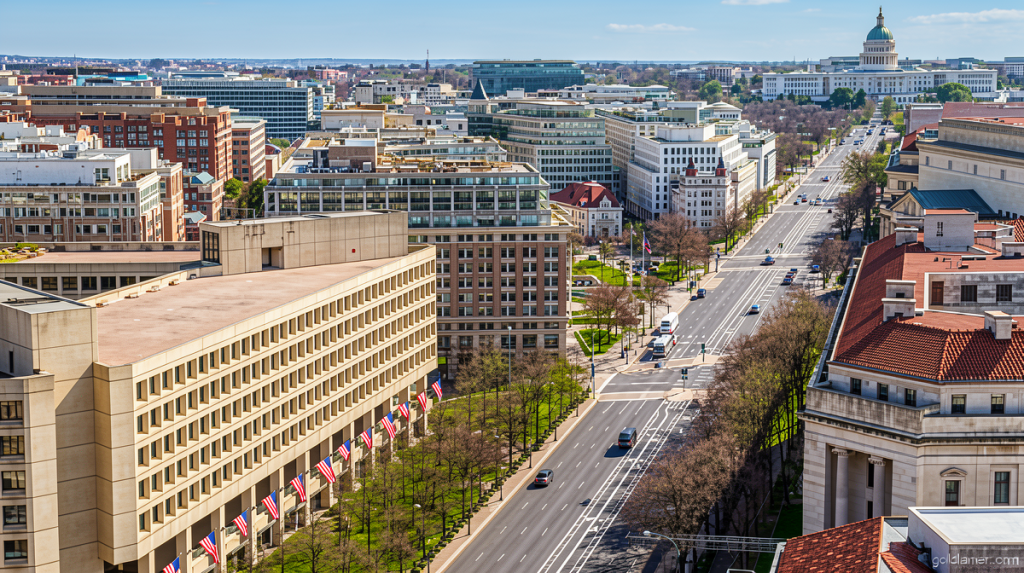
Federal Court Halts FBI Headquarters Relocation to Reagan Building, Reviving Greenbelt Plan
Goldlaner.com – A ruling issued Monday by a federal judge in Washington, D.C., effectively froze the Trump administration’s attempt to redirect the FBI’s headquarters move from a long-planned site in suburban Maryland to a federal office building in the nation’s capital. The decision restores momentum to a relocation strategy that had been in development since roughly 2009 and was formally selected by the General Services Administration in 2023.
The case, brought by Prince George’s County and the state of Maryland after they filed suit in November, centered on whether the FBI and GSA possessed the legal authority to abandon a congressionally funded construction project and redirect those funds toward an alternative location. Judge Theodore Chuang, appointed to the bench by former President Barack Obama, concluded that the agencies overstepped their statutory powers.
The Original Greenbelt Strategy and Its Long Gestation
The FBI’s current home, the J. Edgar Hoover Building in downtown Washington, has long required extensive structural and systems upgrades. Rather than renovate in place, the agency and GSA pursued a full relocation. After nearly fifteen years of planning, site selection, and interagency coordination, GSA designated a parcel in Greenbelt, Maryland — a suburb roughly 15 miles southeast of the Capitol — as the future headquarters campus in 2023. Congress subsequently appropriated $323 million specifically earmarked for that Greenbelt project.
The selection was not merely an administrative choice; it carried significant economic weight for Prince George’s County, which had invested in infrastructure, workforce development, and community planning tied to the anticipated arrival of thousands of federal employees and contractors.
The Administration’s July 2025 Pivot
In July 2025, the FBI and GSA jointly announced a dramatic course correction: the headquarters would instead move to the Ronald Reagan Building, a large federal office complex located just blocks from the Hoover Building in downtown Washington. Under this revised plan, $555 million in previously allocated funds — including the congressionally appropriated $323 million for Greenbelt — would be reprogrammed toward the Reagan Building transition.
The Reagan Building, which previously housed the now-defunct United States Agency for International Development, also accommodates other federal tenants, including U.S. Customs and Border Protection. The administration framed the pivot as a matter of fiscal prudence and operational efficiency, arguing that the Greenbelt project “would have cost the taxpayers billions of dollars and taken years to construct.”
Judge Chuang’s Findings
In his written opinion, Chuang sided with the county and state plaintiffs on the central legal question. He determined that the agencies’ decision to scrap the congressionally funded Greenbelt site and redirect those dollars toward the Reagan Building was “arbitrary and capricious” and not in accordance with law. The judge emphasized that Congress had attached specific conditions to the appropriations, and that the agencies lacked unilateral authority to repurpose those funds for a different location without legislative action.
Chuang also weighed the practical consequences of an injunction. He noted that the FBI’s transition to the Reagan Building remained in its earliest stages, meaning that ordering the agencies to stand down would impose limited immediate disruption on the defendants.
“If the Reagan Building project moves forward, Plaintiffs will lose the opportunity to have the substantial economic benefits that would have a positive impact not just on individual private parties, but on the community in Prince George’s County.”
He added that the defendants were “still at the beginning stages of moving the FBI to the Reagan Building … so the immediate impact of an injunction of Defendants would be limited.”
Administration Reactions
Agency spokespeople pushed back quickly. A GSA representative told reporters that the judge was making a “political decision designed to undermine” the president, and insisted the agency would “not pursue an inferior approach in cost, speed, and value.” The spokesperson pledged to “ensure its agency partners, including the FBI, have workspaces to best accomplish their missions on behalf of the American people.”
An FBI spokesperson offered a shorter rebuke: “The court has chosen to impermissibly intervene for political reasons.” The Justice Department had been contacted for comment but had not responded as of publication.
Maryland’s Celebration and the Broader Political Fight
Maryland Democratic Governor Wes Moore welcomed the ruling in a Monday statement, framing it as a vindication of years of state-level advocacy.
“President Trump tried to take from Maryland what Maryland had already won. He failed.”
Moore urged officials to move swiftly on construction: “Now it is time to stop the games and get to work building the world-class FBI headquarters that our public servants deserve, where it belongs: in Prince George’s County, Maryland.”
The political dimension of the dispute dates to shortly after Trump took office. During a March 2025 address at the Department of Justice, the president vowed to prevent the headquarters from moving to what he called “a liberal state.” “We’re going to stop it. Not going to let that happen,” he declared.
FBI Director Kash Patel, who has overseen the agency since early 2025, defended the Reagan Building option as “the most cost effective and resource efficient way to carry out our mission to protect the American people and uphold the Constitution.”
What Comes Next
The ruling does not permanently settle the question of where the FBI will ultimately be headquartered. The administration retains the option to appeal to the Fourth Circuit Court of Appeals, and Congress could, in theory, pass new legislation authorizing a different site or reallocating the appropriated funds. For Prince George’s County, however, the decision preserves the economic pipeline that local leaders spent years cultivating — a pipeline that, absent further legal or legislative intervention, now points back toward Greenbelt.
The Hoover Building, meanwhile, remains in need of major repairs regardless of where the agency ultimately settles. The question of whether those upgrades proceed in parallel with any relocation, or whether the building is decommissioned entirely, will shape the timeline for whichever site ultimately receives the FBI’s operations.
Related Reading
Frequently Asked Questions
What is Judge rules FBI can t abandon?
Judge rules FBI can t abandon is the main topic of this guide. The article explains the context, practical details, and next steps readers should understand.
Why does Judge rules FBI can t abandon matter?
Judge rules FBI can t abandon matters because readers are looking for a useful answer, not just a short summary. Good content should match search intent and help them decide what to do next.