
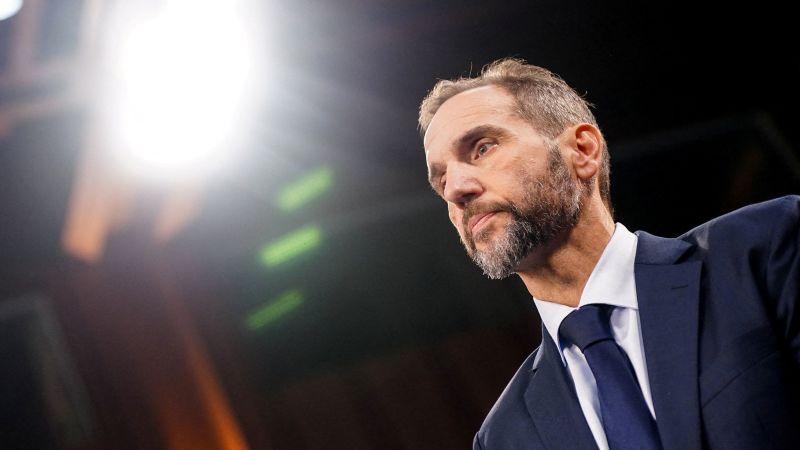
Jack Smith’s Senate appearance puts GOP accusations under sharper scrutiny
Goldlaner.com – Former special counsel Jack Smith returned to Capitol Hill on Tuesday to testify before the Senate Judiciary Committee, facing lawmakers still focused on his two 2023 indictments of President Donald Trump. The hearing arrived amid continued Republican efforts to examine the investigations and calls from some GOP figures, including Trump, for criminal action against Smith.
But one of the day’s most forceful attacks on Smith instead became an uncomfortable moment for the senator pursuing it. A line of questioning from Missouri Republican Sen. Eric Schmitt, built around text messages and an alleged trip to Atlanta, unraveled after Smith reviewed the evidence himself.
A basketball-game allegation goes off course
Schmitt suggested that Smith’s supposed presence at an Atlanta Hawks game on February 3, 2024, could connect him to the Fulton County, Georgia, prosecution of Trump. That date came one day after Fulton County District Attorney Fani Willis and special prosecutor Nathan Wade acknowledged their relationship.
Smith initially denied attending a Hawks game and said he did not recall even being in Atlanta. Schmitt framed the exchange as a potentially serious credibility test.
“What would you say if I had a series of text messages from your team that said you were in Atlanta at a Warriors-Hawks game on February 3, 2024 – the day after Willis and Wade announced their affair?”
Schmitt pressed the point, telling Smith that he might not realize what material the committee possessed and cautioning him against perjury. He later used the term “dirtbag” to describe Smith.
After Democrats pushed for Smith to be allowed to see the display containing the messages, the apparent basis for the allegation came into clearer view. One message referred to a seat being held for Smith, while the display used imagery of the Hawks’ arena. Smith then said the game he attended was not an NBA contest in Atlanta. Instead, he said he had gone to see the University of Iowa women’s team, led at the time by Caitlin Clark, play at the University of Maryland near Washington, DC.
That recollection matches a game played on February 3, 2024. The distinction was central: the inquiry had treated a reference to a “Hawks” game as proof that Smith had been in Atlanta, overlooking the possibility that it referred to Iowa’s Hawkeyes women’s basketball team.
A person familiar with how the error occurred said Schmitt’s team checked that day’s NBA and men’s college basketball schedules and found the Hawks playing, but did not account for women’s college basketball.
Calls for an apology, and a defiant response
After the confusion was resolved, Democratic Sen. Amy Klobuchar of Minnesota said Schmitt should apologize. Schmitt instead brushed off the episode, joking afterward about Smith’s interest in Caitlin Clark.
“Who knew Jack Smith was a Caitlan Clark fan?”
Schmitt maintained that pointed questioning was appropriate at a congressional hearing and said the texts could still have been related to the Fulton County case. He also stood by his description of Smith. His defense underscored the broader divide on the committee: Republicans have pursued claims that Trump’s political opponents and the justice system worked improperly against him, while Democrats have challenged the factual foundation for those claims.
The exchange offered an unusually clear example of the risks in building a major allegation from incomplete information. What began as a suggestion of a hidden connection between Smith and the Georgia prosecution quickly became a dispute over the name of a basketball team and the location of a game.
For readers following the larger political fight, the moment matters because it shows how congressional hearings can shape public perceptions even when an accusation does not hold up. Claims raised in a high-profile setting can travel quickly, while corrections often require more context: reviewing the underlying material, reconstructing a timeline and allowing the witness to respond directly.
A composed witness takes a more forceful tone
Smith has developed a reputation as a deliberate witness. He frequently pauses before answering questions, an approach that can make his testimony feel measured and cautious. On Tuesday, however, he also displayed more emotion in discussing what he described as efforts by the Trump administration to use the Justice Department against people connected to his work.
His opening statement ended with a broader warning about the political climate and the importance of resisting fear.
“Fear may be contagious; courage is as well.”
Smith called it an “outrage” that people who worked with him had been illegally targeted, illegally lost their jobs and had their lives disrupted by the Justice Department. His remarks placed the hearing in a larger argument over institutional independence, prosecutorial accountability and the consequences for career officials drawn into politically charged investigations.
He also addressed the Supreme Court’s 2024 decision giving presidents substantial immunity for official conduct. Smith said broad exceptions benefiting powerful officials could pose a serious threat to the rule of law.
“can be very dangerous for the rule of law”
That response connected the hearing to an ongoing national debate about presidential power. Smith’s cases against Trump made questions of presidential authority, criminal liability and the limits of executive action especially consequential. Even after the immediate legal proceedings, those questions remain central to how lawmakers and the public assess the boundaries of the presidency.
The political takeaway
Tuesday’s hearing did not erase the partisan conflict surrounding Smith’s investigations. Republicans remain determined to investigate how the Trump cases were pursued, while Smith has made clear that he rejects the suggestion that he or his colleagues acted improperly.
Yet the basketball-game episode made the divide more tangible. It illustrated the difference between raising difficult questions and substantiating them with verified evidence. In a hearing centered on accusations of misconduct and perjury, the most memorable exchange was one in which a seemingly dramatic allegation collapsed after a basic factual clarification.
Smith left the hearing having faced sustained criticism, but the most conspicuous misstep belonged to one of his questioners. The episode is likely to remain a defining image of a broader struggle over Trump’s prosecutions: intense political claims, competing interpretations of the justice system and a continuing demand for evidence that can withstand close examination.
Related Reading
Frequently Asked Questions
What is An embarrassing moment for the GOP?
An embarrassing moment for the GOP is the main topic of this guide. The article explains the context, practical details, and next steps readers should understand.
Why does An embarrassing moment for the GOP matter?
An embarrassing moment for the GOP matters because readers are looking for a useful answer, not just a short summary. Good content should match search intent and help them decide what to do next.