
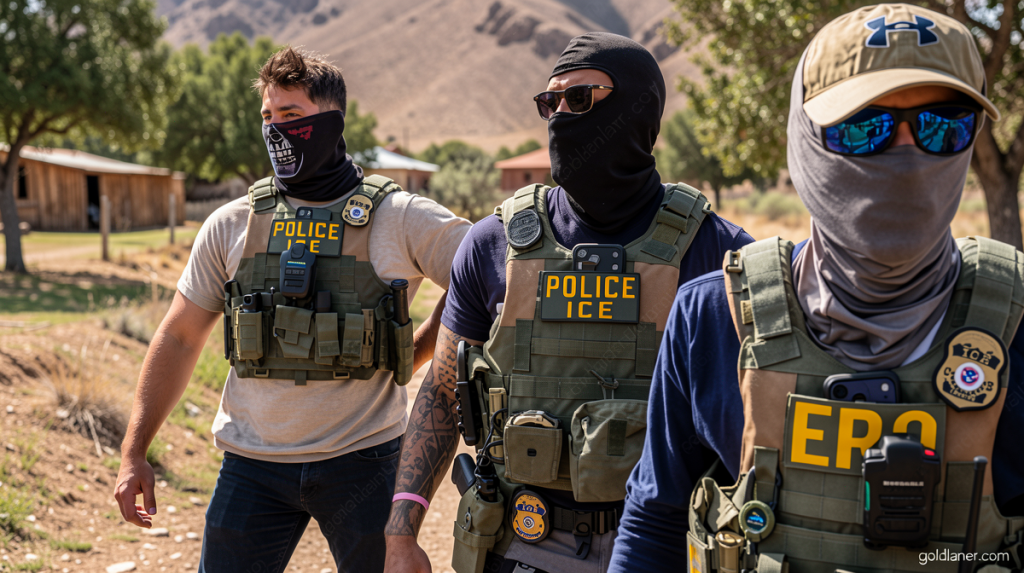
All ICE Agents in the Field Get Cameras by September
Goldlaner.com – Homeland Security Secretary Markwayne Mullin confirmed on Tuesday that every active immigration officer deployed in the field will carry a body-worn camera before the month ends. Speaking at a press briefing in New York, Mullin acknowledged the rollout has slipped past its original August deadline but insisted the agency is now within weeks of full compliance. He framed the delay as a matter of logistics rather than will: outfitting a dispersed workforce spread across ports, airports, rural border posts, and urban enforcement hubs takes longer than procurement timelines initially projected.
“We’re getting close. By the end of September, I’m pretty sure we will be there.”
The agency had earlier issued a statement confirming that hardware had been procured and that individual officers were undergoing familiarization training. Yet the practical reality of equipping thousands of agents simultaneously — many stationed in remote or multilingual operating environments — has stretched the schedule beyond what internal projections anticipated.
Bipartisan Momentum Behind the Mandate
Pushing recording devices onto federal immigration personnel has generated a level of cross-party support that is rare in today’s polarized climate. That consensus sharpened considerably after a year of increasingly confrontational — and in some cases fatal — encounters between enforcement officers and members of the public. Smartphone videos shot by bystanders during detentions and removals have intensified public demand for an independent, timestamped record of what agents see and say during each interaction.
White House border czar Tom Homan has been the administration’s most visible champion of the measure. On a Sunday television appearance he framed the issue not as an accountability question but as a transparency one.
“I’m a big proponent of cameras. I want the American people to see what the officer sees when he makes a decision.”
The political calculus mirrors a broader law-enforcement trend. Municipal police departments adopted body cameras in waves following high-profile incidents in the early 2010s, and peer-reviewed studies have generally linked their use to modest declines in use-of-force events and citizen complaints. Whether those findings transfer cleanly to the federal immigration-enforcement context — where agents operate under distinct statutory authorities and frequently in high-stress, multilingual settings — remains unresolved. Still, the political cost of appearing to resist the measure has grown steep as scrutiny of operations intensifies.
A Two-Track Technology Strategy
Mullin outlined a parallel approach that could eliminate the need for separate camera hardware altogether. Agents already wear microphones as standard field equipment, and Mullin indicated that some of those existing units carry embedded camera capability that simply has not yet been activated at scale.
“Some of the technology with some of the mics that all of these guys already wear, already have on them, have the ability for cameras too.”
Motorola, a long-standing supplier of communications and field-equipment technology to federal agencies, is in active discussions with the Department of Homeland Security regarding those microphone units. Mullin confirmed he would sit down with the Motorola chief executive during the current week to explore accelerating the activation timeline.
“We’re talking about how we can activate those faster too.”
A second track runs independently: permanent, purpose-built cameras that the department is working to deploy regardless of the microphone solution. Mullin described both pathways as complementary rather than mutually exclusive, suggesting agents may carry both a microphone-integrated camera and a standalone recording device during a transitional period. That overlap raises practical questions about data management, storage protocols, and which feed would be treated as authoritative in any subsequent review or litigation.
Frequently Asked Questions
When exactly will every agent in the field have a camera? Mullin pointed to the close of September as the target date, noting the original August deadline had slipped due to the scale of simultaneous deployment across a geographically dispersed workforce.
What happens during the gap between now and full rollout? The agency is pursuing two parallel tracks — activating camera capability already embedded in existing microphone units and procuring dedicated standalone cameras — so that coverage expands incrementally rather than waiting for a single hardware solution.
Who is supplying the equipment? Motorola is engaged in discussions with DHS about the microphone-integrated units. Separate procurement for permanent cameras is proceeding through standard departmental channels.
Is there bipartisan support for the mandate? Yes. Both parties have voiced backing for body cameras on federal immigration officers, a consensus sharpened by a year of widely publicized confrontations and bystander video that fueled calls for independent recording of every interaction.