
Understanding AI Technology: How It Works and Why It Matters
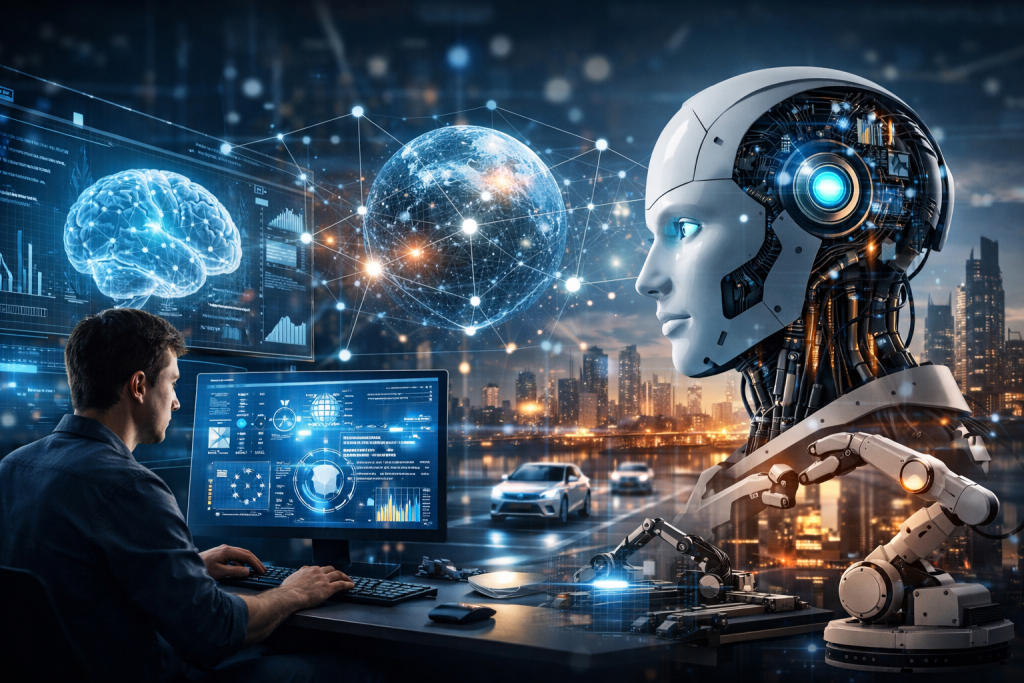
Artificial intelligence is no longer a distant concept reserved for research labs or science fiction. It is embedded in everyday tools, business systems, and decision-making processes across industries. Understanding AI technology helps clarify how these systems function, what problems they solve, and why they are becoming essential in a data-driven world. This article explains how AI works, its core components, and its broader significance in modern society.
What Artificial Intelligence Really Is
Artificial intelligence refers to computer systems designed to perform tasks that normally require human intelligence. These tasks include recognizing patterns, learning from data, making decisions, and understanding language. At its core, AI is about enabling machines to process information and act on it intelligently.
Many people associate AI with robots, but most AI exists as software. Recommendation engines, voice assistants, and fraud detection systems are common examples. Understanding AI technology starts with recognizing that AI is not a single tool but a collection of methods and models.
AI systems operate based on algorithms, which are structured sets of rules. These algorithms analyze data, identify patterns, and produce outputs. The quality of an AI system depends heavily on the data it receives and how it is trained.
Core Components Behind AI Systems
Every AI system is built on three main components: data, algorithms, and computing power. Data provides the raw material from which AI systems learn. Without sufficient and relevant data, even advanced algorithms perform poorly.
Algorithms define how data is processed and interpreted. In modern AI, many algorithms are designed to adapt over time. This adaptability allows systems to improve performance as more data becomes available.
Computing power enables AI systems to process massive datasets efficiently. Advances in cloud computing and specialized hardware have accelerated AI development. Understanding AI technology requires seeing how these components work together as an integrated system.
How Machine Learning and Deep Learning Work
Machine learning is a subset of AI focused on enabling systems to learn from data rather than relying on fixed rules. Instead of being explicitly programmed for every scenario, machine learning models identify patterns and make predictions. This approach is widely used in image recognition, recommendation systems, and predictive analytics.
Deep learning is a specialized form of machine learning that uses neural networks with multiple layers. These networks mimic aspects of the human brain by processing information in stages. Each layer extracts increasingly complex features from the data.
Deep learning excels at handling unstructured data such as images, audio, and text. However, it requires large datasets and significant computational resources. Understanding AI technology involves knowing when simpler models are sufficient and when deep learning is necessary.
How AI Systems Make Decisions
AI decision-making is based on probabilities and optimization rather than human-like reasoning. Models evaluate multiple possible outcomes and select the one with the highest likelihood of success. This process is mathematical, not intuitive.
Training an AI model involves adjusting parameters to minimize errors. During training, the system compares predictions with actual outcomes and refines itself. Over time, this leads to more accurate results.
Despite their effectiveness, AI decisions are limited by their training data. Biases in data can lead to biased outcomes. Understanding AI technology includes recognizing these limitations and the need for responsible model design.
Real-World Applications Across Industries
AI is used extensively in healthcare to assist with diagnostics, treatment planning, and patient monitoring. Machine learning models can analyze medical images and detect patterns that may be missed by human observers. This improves accuracy and efficiency.
In finance, AI supports fraud detection, risk assessment, and algorithmic trading. Systems can analyze transactions in real time and flag anomalies instantly. This reduces losses and enhances security.
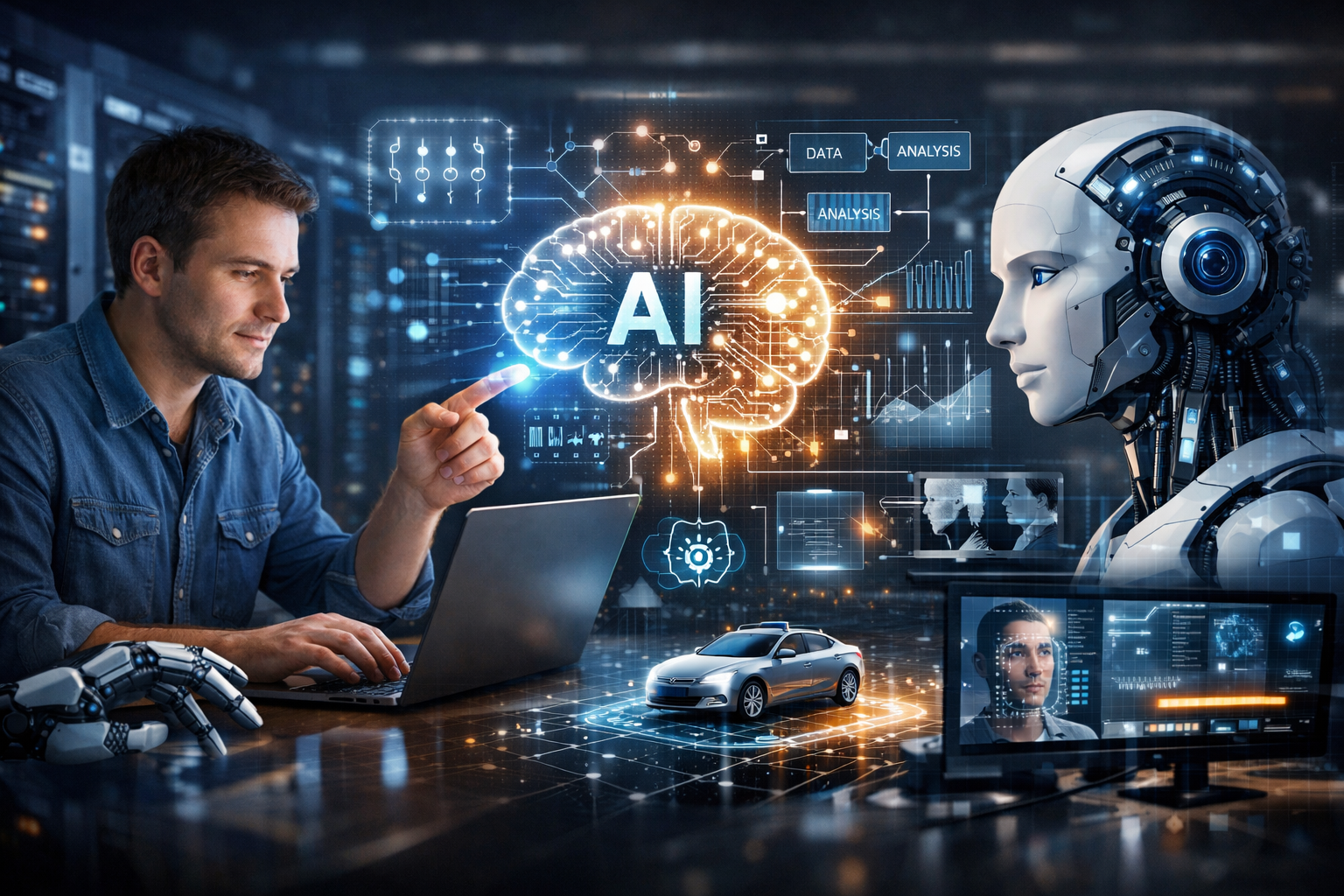
Manufacturing, retail, education, and logistics also rely on AI for optimization and forecasting. Understanding AI technology helps organizations identify where automation adds value and where human oversight remains essential.
Why AI Technology Matters Today
AI matters because it amplifies human capability. It enables faster analysis, more informed decisions, and scalable solutions to complex problems. As data volumes continue to grow, manual processing becomes impractical.
Economic competitiveness increasingly depends on effective AI adoption. Companies that integrate AI strategically gain efficiency and insight advantages. Governments also use AI for urban planning, public services, and security.
However, AI raises ethical and regulatory concerns. Transparency, accountability, and data privacy are critical considerations. Understanding AI technology is necessary not only for adoption but also for governance and trust.
Challenges and Limitations of AI Systems
Despite rapid progress, AI systems are not truly intelligent in a human sense. They lack common sense, emotional understanding, and contextual awareness beyond their training data. This limits their ability to handle novel situations.
AI models can be opaque, making it difficult to explain how decisions are reached. This lack of explainability is a concern in high-stakes areas such as healthcare and law. Researchers are actively working on more interpretable models.
Resource requirements are another challenge. Training advanced AI models consumes significant energy and infrastructure. Understanding AI technology includes weighing these costs against the benefits.
AI technology plays a critical role in shaping modern systems, economies, and daily life. By understanding how AI works, what powers it, and where its limitations lie, individuals and organizations can make informed decisions about its use. Understanding AI technology is not about replacing human judgment, but about enhancing it through responsible and informed application.
FAQ
Q: What does understanding AI technology actually involve? A: It involves knowing how AI systems use data, algorithms, and computing power to learn, make predictions, and support decision-making.
Q: Is artificial intelligence the same as machine learning? A: No. Machine learning is a subset of AI focused on learning from data, while AI also includes rule-based systems and other approaches.
Q: Why is data so important in AI systems? A: Data determines how well an AI model learns and performs. Poor or biased data leads to unreliable outcomes.
Q: Can AI systems think like humans? A: AI systems do not think or reason like humans. They operate through mathematical models and pattern recognition.
Q: Why should non-technical people care about AI technology? A: AI affects everyday tools, services, and decisions, making basic understanding important for informed use and oversight.
